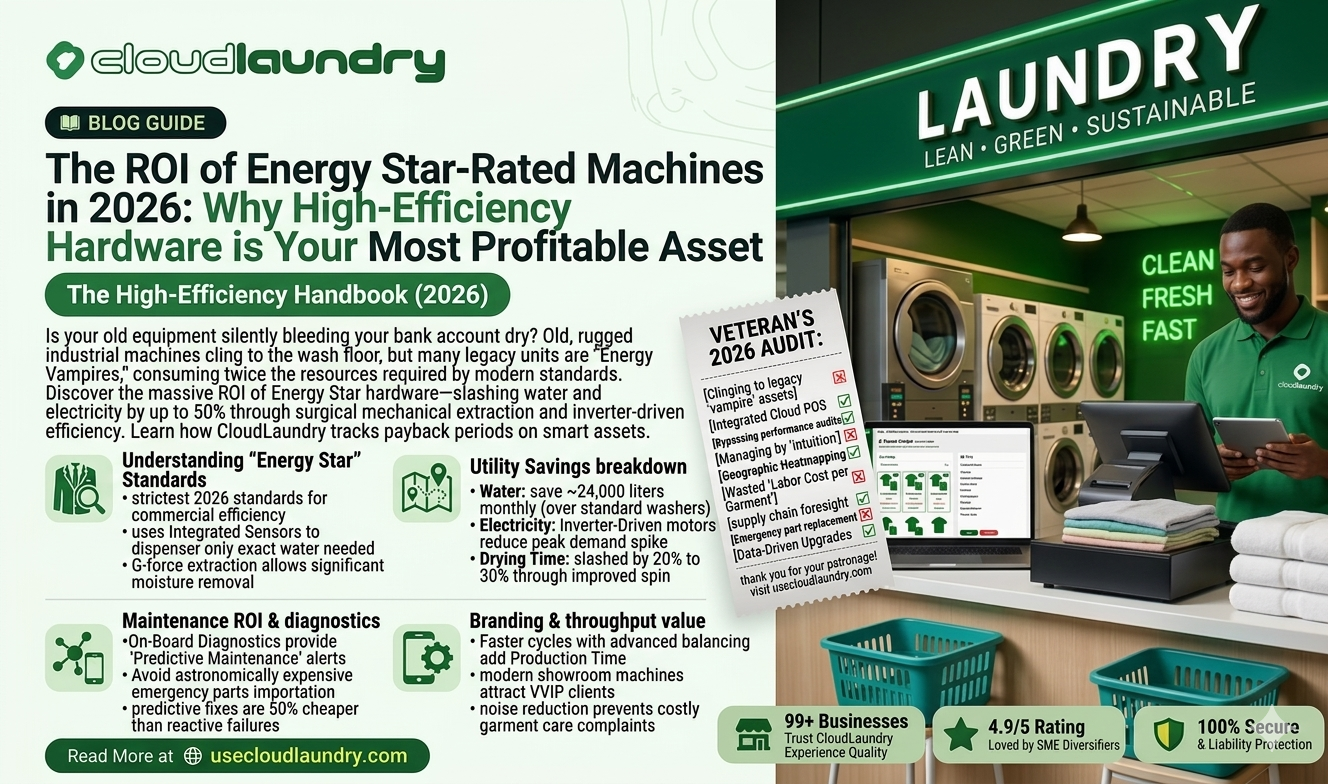
In the high-stakes world of the 2026 Nigerian laundry market, the equipment on your wash floor is either an engine for wealth or a "sinkhole" for cash. Many laundry owners in Lagos, Abuja, and beyond cling to their old, "rugged" industrial machines, believing that because they are still turning, they are still profitable. This is a dangerous financial illusion. In an era where electricity tariffs have soared and the cost of water sourcing is at an all-time high, these legacy machines are "Energy Vampires," consuming twice the resources required by modern standards.
When you use outdated equipment, your "Cost per Load" is fundamentally uncompetitive. You are spending more on water, more on electricity, and more on maintenance than the shop down the street that has modernized. In 2026, the ROI of Energy Star-rated machines isn't just a technical metric; it is the difference between a business that is barely surviving and one that is ready to dominate the region.
Investing in new hardware is often seen as a daunting capital expenditure (CAPEX), but the reality is that these machines pay for themselves through the sheer volume of utility savings they generate. To truly understand your payback period and manage your assets with surgical precision, you need the best tool to manage your laundry business, CloudLaundry. This guide breaks down exactly why Energy Star is the smartest investment you will make this year.
What Does "Energy Star" Actually Mean in 2026?
The Energy Star rating is a global standard for energy efficiency, but in 2026, the benchmarks have become even stricter. For a commercial washing machine or dryer to earn this badge, it must meet rigorous criteria for both energy consumption and water use.
The Efficiency Standards:
- Water Factor (WF): Energy Star washers use about 33% less water than standard models. They achieve this through "Integrated Sensors" that weigh the load and dispense only the exact amount of water needed.
- Integrated Modified Energy Factor (IMEF): This measures how much energy is used to run the machine and how much moisture remains in the clothes afterward.
- The "Extraction" Advantage: Energy Star machines have higher G-force spin cycles. By spinning faster, they remove significantly more water from the fabric before it even hits the dryer. Since dryers are the most expensive machines to run, this "Mechanical Extraction" is where the biggest savings are found.
Calculating the Direct Utility Savings
The ROI of Energy Star-rated machines is most visible in your monthly utility statements. Let's look at the three pillars of savings:
1. Water Savings: A legacy industrial washer might use 120 liters for a large load. An Energy Star equivalent uses approximately 75–80 liters. If you run 20 loads a day, you are saving 800 liters daily. Over a month, that’s 24,000 liters nearly three medium-sized water tankers. In Nigerian cities where water is a paid commodity, this is an immediate injection of cash back into your business.
2. Electricity Savings: Modern motors in Energy Star units are "Inverter-Driven." They don't draw a massive spike of current every time they start; instead, they ramp up smoothly. This reduces your peak demand, which can lower your commercial electricity tariff and reduce the strain on your backup generator, extending the life of your power plant.
3. Gas/Thermal Savings: Because the Energy Star washer extracts more water, your drying time is reduced by 20% to 30%. Whether you use gas or electric dryers, this reduction in heat-time is the single biggest "Profit Protector" in your facility. Use CloudLaundry to track these utility drops against your order volume to see the real-time impact.
Labor ROI and Throughput
ROI isn't just about bills; it’s about "Time." Legacy machines are often slow to fill, slow to drain, and prone to "Unbalanced Load" errors that require staff intervention.
The Efficiency of Speed: Energy Star-rated machines are designed for "High-Throughput." They feature faster cycles and advanced balancing technology that prevents the machine from stopping mid-wash. If a new machine saves 15 minutes per cycle and you run 8 cycles a day, you have gained 2 hours of production time per machine.
Over a month, that’s 60 hours of "Found Time." Your staff can process more clothes in the same shift, meaning your "Labor Cost per Garment" decreases. By monitoring staff productivity in usecloudlaundry.com, you can see how much more revenue your team generates when they aren't babysitting old, temperamental equipment.
Maintenance ROI: Avoiding the "Breakdown Tax"
Old machines don't just use more power; they "eat" spare parts. In Nigeria, the cost of importing specialized parts for 15-year-old machines is astronomical.
Predictive vs. Reactive Maintenance: Modern Energy Star equipment often comes with "On-Board Diagnostics." They can tell you exactly which valve is leaking or when a bearing is starting to wear. This allows for "Predictive Maintenance," which is 50% cheaper than "Emergency Repairs." When you stop paying for emergency call-outs and "Improvised Repairs," your ROI skyrockets. CloudLaundry allows you to log every repair, giving you a clear picture of when an old machine has finally become a "Liability" rather than an asset.
The Branding and Perception ROI
In 2026, customers are attracted to "Tech and Tidiness."
The Showroom Effect: If a customer walks into your shop and sees gleaming, modern Energy Star machines, their perception of your quality immediately rises. They feel more comfortable giving you their N250,000 designer suit. Modern machines are quieter, look more professional, and signal that you are a "Future-Ready" business. This "Branding ROI" allows you to maintain premium pricing while your competitors are forced into "Price Wars."
Practical Case Study: The "Apapa Upgrade"
"Ocean View Dry Cleaners" in Apapa, Lagos, was operating with four legacy machines from 2010. They were spending N350,000 monthly on diesel and N80,000 on water tankers. Their machines were breaking down twice a month.
The Intervention: The owner secured a small business loan to replace the four old units with three high-capacity Energy Star-rated machines. They integrated CloudLaundry to monitor the "Before and After" metrics.
The Result: Even with one fewer machine, their "Total Daily Output" increased because the new machines were 25% faster. Their diesel bill dropped to N190,000 (a 45% saving) because the generator didn't have to work as hard and drying times were shorter. Their water bill was cut by 30%. Within 14 months, the savings on utilities and maintenance alone had completely paid for the cost of one of the new machines. The ROI of Energy Star-rated machines was so clear in the CloudLaundry reports that the owner was able to secure a second loan to upgrade their entire facility.
Tie into CloudLaundry Softly
Investing in expensive hardware without data is like flying a plane without a dashboard. To realize the full ROI of Energy Star-rated machines, you need a way to correlate your equipment's performance with your financial health. This is where CloudLaundry proves its value.
As the best tool to manage your laundry business, usecloudlaundry.com allows you to track "Machine Utilization." You can see exactly how many loads each machine has processed and compare the "Utility Cost per Order" over time. When you install new Energy Star gear, you can set a "Performance Baseline" in CloudLaundry. If your costs start to creep back up, the system alerts you that a machine might need servicing or that staff are using the wrong (less efficient) wash cycles. CloudLaundry turns your hardware into "Smart Assets" that actively report on their own profitability.
Navigating the CAPEX: How to Afford the Upgrade
We know that N5,000,000 for a new machine is a lot for a Nigerian SME. Here is how to manage it:
- Phased Replacement: Don't replace everything at once. Use the data in CloudLaundry to identify your "Least Efficient" machine and replace that first.
- Asset Financing: Many Nigerian banks now offer "Green Loans" for energy-efficient equipment. Showing them your professional reports from CloudLaundry can help prove your business’s creditworthiness.
- The "Savings Reinvestment" Model: Take the N50,000 you save on electricity this month and put it into a dedicated "Upgrade Fund." Let the old machines pay for their own replacements.
The "Hidden" ROI: Fabric Longevity
Energy Star machines are gentler on clothes. They use "Sensor-Driven Agitation" and smooth-surface drums that don't snag fibers. This means fewer "Torn Garment" complaints. Every time you don't have to pay a customer N100,000 for a ruined dress, that is direct ROI on your machine investment. CloudLaundry helps you track these "Avoided Costs," showing you a more complete picture of your equipment's value.
Conclusion: The Cost of Waiting
In 2026, the question isn't "Can I afford to buy Energy Star machines?" The real question is "Can I afford to keep using these old ones?" Every day you wait to upgrade, you are handing your profit to the utility companies and the repairmen.
The ROI of Energy Star-rated machines is found in the hundreds of thousands of Naira saved on water, the reduced diesel consumption, the faster turnaround times, and the massive boost to your brand's reputation. It is an investment that pays dividends in both the short and long term.
Combine the mechanical efficiency of Energy Star hardware with the digital intelligence of CloudLaundry to build a business that is lean, green, and incredibly profitable. Stop fighting against your equipment and start letting it work for you. Visit usecloudlaundry.com today and take the first step toward a high-efficiency, high-profit future.