In the high-intensity environment of a Nigerian commercial laundry in 2026, water is the lifeblood of the operation. From the massive industrial washers in Ikeja to the boutique dry cleaners in Abuja, thousands of liters flow through a complex network of pipes, valves, and gaskets every single day. However, this lifeblood can quickly turn into a financial hemorrhage. Water leaks are the "Silent Thieves" of the laundry industry.
A small, steady drip from a faulty solenoid valve might seem insignificant, but over a month, it can waste enough water to fill several tankers. Even worse are the “Catastrophic Leaks” a burst pipe in the middle of the night that floods the wash floor, ruins expensive Energy Star-rated machinery, and leaves the owner with a staggering water bill and days of downtime. In an era where the cost of water sourcing and treatment is rising across Nigeria, you cannot afford to leave your plumbing to chance.
The 2026 solution is the integration of smart valves and sensors for laundry facilities. These Internet of Things (IoT) devices act as a 24/7 digital guard, monitoring flow rates in real-time and automatically shutting off the water the moment an anomaly is detected. By moving from "Reactive Repairs" to "Predictive Protection," you secure your margins and your peace of mind. To truly capitalize on this technology and see the direct impact on your bottom line, you need the best tool to manage your laundry business, CloudLaundry.
The Anatomy of a Leak – Where the Money Goes
To understand the value of smart sensors, we must first identify the common points of failure in a laundry’s plumbing infrastructure.
The Usual Suspects:
Washing Machine Solenoids: These valves open and close thousands of times a week. When they fail to close completely, water "weeps" into the drum even when the machine is off.
High-Pressure Seals: The vibration of high-G-force extractors can loosen fittings over time, leading to spray-leaks behind the machines where they are rarely seen.
Storage Tank Overflows: Faulty float valves in your overhead tanks can lead to hours of overflow, wasting treated water onto the roof or into the drain.
Underground Pipe Corrosion: In older buildings, pipes buried in the foundation can develop "pinhole leaks" that saturate the ground for months before a damp spot appears on the wall.
Traditional water meters only tell you how much you used at the end of the month. Smart valves and sensors for laundry tell you exactly where the waste is happening, the moment it starts.
How Smart IoT Sensors Work in a Laundry
Modern sensor technology has moved beyond simple "puddle detectors." In 2026, we utilize a tiered approach to water security.
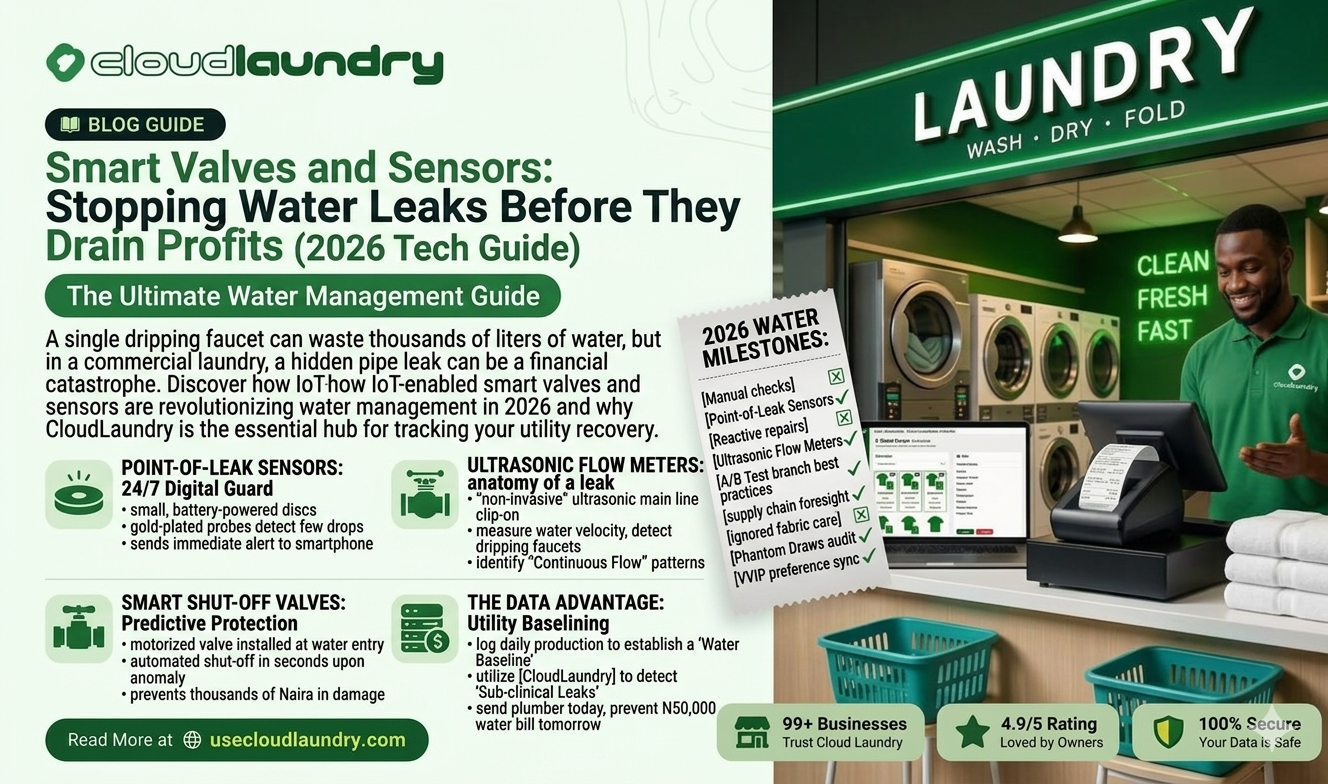
Point-of-Leak Sensors: These are small, battery-powered discs placed under washing machines, water heaters, and sinks. They contain gold-plated probes that detect even a few drops of water. When they get wet, they send an immediate alert to your smartphone.
Ultrasonic Flow Meters: These sensors clip onto the outside of your main water line. They use ultrasonic waves to measure the velocity of water moving through the pipe. Because they are "non-invasive," you don't need to cut your pipes to install them. They are sensitive enough to detect a dripping faucet anywhere in the building by identifying "Continuous Flow" patterns during hours when the shop should be closed.
Smart Shut-off Valves: This is the "Brain" of the system. Installed at the main water entry point, this motorized valve is connected to your Wi-Fi. If the flow meters detect a burst pipe or if a floor sensor detects a flood, the smart valve automatically closes, stopping the water in seconds—preventing thousands of Naira in potential damage.
The Data Advantage: Utility Baselining
The primary ROI of smart valves and sensors for laundry isn't just flood prevention; it’s "Micro-Efficiency."
By using usecloudlaundry.com to log your daily production volume, you can establish a "Water Baseline." For example, your data might show that you use exactly 15 liters of water per kilogram of laundry. If your smart sensors suddenly show that you are using 18 liters per kilogram, but your production hasn't changed, you know you have a "Sub-clinical Leak."
This allows you to send in a plumber to fix a N5,000 gasket today before it becomes a N50,000 water bill tomorrow. This level of precision is only possible when you combine IoT hardware with the analytical power of CloudLaundry.
Preventing the "Nightmare Shift" Flood
In many Nigerian laundries, the facility is left unattended overnight. A pipe that bursts at 11:00 PM will run for nine hours before the staff arrives at 8:00 AM.
The Cost of a Night Flood:
- Machine Replacement: Most laundry electronics are located near the floor. Standing water can "fry" the motherboards of three machines simultaneously.
- Structural Damage: Water can seep under floor tiles, causing them to lift, and can weaken the walls of your facility.
- Reputation Loss: If you have to call 50 customers to tell them their clothes were ruined in a flood, your brand may never recover.
With smart valves and sensors for laundry, the system detects the abnormal flow at 11:01 PM, shuts off the main valve, and sends an emergency alert to the owner. The total "leak" is limited to the water already in the pipes.
Reducing Labor Costs through Automated Monitoring
In a traditional shop, the manager has to manually check tanks and pipes every morning. This "Manual Audit" is prone to human error and takes away from productive time.
Digital Oversight: Smart sensors provide a "Live Dashboard" of your water health. You can see your tank levels, flow rates, and valve status from your home or while running errands. Use usecloudlaundry.com to view these metrics alongside your staff's performance. When the "Tech" handles the monitoring, your staff can focus on what actually makes money: processing clothes with the highest quality standards.
Practical Case Study: The "Surulere Savings"
A busy commercial laundry in Surulere was experiencing erratic water bills. Some months were N40,000, others were N95,000, despite similar order volumes. They suspected their borehole pump was working too hard but couldn't prove it.
The Intervention: The owner installed an ultrasonic flow meter and three floor sensors, all integrated with their CloudLaundry account. Within 48 hours, the system flagged a "Constant Low Flow" occurring between 2:00 AM and 5:00 AM.
The Discovery: The plumber discovered a cracked pipe behind a heavy industrial dryer. The water was leaking directly into a floor drain, making it invisible to the staff. It was wasting 1,200 liters every night.
The Result: The repair cost N12,000. The monthly water bill dropped back to a consistent N38,000. The owner calculated that the smart valves and sensors for laundry paid for themselves in less than three months just by stopping that one hidden leak. By using the best tool to manage your laundry business, they turned a mystery expense into a controlled, predictable utility cost.
Tie into CloudLaundry Softly
IoT sensors are only as good as the action they inspire. If a sensor sends an alert but no one is looking at the dashboard, the value is lost. This is where CloudLaundry becomes the "Command Center" for your facility.
As the best tool to manage your laundry business, usecloudlaundry.com can integrate your smart sensor data into your daily "Operational Report." You don't have to check five different apps; you simply check your CloudLaundry dashboard. The system can even be set to generate a "Maintenance Ticket" automatically if a sensor detects a drop in pressure or a consistent leak. This ensures that your plumbing health is treated with the same level of professional rigor as your customer orders. CloudLaundry helps you move from being a "Laundry Operator" to a "Facility Manager" who uses data to protect every Kobo of profit.
Overcoming the "Wi-Fi in the Washroom" Challenge
One barrier to IoT in Nigeria is consistent connectivity. 2026 technology has solved this with "Hybrid Hubs."
The Solution: Modern smart valves use "LoRaWAN" or "Zigbee" frequencies to talk to a central hub. These frequencies penetrate thick concrete walls and use very little power. The central hub is then connected to your CloudLaundry system via a 4G/5G SIM card or a stable Wi-Fi connection. Even if the internet goes down, the "Local Logic" in the valve will still shut off the water if a flood is detected. Your data will simply "Sync" to the cloud once the connection returns.
Insurance ROI: Lowering Your Premiums
In 2026, insurance companies are beginning to reward "Proactive Businesses." If you can prove to your insurer that you have installed smart valves and sensors for laundry, you can often negotiate a lower premium for "Property and Liability" coverage.
Providing your insurer with a "Water Safety Report" from usecloudlaundry.com serves as proof that you have significantly lowered the risk of an expensive "Water Damage Claim." This is another layer of ROI that makes the tech an easy decision for any serious business owner.
Conclusion: Don't Let Your Profit Wash Away
In the competitive landscape of 2026, the margin for error is thin. You cannot afford to pay for water that you aren't using to clean clothes. Smart valves and sensors for laundry are no longer a "luxury" for big industrial plants; they are an essential tool for any SME that wants to scale responsibly.
By embracing IoT water management, you protect your machinery, your facility, and your reputation. You turn a chaotic, invisible utility into a transparent, managed resource.
Combine the "Digital Guard" of smart sensors with the operational excellence of CloudLaundry to build a business that is as efficient as it is safe. Stop the leaks before they stop your growth. Visit usecloudlaundry.com today and see how our platform can help you integrate the latest smart technology into your daily operations. The future of laundry is smart is your plumbing ready?
