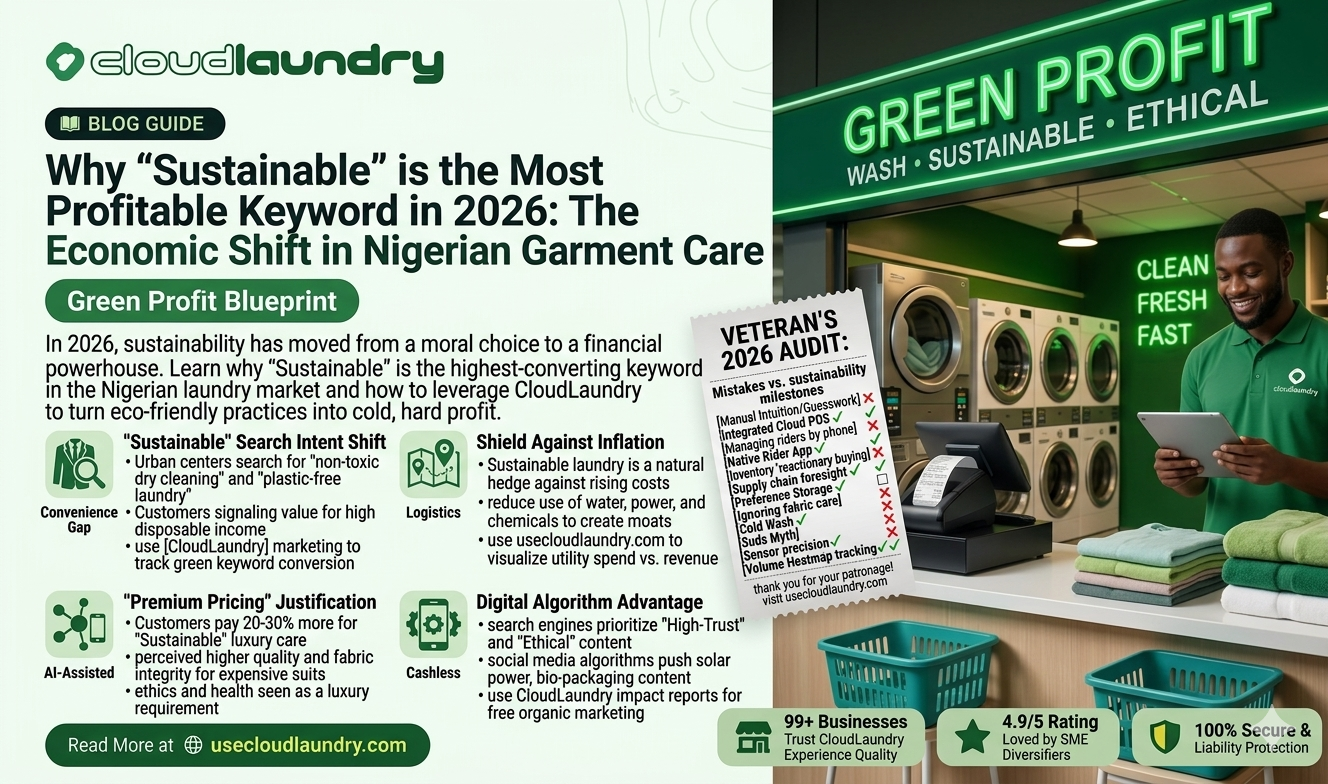
If you had told a laundry owner in Lagos ten years ago that "Sustainability" would be the primary driver of their profit margins in 2026, they would have likely laughed. Back then, the industry was obsessed with two things: speed and price. The goal was to wash as fast as possible for the lowest cost possible, often at the expense of the environment, fabric longevity, and worker health. But the world has shifted.
In 2026, the word "Sustainable" is no longer just a tagline for international NGOs; it is the most profitable keyword in the Nigerian commercial sector. We are witnessing a massive convergence of three forces: skyrocketing utility costs, a new generation of eco-conscious consumers, and a digital landscape where "Green" terms dominate search engine results and social media algorithms.
For the modern laundry entrepreneur, sustainable laundry profitability is the new gold standard. It is a strategy that attacks the balance sheet from both sides drastically reducing operational overhead while simultaneously allowing for premium price positioning. In a market where traditional shops are suffocating under the weight of high energy bills and low customer loyalty, the "Sustainable" shop is thriving. To navigate this shift and prove your green credentials through data, you need the best tool to manage your laundry business, CloudLaundry.
The "Search Intent" Shift: What Customers Want in 2026
Marketing has fundamentally changed. In 2026, customers in Nigerian urban centers aren't just searching for "laundry near me." They are searching for "non-toxic laundry," "eco-friendly dry cleaning," and "plastic-free laundry services."
The Psychology of the Search: When a customer uses the keyword "Sustainable," they are signaling that they value quality over quantity. They are tired of the chemical smell of PERC, they are worried about the microplastics in their water, and they are concerned about the longevity of their expensive designer outfits. By optimizing your business around this keyword, you aren't just catching "any" customer; you are catching the right customer—the one with high disposable income and a high lifetime value.
Use the marketing modules in CloudLaundry to track which search terms are bringing customers to your portal. You will likely find that "Sustainable" and its variations have a significantly higher conversion rate than generic terms like "cheap wash."
Sustainability as a Shield Against Inflation
In Nigeria, inflation is a constant shadow over business operations. However, sustainability is a natural hedge against rising costs.
Reducing the "Inputs": A sustainable laundry uses less of everything.
Less Water: Through reclamation systems.
Less Power: Through Energy Star-rated machines and solar-hybrid systems.
Less Chemical Waste: Through concentrated, precise dosing.
When the price of diesel or municipal water spikes, the "traditional" laundry is forced to raise prices immediately, often losing customers in the process. The "Sustainable" laundry, having already reduced its consumption, can absorb those shocks or maintain much higher margins. This is the core of sustainable laundry profitability: efficiency isn't just "good for the planet"; it’s a defensive moat for your bank account. CloudLaundry helps you visualize this by showing your "Utility Spend vs. Revenue" over time.
The "Premium Pricing" Justification
One of the biggest myths in the industry is that sustainability is "too expensive" for the average Nigerian. In 2026, the opposite is true.
The Value Equation: Customers pay more for "Sustainable" services because they perceive a higher level of care. They aren't just paying for clean clothes; they are paying for:
Health: No toxic residues on their skin.
Fabric Integrity: Gentle, cold-water processes that keep their N200,000 Senator suits looking new.
Ethics: The knowledge that they aren't contributing to local water pollution.
By using the keyword "Sustainable," you move your business out of the "Commodity" category and into the "Luxury" category. usecloudlaundry.com allows you to set up tiered pricing models where "Eco-Premium" washes carry a 20–30% higher margin—and in 2026, these are often the most requested services.
Attracting the "Gen Z" and "Millennial" Workforce
Profitability isn't just about customers; it's about "Human Capital." In 2026, the most talented young Nigerians want to work for companies with a purpose.
The Recruitment ROI: A laundry that brands itself as "Sustainable" attracts better staff—people who are more diligent, more tech-savvy, and more likely to stay long-term. High staff turnover is a massive "Hidden Cost" in the laundry industry. By building a sustainable brand, you reduce recruitment and training costs. When your staff uses CloudLaundry to manage an eco-friendly facility, they feel like they are part of a modern, forward-thinking industry rather than a "manual labor" shop. This boost in morale leads directly to better quality control and higher customer satisfaction.
The "Digital Algorithm" Advantage
In 2026, social media platforms and search engines prioritize "High-Trust" and "Ethical" content.
Winning the Algorithm: Content that showcases solar panels on your roof, biodegradable packaging, or water-saving tech gets higher organic reach. "Sustainability" is a "High-Engagement" topic. When you share your "Impact Reports" from CloudLaundry—showing how many thousands of liters of water you've saved—people like, comment, and share. This is "Free Marketing" that traditional, non-sustainable shops simply cannot generate. The keyword "Sustainable" acts as a magnet for the algorithms, pushing your brand to the top of the feed without you having to spend millions on paid ads.
Practical Case Study: The "Victoria Island Vanguard"
A mid-sized laundry in Victoria Island was struggling with a 15% year-on-year increase in overhead and stagnant growth. They were viewed as "just another dry cleaner."
The Intervention: The owner rebranded the business around the keyword "Sustainable." They invested in a water recycling unit, swapped plastic bags for reusable garment covers, and integrated CloudLaundry to track every metric. They changed their Google My Business keywords to focus on "Sustainable Garment Care Lagos."
The Result: In 12 months, their customer base grew by 40%. More importantly, their "Average Order Value" (AOV) increased because the new customers were opting for the more expensive, eco-friendly packages. Their electricity bill dropped by 20% due to better machine utilization and solar-hybrid power. By using the best tool to manage your laundry business, they proved that the "Sustainable" pivot was the most successful financial decision in the company’s history.
Tie into CloudLaundry Softly
In 2026, you cannot just "say" you are sustainable; you have to "prove" it. "Green-washing" is a fast track to a PR disaster. This is where CloudLaundry becomes your "Trust Engine."
As the best tool to manage your laundry business, usecloudlaundry.com provides the raw data needed to back up your marketing claims. When you use the word "Sustainable" in your ads, you can point to your CloudLaundry dashboard as evidence. You can show customers exactly how much water was saved on their specific order or provide a "Year-End Impact Statement" that shows their total carbon footprint reduction. CloudLaundry turns the keyword from a marketing slogan into a verified business asset, ensuring that your sustainable laundry profitability is built on a foundation of hard facts.
Sustainability as a Multi-Stream Revenue Opportunity
A sustainable model opens doors to revenue streams that traditional laundries can't access.
Corporate ESG Contracts: In 2026, large corporations and hotels in Nigeria are required to report on their supply chain sustainability. They need to hire eco-friendly laundry services to meet their own targets.
Eco-Product Sales: As a sustainable hub, you can sell the same biodegradable detergents and wool dryer balls you use.
Consultancy: Successful sustainable laundry owners are now being paid to consult for newer shops, using their CloudLaundry data as a "Blueprint for Success."
The keyword "Sustainable" doesn't just bring in laundry orders; it brings in "Partnerships."
Future-Proofing Against "Carbon Taxes"
While not yet fully implemented, the conversation around "Carbon Credits" and "Environmental Levies" in Nigeria is accelerating. By 2027 or 2028, high-pollution businesses may face direct financial penalties.
The Proactive Profit: By becoming "Sustainable" in 2026, you are avoiding the "Compliance Costs" of the future. While your competitors are scrambling to retro-fit their shops to avoid fines, you will already be optimized and miles ahead. Sustainability is "Future Profit" secured today. Use usecloudlaundry.com to keep your records audit-ready for the day when green certifications become a mandatory part of Nigerian business licensing.
Conclusion: The Wealth of the Green Economy
The evidence is overwhelming: sustainable laundry profitability is the defining trend of the 2026 garment care industry. The keyword "Sustainable" is profitable because it represents what the market now demands: efficiency, transparency, and health.
The businesses that continue to ignore this shift are choosing a path of declining margins and increasing irrelevance. The businesses that embrace it are finding themselves at the center of a new, wealthy, and loyal "Green Economy."
You don't have to change everything overnight, but you must start the journey. Use the data, use the technology, and use the keyword. Combine your passion for garment care with the sustainability-focused power of CloudLaundry to build a business that is as profitable as it is purposeful.
The future of Nigerian laundry isn't just about cleaning clothes; it's about cleaning up the industry. Visit usecloudlaundry.com today and let us help you turn "Sustainable" into your most profitable keyword yet.