In the 2026 Nigerian business landscape, a laundry shop is no longer an isolated island. It is the final link in a long, complex chain that stretches from chemical factories in Shagamu to plastic manufacturers in Onitsha, and fuel refineries across the borders. For decades, the "Supply Chain" was something laundry owners only thought about when they ran out of soap or when the price of diesel spiked. However, as we move deeper into a decade defined by climate change and resource scarcity, this reactive approach is a recipe for failure.
Building a sustainable supply chain for your laundry business is the process of ensuring that every resource you consume every liter of detergent, every hanger, and every kilowatt of power is sourced with the lowest possible environmental impact and the highest social responsibility. In a country like Nigeria, where supply shocks are common, a "Sustainable Chain" is also a "Resilient Chain." By shortening your supply lines, sourcing locally, and choosing concentrated, eco-friendly products, you reduce your exposure to global price fluctuations and logistics bottlenecks.
Sustainability in the supply chain is no longer just a "corporate social responsibility" (CSR) checkbox; it is a fundamental pillar of operational excellence. To manage these moving parts and ensure your vendors meet your high standards, you need the best tool to manage your laundry business, CloudLaundry.
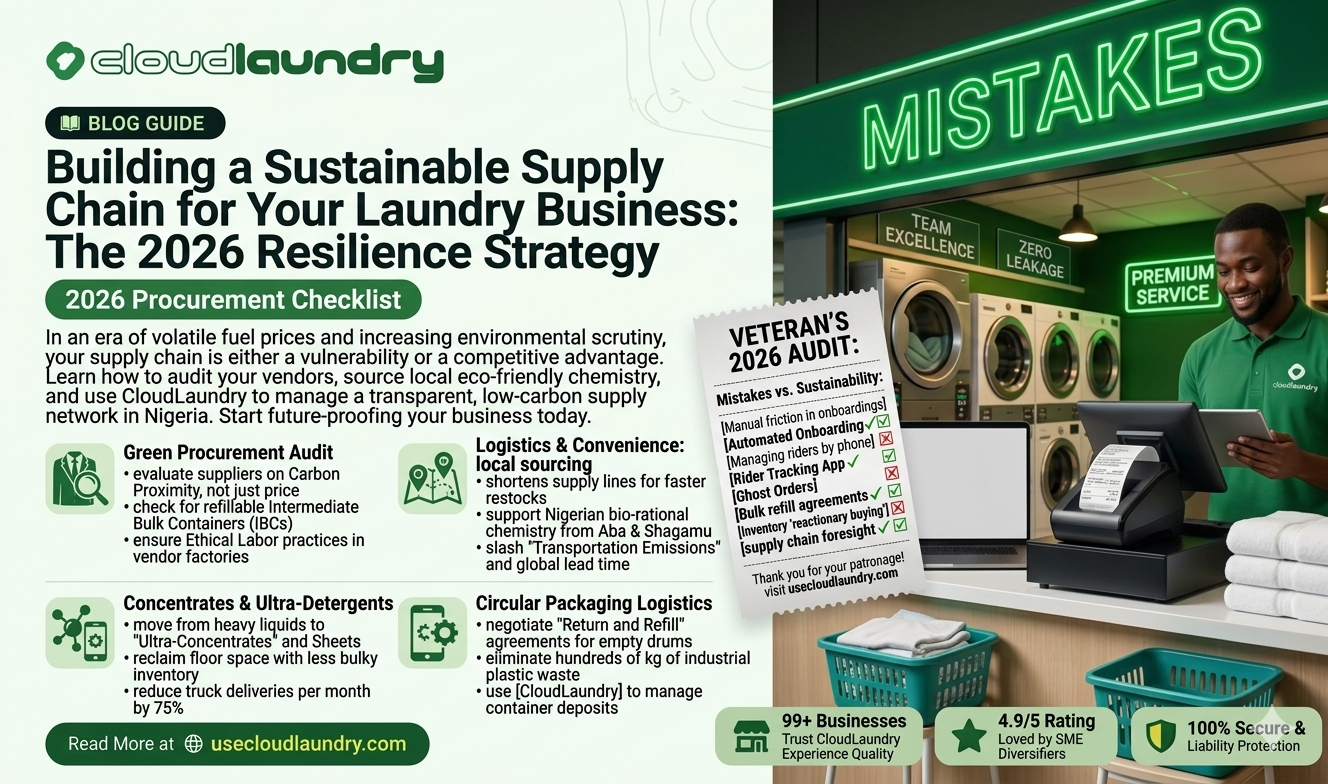
The "Green Procurement" Audit
The journey to a sustainable supply chain begins with a "Procurement Audit." You need to look at what you are buying and who you are buying it from.
The Vendor Scorecard: In 2026, you should evaluate your suppliers based on more than just "Price per Unit."
Carbon Proximity: How far does the product travel to reach you? A "cheap" detergent from overseas might have a massive carbon footprint compared to a high-quality Nigerian alternative.
Packaging Efficiency: Does your supplier send chemicals in small, single-use plastic bottles, or do they offer high-volume "Refill IBCs" (Intermediate Bulk Containers) that reduce plastic waste?
Ethical Labor: Does the supplier treat their workers fairly? In the age of radical transparency, your brand is guilty by association if your suppliers use unethical labor practices.
Use CloudLaundry to log your vendor details and set "Sustainability Benchmarks." If a supplier fails to meet your green standards over six months, the system can flag them for review or replacement.
Sourcing "Bio-Rational" Chemistry Locally
One of the biggest carbon leaks in the Nigerian laundry industry is the importation of heavy liquid detergents. Shipping water across oceans is incredibly carbon-intensive.
The Shift to Local Bio-Chemistry: Nigeria is rich in botanical resources. In 2026, we are seeing a surge in local manufacturers producing professional-grade, plant-based detergents derived from palm kernel oil, coconut husks, and citrus peels.
The Benefit: By sourcing locally, you slash your "Transportation Emissions" and support the Nigerian economy.
The Performance: Modern local bio-detergents are formulated for Nigeria’s "Hard Water" conditions, often outperforming imported synthetic brands that were designed for different water mineral profiles.
By integrating these local finds into your wash floor, you simplify your sustainable supply chain for laundry and reduce the lead time for restocks. CloudLaundry helps you track the performance of these local brands against your previous imported standards.
Concentrates and the "Weight Reduction" Strategy
A sustainable supply chain is a "Lightweight" supply chain. In 2026, the industry is moving away from ready-to-use liquids toward "Ultra-Concentrates" and "Detergent Sheets."
The Math of Sustainability: One box of ultra-concentrated detergent powder can replace five bulky plastic drums of liquid soap. This means:
Fewer Deliveries: You need one truck delivery per month instead of four.
Less Storage: You reclaim valuable floor space in your shop.
Lower Cost: Concentrates are almost always cheaper per load when the "Logistics Tax" is removed.
Use the inventory management features in usecloudlaundry.com to calculate your "Cost per Load" with concentrates. You will likely find that the most sustainable option is also the most profitable.
Circular Packaging Logistics
Packaging is the "Visible Waste" of your supply chain. To be truly sustainable, you must move toward a "Closed-Loop" packaging system with your vendors.
The "Return and Refill" Agreement: Negotiate with your local chemical suppliers to take back their empty drums. In a circular sustainable supply chain for laundry, the manufacturer sanitizes and refills the same containers for your next delivery. This eliminates hundreds of kilograms of industrial plastic waste from your business footprint every year. Use CloudLaundry to track "Container Deposits," ensuring you get your money back when the empties are returned to the vendor.
The "Energy as a Supply" Mindset
We often think of energy as a utility, but in a sustainable model, energy is a "Supplied Resource."
Decarbonizing Your Power Supply: If your energy "Supplier" is a diesel generator, your chain is broken. In 2026, moving your energy supply to an on-site solar array or a "Green PPA" (Power Purchase Agreement) with a local renewable provider is the ultimate supply chain upgrade. By "Sourcing" your power from the sun, you eliminate the carbon-heavy logistics of diesel delivery and protect yourself from the price volatility of the Nigerian fuel market.
Practical Case Study: The "Port Harcourt Pivot"
"Oil City Cleaners" in Port Harcourt was struggling with erratic supply lines and the high cost of imported specialty chemicals. Their "Carbon Score" was extremely high due to constant long-distance trucking.
The Intervention: The owner conducted a supply chain audit using CloudLaundry. They identified a local manufacturer in Aba producing high-performance enzyme detergents and switched 80% of their procurement to them. They also moved to a "Bulk Refill" system for their softeners and starches.
The Result: Their "Supply Chain Lead Time" dropped from 14 days to 3 days. Their procurement costs fell by 18% due to lower transport fees and bulk discounts. Most importantly, their customers loved the "Supporting Local" story. By using the best tool to manage your laundry business, they were able to show investors a 22% increase in net margin directly linked to supply chain optimization.
Tie into CloudLaundry Softly
Managing multiple vendors, tracking local vs. imported spends, and monitoring the carbon impact of your logistics requires a sophisticated digital backbone. This is where CloudLaundry provides the "Eyes" for your operation.
As the best tool to manage your laundry business, usecloudlaundry.com offers a comprehensive "Vendor Management Portal." You can store "Sustainability Certifications" for every supplier, ensuring that your "Green" claim is backed by the reality of your procurement. The platform’s "Smart Inventory" alerts prevent "Panic Buying"—those last-minute, high-carbon emergency deliveries that happen when you run out of supplies. By maintaining a steady, data-driven flow of resources, CloudLaundry ensures your supply chain remains as smooth as a freshly pressed shirt.
Reducing the "Last-Mile" Carbon of Your Customers
Your supply chain doesn't end at your door; it ends at the customer's closet.
Green Delivery Logistics: In 2026, "Sustainable Logistics" means optimizing your delivery routes to use the least amount of fuel possible. Use the route optimization algorithms in CloudLaundry to group pickups and deliveries by neighborhood. If you can reduce your delivery van's mileage by 20% through better data, you have significantly strengthened your sustainable supply chain for laundry. For the 2026 market, consider transitioning to electric scooters or "Cargo Bikes" for dense urban areas like Victoria Island or Wuse II.
The Role of "Slow Sourcing"
In a world of "Fast Everything," sustainable businesses are embracing "Slow Sourcing." This means planning your inventory months in advance to allow for the most efficient (often slower, lower-carbon) transport methods. Instead of "Express Air Freight" for a specific stain remover, use the predictive analytics in usecloudlaundry.com to forecast your needs and use sea or road freight. Slow sourcing is cheaper, greener, and much less stressful for your operations team.
Conclusion: Resilience Through Sustainability
Building a sustainable supply chain for your laundry business is the ultimate act of future-proofing. It is about moving away from a fragile, high-carbon, "Just-in-Time" model toward a resilient, low-carbon, "Just-in-Case" network.
In 2026, the Nigerian laundry businesses that thrive will be those that know exactly where their supplies come from and are actively working to make that journey shorter, cleaner, and fairer. By sourcing locally, embracing concentrates, and using data to optimize logistics, you build a business that is not only "Green" but "Anti-Fragile."
Combine your ethical vision with the analytical power of CloudLaundry to build a supply chain that reflects the quality of your brand. The future of laundry is interconnected. Make sure your connections are sustainable. Visit usecloudlaundry.com today and let us help you manage your journey toward a transparent, eco-friendly, and highly profitable supply chain.