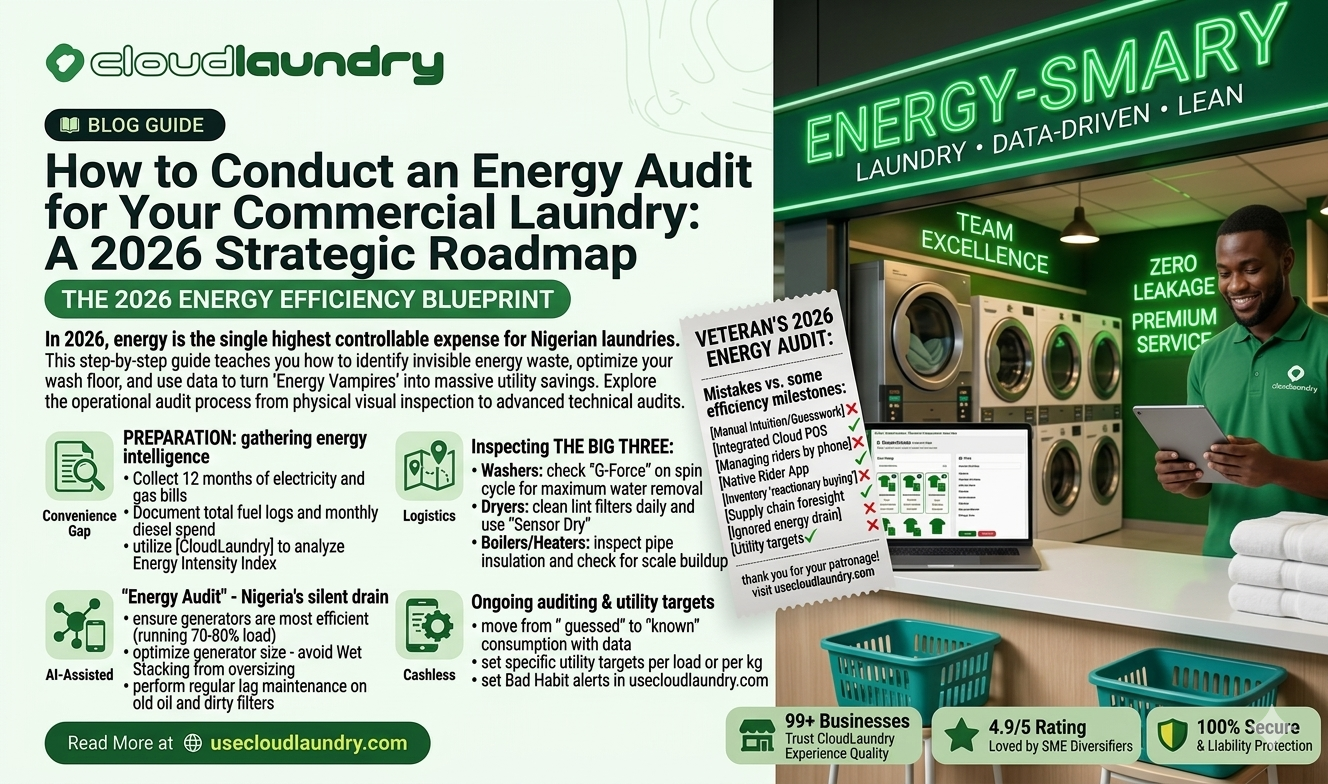
In the 2026 Nigerian business landscape, energy isn't just a utility; it is a "Profit Killer." Between the fluctuating costs of the national grid and the volatile price of diesel for backup generators, the average commercial laundry in Lagos or Abuja spends between 25% and 40% of its total revenue on power. Most laundry owners accept these high bills as a "Cost of Doing Business," but the truth is far more startling: up to 30% of that energy is likely being wasted.
Conducting an energy audit for commercial laundry operations is the only way to find where your money is disappearing. An energy audit is a systematic review of how energy enters your facility, where it is consumed, and where it is lost. It is the difference between "guessing" why your bills are high and "knowing" exactly which machine or habit is draining your bank account. In an era where margins are squeezed by inflation, an energy audit isn't just a "Green" project it is a survival strategy.
To turn the findings of an audit into actual savings, you need more than just a clipboard; you need a data-driven management system. This is where the best tool to manage your laundry business, CloudLaundry, becomes your most valuable partner in efficiency.
The Three Levels of an Energy Audit
Not all audits are created equal. Depending on your shop's size and budget, you can choose the level of depth that fits your needs:
- Level 1: The "Walk-Through" Audit: This is a basic visual inspection. You look for obvious leaks, feel for heat escaping from dryer vents, and check if lights are left on in empty rooms.
- Level 2: The "Data-Driven" Audit: This involves analyzing at least 12 months of utility bills and tracking machine runtime. This is where CloudLaundry shines, as it stores your historical utility data and production volume in one place.
- Level 3: The "Technical" Audit: This requires specialized equipment like thermal imaging cameras to find heat loss in boilers and "Kill-A-Watt" meters to measure the exact draw of every single appliance.
For most Nigerian SMEs in 2026, a Level 2 audit combining physical inspection with CloudLaundry’s analytics provides the highest ROI.
Preparation: Gathering Your "Energy Intelligence"
Before you step onto the wash floor, you need your data. You cannot fix what you cannot see.
The Data Stack:
Utility Bills: Collect your last 12 months of electricity and gas bills.
Fuel Logs: Document every liter of diesel or petrol purchased for your generator.
Production Logs: How many kilograms of laundry did you process during those 12 months?
By entering this data into usecloudlaundry.com, the platform can calculate your "Energy Intensity Index" (Energy Cost per KG). If your index is rising while your volume is steady, you have an "Energy Leak."
Inspecting the "Big Three": Washers, Dryers, and Boilers
The core of your energy audit for commercial laundry must focus on your heavy machinery.
Washers: Check the water temperature settings. Are your machines heating water to 60°C for loads that only require 30°C? Check for “Phantom Draws” machines that pull power even when they aren't running. Ensure the "G-Force" on the spin cycle is at its maximum setting; if it isn't, your dryers will have to work twice as hard.
Dryers: This is usually the hungriest energy consumer. Inspect the lint filters; a clogged filter can increase energy use by 15%. Check the exhaust ducts for kinks or lint buildup. Most importantly, check the "Auto-Dry" sensors. If your dryers are running for 10 minutes after the clothes are already dry, you are literally burning money.
Boilers and Water Heaters: If you use a central boiler, inspect the insulation on the pipes. If the pipes are hot to the touch, you are losing heat to the air instead of the water. Look for "Scale Buildup" inside the tanks; in many parts of Nigeria with hard water, calcium deposits act as an insulator, forcing the heater to stay on longer to reach the same temperature.
The "Generator Audit": Nigeria’s Silent Drain
In 2026, the generator is often the heart of the Nigerian laundry, but it is rarely audited for efficiency.
The Hidden Losses:
- Oversizing: Is your 50kVA generator running at 20% capacity most of the time? Generators are most efficient when running at 70-80% load. If yours is too big, you are "Wet Stacking" and wasting diesel.
- Maintenance Lag: Old oil and dirty air filters can increase fuel consumption by 10%.
- Synchronized Starts: Are all your washers starting their "Heat Cycle" at the exact same time? This creates a massive "In-Rush" current that forces your generator to burn more fuel.
Use CloudLaundry to schedule "Staggered Starts," ensuring your power load remains flat and efficient rather than spikey and wasteful.
Lighting, HVAC, and the "Envelope"
While the machines are the main event, the "Environment" of your shop matters.
Lighting: In 2026, there is no excuse for anything other than LEDs. If you still have fluorescent tubes, your audit should immediately flag them for replacement.
The "Envelope": Check the seals on your doors and windows. If your air conditioner is fighting against the heat of the dryers because of poor ventilation or open doors, your cooling costs will double.
Ventilation: Ensure your dryer exhaust is vented outside the building, not into the workspace. A hot workspace makes staff move slower and ACs work harder.
Practical Case Study: The "Ikeja Efficiency" Overhaul
A mid-sized laundry in Ikeja was seeing its diesel costs consume nearly 35% of its monthly revenue. The owner felt they were being "cheated" by fuel suppliers.
The Intervention: They conducted a Level 2 energy audit for commercial laundry using CloudLaundry. The audit revealed three major issues:
Dryers were running on "Timed Dry" (60 mins) instead of "Sensor Dry," causing 15 minutes of wasted heat per load.
The water heater was set to 75°C, but the staff were mixing it with cold water to avoid burning the clothes.
The generator was being turned on at 8:00 AM regardless of whether there were clothes ready to be washed.
The Result: By switching to "Sensor Drying," lowering the water heater to 50°C, and using usecloudlaundry.com to only start the generator when a "Batch" was ready, they reduced their diesel consumption by 28% in the first month. That N120,000 monthly saving was redirected into a new high-efficiency washer.
Tie into CloudLaundry Softly
An energy audit is not a "One-and-Done" event; it is a continuous process of refinement. This is where CloudLaundry transforms from a management tool into an "Efficiency Engine."
As the best tool to manage your laundry business, usecloudlaundry.com allows you to perform "Ongoing Auditing." You can set "Utility Targets" based on your initial audit. For example, if your audit says you should be using 1 liter of diesel per 5kg of laundry, CloudLaundry can flag an alert if that ratio starts to climb. This "Real-Time Auditing" ensures that bad habits (like leaving machines on) are caught the same day they happen, not at the end of the month when you see the bill. CloudLaundry gives you the "Command Center" needed to keep your energy audit recommendations alive and profitable.
Creating an "Energy Action Plan" (EAP)
Once the audit is done, you need to rank your findings based on "Payback Period."
- Quick Wins (0-3 Months): Fixing leaks, cleaning lint filters, switching to LEDs, and training staff on CloudLaundry batching.
- Medium-Term (6-12 Months): Installing pipe insulation, adding "Auto-Dry" sensors to old dryers, and upgrading to a smaller, more efficient generator.
- Long-Term (1-2 Years): Replacing legacy washers with Energy Star-rated units and installing a solar-hybrid system.
By organizing your audit results into an EAP, you ensure that the most impactful changes happen first, providing the cash flow needed for the larger investments.
The Human Factor : Training for Efficiency
The best machinery in the world can be defeated by a staff member who doesn't understand energy costs.
Staff Audit Training: Show your team the utility reports in CloudLaundry. Explain that a 10% saving in energy could lead to a performance bonus. When the team sees that "Energy Efficiency" is part of their job description, they become your most effective "Audit Sensors," spotting leaks and waste before you do.
Conclusion: From Audit to Empire
An energy audit for commercial laundry is more than a technical exercise; it is an act of "Financial Empowerment." In the competitive Nigerian market of 2026, the shop that spends the least to produce the best result is the shop that wins.
By identifying your energy leaks and optimizing your resource use, you stop being a victim of rising utility prices and start becoming a master of your own margins. You create a business that is not only more profitable but also more resilient and environmentally responsible.
Don't let your profits evaporate through your dryer vents. Take the first step today. Start your audit, gather your data, and use CloudLaundry to guide your journey from a high-cost operator to a high-efficiency leader. The future of Nigerian laundry is lean, data-driven, and energy-smart. Is your business ready to lead the way?
Visit usecloudlaundry.com today to see how our utility analytics can help you conduct your first energy audit and start saving money immediately.