There is a famous saying in advertising: "Half the money I spend on advertising is wasted; the trouble is I don't know which half." For the laundry business owner in 2026, this lack of clarity is a major threat to scaling. You might be printing 5,000 flyers for a neighborhood in Abuja, paying for a colorful street sign in Lagos, and sponsoring a local community football match in Port Harcourt all at the same time. When the phone rings or a new customer walks in, do you know which of those efforts moved the needle?
If you cannot measure it, you cannot improve it. Without attribution, you might stop the very marketing activity that is quietly driving your highest-value customers while doubling down on a flashy "vanity" project that yields no real profit. The challenge is that offline marketing (physical objects in the real world) doesn't naturally come with a “click-through rate” like a Facebook ad does.
Measuring offline marketing ROI for laundry requires creating “digital bridges.” You must give your physical marketing assets a way to talk to your digital management system. By using specialized tracking methods and the best tool to manage your laundry business, CloudLaundry, you can finally see through the fog. You can turn "I think this is working" into "I know this produced a 400% return on investment."
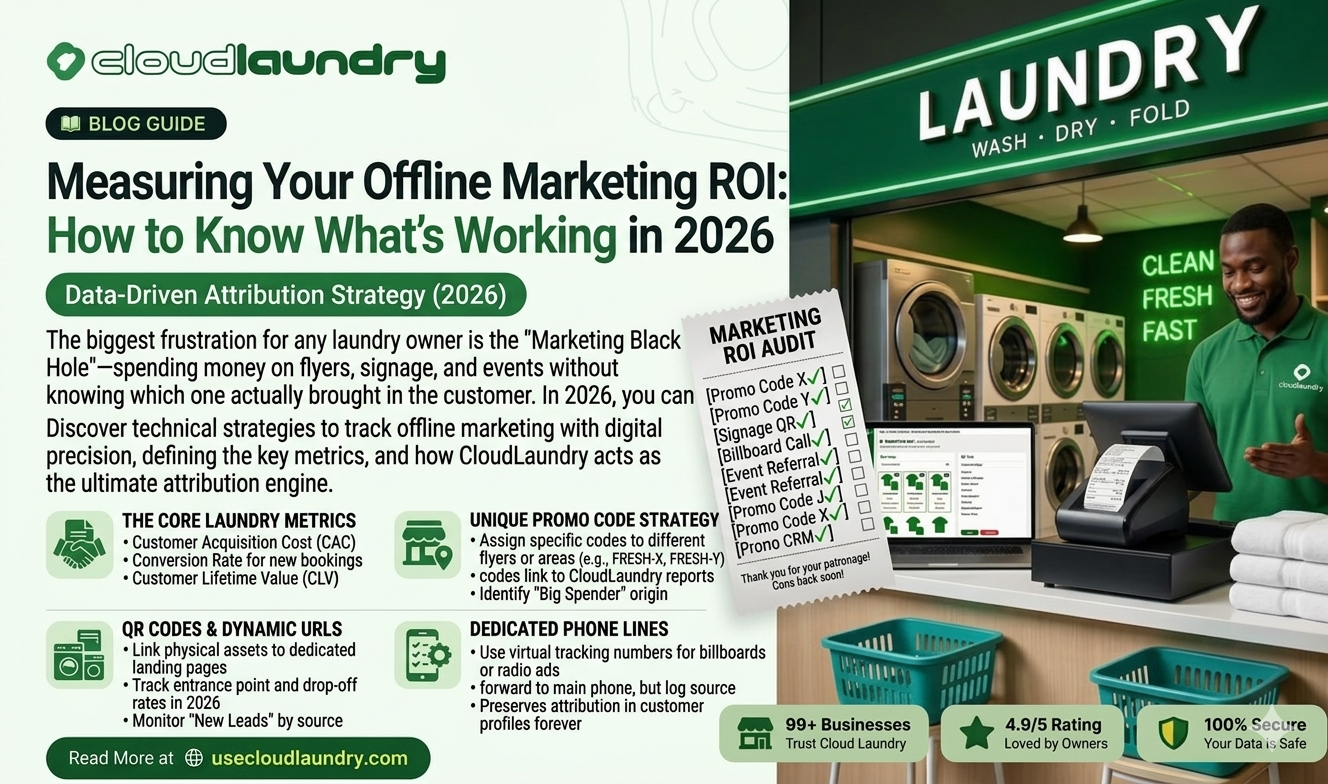
The Core Metrics of Laundry Marketing
Before you can measure "Return," you must define what "Success" looks like. In the laundry industry, there are three primary metrics you should track for every offline campaign.
The Big Three:
- Customer Acquisition Cost (CAC): How much did you spend to get one new person to drop off their first bag? (Total Campaign Spend ÷ New Customers).
- Conversion Rate: If you handed out 1,000 flyers and 50 people booked a wash, your conversion rate is 5%.
- Customer Lifetime Value (CLV): This is the most important metric. A flyer might cost more than the profit from a single shirt, but if that customer stays with you for two years, the ROI is massive.
CloudLaundry is designed to track these metrics automatically. Because the system follows the customer from their first registration to their 100th order, it gives you a true picture of the long-term value of your marketing efforts.
Method 1: The "Unique Promo Code" Strategy
This is the simplest and most effective way to track attribution for flyers, business cards, and newspaper ads.
How it Works: Instead of a generic "10% off" message, you assign a unique code to every physical asset.
- Flyer A (Neighborhood X): Use code "FRESH-X"
- Flyer B (Neighborhood Y): Use code "FRESH-Y"
- Street Sign: Use code "SIGN10"
When a customer enters the code into your usecloudlaundry.com booking portal, the system tags that customer to that specific campaign. At the end of the month, you can run a report in CloudLaundry to see which code was used the most and, more importantly, which code brought in the "Big Spenders."
Method 2: QR Code Attribution and Dynamic URLs
As we discussed in our QR code topic, the "Destination" of the scan is where the tracking happens. In 2026, you shouldn't just link to your homepage; you should use "UTM Parameters" or unique landing pages.
The Technical Setup:
Create a specific page on your site: yourlaundry.com/july-promo.
Link your QR code on your laundry bags or signs to this specific URL.
Use CloudLaundry to monitor how many "New Leads" were generated through that specific entrance point.
This allows you to see the "Drop-off Rate." If 500 people scanned the code but only 10 booked, you know the QR code worked, but your pricing or your booking form might be the problem.
Method 3: The "Dedicated Phone Line" (Virtual Numbers)
If your primary way of taking orders is through phone calls or WhatsApp, you can use virtual tracking numbers.
The Strategy: Put a specific phone number on your billboard and a different one on your radio ad. Both numbers forward to your main shop phone, but your phone system (or a simple manual log) tracks which number is ringing. By entering this "Source" into the CloudLaundry customer profile during the first call, you preserve the data forever. You can later ask the system, "Show me the total revenue from everyone who called the 'Billboard Number'."
Measuring "Brand Awareness" and Foot Traffic
Not all ROI is immediate. Sometimes, a sign on the street just makes people aware you exist, and they walk in three months later.
The "Baseline" Test:
- Step 1: Measure your average walk-in traffic for a month with no extra marketing.
- Step 2: Launch your new street signage (as discussed in our signage topic).
- Step 3: Measure the "Lift" in traffic.
If your daily walk-ins go from 10 to 15, those 5 extra customers are attributed to the sign. By using the best tool to manage your laundry business, CloudLaundry, you can mark these customers as "Walk-in (Signage)" to keep your data clean and actionable.
Practical Case Study: The "Flyer Flip" in Victoria Island
A laundry service in VI was spending N100,000 every month on high-quality glossy flyers. They felt it was working, but they weren't sure.
The Intervention: They stopped the generic flyers and moved to a tracked system. They divided their service area into four zones and gave each zone a different CloudLaundry promo code. They also added a QR code that led to a "Welcome" video.
The Result: They discovered that Zone A (Corporate offices) had a 0.5% conversion rate, but Zone B (Luxury apartments) had a 4% conversion rate. Even more interestingly, the customers from Zone B had a 3x higher average order value. They immediately stopped printing flyers for Zone A and doubled their budget for Zone B. By measuring offline marketing ROI for laundry through usecloudlaundry.com, they saved N50,000 in wasted printing and increased their monthly revenue by 25%.
Tie into CloudLaundry Softly
Data is only useful if it is organized and easy to read. You don't have time to sit with a calculator and a pile of receipts at the end of a long day.
As the best tool to manage your laundry business, usecloudlaundry.com is your "Chief Financial Officer." The platform's reporting dashboard takes all the "Source" data you've entered from promo codes to referral links and turns it into beautiful, easy-to-understand charts. You can see your "Marketing Spend vs. Revenue" in real-time. This allows you to be an agile business owner. If a campaign isn't working by the 15th of the month, you can pivot immediately rather than waiting for the end of the quarter. CloudLaundry provides the "Digital Proof" for your offline hard work. It ensures that every Naira you spend on the street is working to build your empire. CloudLaundry turns marketing from a "gamble" into a "guarantee."
The "Referral Source" Field: Training Your Staff
Technology is only half the battle; the other half is your "Front Desk Protocol."
- The Golden Question: Every time a new customer walks in or calls, your staff must be trained to ask: "Out of curiosity, how did you hear about us today?"
- The Manual Backup: In CloudLaundry, there is a mandatory "Referral Source" dropdown menu for new registrations.
- The Options: "Saw the sign," "Got a flyer," "Friend referral," "Instagram," etc. If your staff skips this step, your ROI data becomes incomplete. Make this "Data Entry" a key part of their performance review.
Calculating the "Break-Even" Point
To know if your ROI is positive, you must know your "Break-Even."
- The Formula: If a flyer campaign costs N20,000 and your average profit per order is N1,000, you need 20 new orders just to cover the cost of the paper and distribution.
- The "Second Order" Rule: In 2026, many savvy owners don't expect to profit on the first order. They use the marketing to "buy" the customer, knowing that the real profit comes from the 2nd, 3rd, and 4th orders managed through usecloudlaundry.com.
- Tracking Retention: Use CloudLaundry to see which marketing sources produce the most loyal customers. A source that brings in 100 one-time customers is worse than a source that brings in 10 customers who stay for a year.
Conclusion: The End of the Guessing Game
In 2026, the difference between a struggling laundry shop and a local powerhouse is "Information." The shops that thrive are the ones that treat their marketing budget like an investment portfolio constantly monitoring, pruning the losers, and backing the winners.
Measuring offline marketing ROI for laundry is no longer an optional "extra." It is a survival skill. By using promo codes, QR codes, and disciplined staff protocols, you turn your physical marketing into a high-precision digital tool.
Stop wondering if your flyers are working. Start knowing. Use the operational and analytical power of CloudLaundry to take control of your growth. Visit usecloudlaundry.com today and see how the best tool to manage your laundry business can help you track your way to the top. The data is waiting. Are you ready to use it?
