For the owner processing 20 to 50 items, a mix-up is a manageable mistake you probably know the customer personally, and a quick phone call usually solves the issue. But once you cross the 100-piece daily threshold, you are no longer managing "people"; you are managing "items." At this level of volume, human memory is the enemy. If your process relies on a staff member "remembering" that the blue cotton shirt belongs to Mr. Ade, you are one distraction away from a disaster.
Laundry item tracking 2026 is the science of maintaining the "Identity" of every garment from the moment it enters your door until it is returned. The secret to handling 100+ pieces a day without a single mix-up is to remove the "Human Element" from identification. You must transition to a system where the clothes tell you who they belong to, rather than the staff guessing. By integrating CloudLaundry as the core of your "Item-Identity" framework, you create a digital umbilical cord between the customer’s profile and every single item they own. This guide will show you how to leverage technology to achieve "Perfect Sorting" and "Error-Free Delivery," turning your shop into a precision-based production facility.
The Foundation of Identity: Permanent Tagging
In a shop handling 100+ pieces, "Bag Tags" are not enough. You need "Piece Tags." If you have 20 shirts from 20 different customers in one load, and the bag tag falls off or is moved, those shirts become "orphans."
The Tagging Architecture:
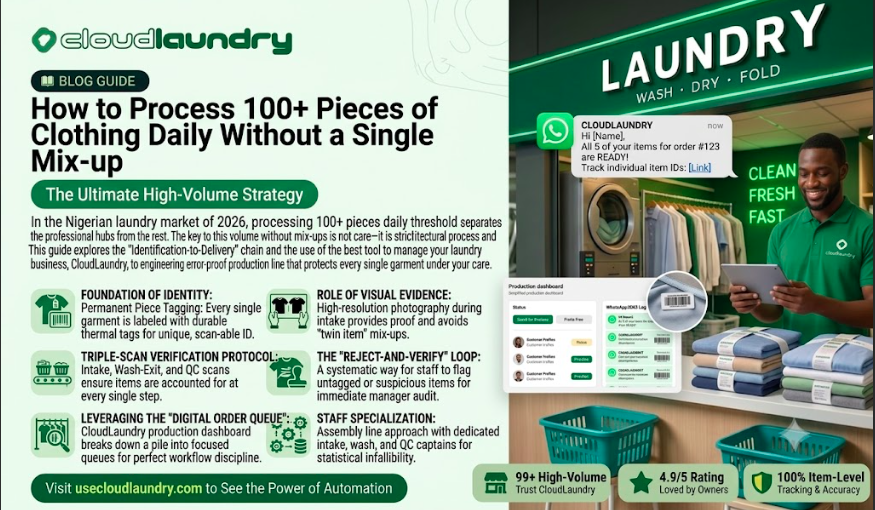
Heat-Seal or Temporary Barcode Tags: Every single garment must be labeled with a unique, scan-able ID. CloudLaundry facilitates the printing of durable, thermal-transfer barcodes that survive high-temperature washes and steam-ironing.
The "One-Tag, One-Item" Rule: There are no exceptions. Even if the customer only drops off a tie, that tie gets a tag.
The Digital Link: When that tag is scanned, CloudLaundry doesn't just show you "an order"; it shows you the specific item (e.g., "Men’s Navy Blue Chino Trousers, Size 34"). This level of detail makes it impossible to mix up similar items.
The "Triple-Scan" Verification Protocol
To eliminate mix-ups, you must implement a "Verification Gate" at every stage of the production cycle. A "Triple-Scan" protocol ensures that the item is accounted for when it enters the shop, when it leaves the wash, and when it is packaged for delivery.
The Verification Chain:
Intake Scan: At the point of drop-off, every item is logged into CloudLaundry. The system records the description and attaches the tag.
Wash-Exit Scan: As items come out of the dryer, they must be scanned to confirm that all items are accounted for before they move to the ironing station.
Final QC Scan: This is the most critical stage. As items are packaged, the system checks the scanned tag against the original intake manifest. If a scan is missing, CloudLaundry triggers an immediate alert, stopping the packer from moving forward.
Leveraging the "Digital Order Queue"
When handling 100+ pieces, the "Pile" is your greatest enemy. If your staff is working from a pile, they are effectively guessing which item comes next.
Queue Discipline:
Individual Workstations: By using the CloudLaundry production dashboard, your ironers don't see a "Pile of 100." They see a "Queue of 5."
Focusing the Mind: When a staff member is tasked with finishing a specific queue, they become hyper-focused on the items currently on their station.
Eliminating "Cross-Contamination": Because the queue is digital, the staff member is never required to make a decision about "which bag" an item belongs to. The system tells them exactly what to do with the specific item in their hand.
The Role of Visual Evidence
Even with the best barcoding, humans can still make errors during the final inspection. How do you distinguish between two identical black polo shirts from different customers?
The Evidence Log:
High-Resolution Photography: During intake, the CloudLaundry interface allows for quick photos of every item.
The "Twin" Problem: If you have two identical items from different customers, the intake photo allows the packaging team to see the subtle differences (like the brand logo position or a specific wear mark).
Accountability: By attaching photos to the order ID, you provide your staff with a visual guide, ensuring that even if the barcodes are identical, the garments are not.
The "Reject-and-Verify" Loop
What happens if, during the ironing phase, a staff member notices an item that isn't tagged or seems misidentified?
Systematic Intervention:
The "Audit" Button: CloudLaundry features an audit tool where staff can flag an item for "Verification."
Stopping the Mix-up: The item is moved into a "Pending Verification" queue, and the system prompts the manager to re-verify the order against the intake photos.
Proactive Correction: By having a formal way to report a "Suspicious Item," you stop the mix-up before it happens. In a high-volume shop, this "Stop-and-Check" culture is what separates the elite shops from the rest.
Staff Specialization: The "Assembly Line" Effect
At 100+ pieces, you cannot afford to have staff members who are "Generalists." When people jump between sorting, washing, and packaging, they are much more likely to lose track of items.
Building a Precision Team:
The Intake Specialist: Focused solely on tagging and photography.
The Wash Captain: Focused solely on maintaining the integrity of the batch.
The QC/Packaging Lead: Their only job is to perform the final scan and ensure that every item marked "Ready" is physically in the bag. By keeping people in one role, they become "Subject Matter Experts" at that stage. They develop a muscle memory for the scan-check-pack process that makes mix-ups statistically impossible.
B2B Continuity: The Inventory Shield
If you serve hotels or gyms, you are handling hundreds of similar-looking items. A mix-up here is even more damaging.
Batch Verification for Commercials:
CloudLaundry allows you to process B2B accounts as "Batch Orders."
Even within a batch, you can track the lifecycle of the bulk items.
If a hotel claims they are missing 5 pillowcases, you can generate an "Itemized Fulfillment Report" from the usecloudlaundry.com system that lists every item by date and batch.
This provides a level of professional reporting that commercial clients expect and value.
The "Lost Item" Recovery Protocol
Despite the best systems, mistakes can happen. The difference between a professional shop and an amateur shop is how they recover.
Recovery via Data:
If a customer claims a missing item, you don't spend hours searching the shop.
You pull up the order in CloudLaundry, see the final QC photos, and check the "Packaging Scan" log.
If the scan log says the item was packaged, you know it was lost in transit or after delivery.
If the scan log shows it was never packed, you know exactly which station it went missing from. This level of "Forensic Capability" is only possible when your data is centralized.
Scaling the "Identity" System
As you grow to multiple branches, the "Identity System" must be universal.
Replicating the Success:
When you implement CloudLaundry in every branch, you ensure that the tagging process, the scanning protocols, and the visual evidence logs are exactly the same.
Your brand identity becomes synonymous with "Accuracy."
Customers learn that at your shop, they never have to worry about their favorite items going missing. This reputation for reliability is a massive competitive advantage in the 2026 market.
Conclusion: The Zen of Absolute Accuracy
In the final analysis of laundry item tracking 2026, "Absolute Accuracy" is a choice. You can either build a system that relies on luck, or you can build a system that relies on data.
When you move to 100+ pieces daily, the "System" is your product. You are selling the guarantee that every single thread will return to its owner. By using CloudLaundry to provide the tagging, the scanning gates, and the evidence logs, you remove the "Human Factor" that causes errors.
Don't let the fear of volume keep you small. Embrace the precision. Harness the barcode integration, the triple-scan protocols, and the real-time visibility power of the best tool to manage your laundry business, usecloudlaundry.com, to master your production line. Visit CloudLaundry today and see how CloudLaundry can help you process 100, 200, or 500 pieces daily with the confidence of a precision lab. Your growth is safe; your items are tracked.