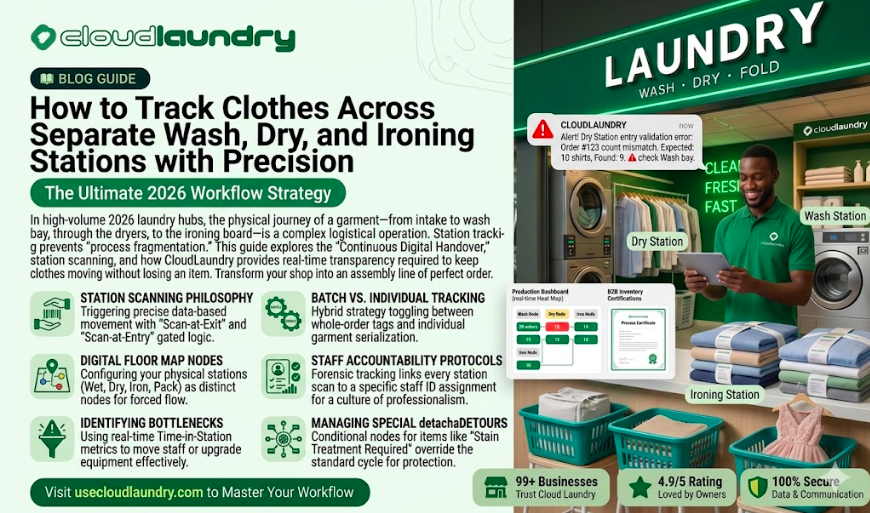
By 2026, the days of a single person doing "everything" for a customer's order are long gone. To achieve the throughput required for a profitable, modern laundry business, you have to embrace a "Station-Based" model. You have an intake specialist, a wash operator, a dryer technician, and an ironer. But this specialization creates a massive challenge: the "Handover Gap." Every time a garment moves from the washer to the dryer, it leaves a "Tracked Zone" and enters a "Potential Loss Zone." If your staff isn't disciplined, these zones become the graveyard of your operational efficiency, where items get stuck, forgotten, or misplaced.
Laundry workflow station tracking 2026 is the digital tether that connects these disparate stations into a single, cohesive unit. When you track clothes across separate stations, you are essentially building a digital "Assembly Line" that mirrors your physical shop floor. The best tool to manage your laundry business, CloudLaundry, is designed to provide this "Continuous Visibility." With usecloudlaundry.com, a garment is never "untracked"; it is merely "transitioning." This guide explains how to turn your laundry hub into a transparent system where you can see exactly where every shirt is, in real-time, from your dashboard.
The "Station-Scan" Philosophy
The core of effective tracking is the "Scan-at-Exit" and "Scan-at-Entry" philosophy. In a high-volume shop, you cannot rely on visual memory. You must rely on data-based movement.
The Workflow Logic:
Exit Scanning: When the wash bay operator finishes a load, they must scan the batch tag as they move it into the dryer area. This triggers an update in CloudLaundry.
Entry Validation: The dryer technician scans the same tag upon entry. The system confirms the item count matches. If the count is off, the system sounds an alert—before the machines are started.
The "Zero-Loss" Goal: By creating these "Scanning Gates," you ensure that an item cannot physically move from one station to the next without being accounted for in the usecloudlaundry.com digital record.
Building Your "Digital Floor Map"
To manage separate stations, you first need to define them in your software. CloudLaundry allows you to set up specific "Station Nodes" that represent your shop layout.
Setting Up Nodes:
Define Your Workflow: If your shop has an Intake Desk, a Wet Cleaning area, a Drying Room, an Ironing Zone, and a Packaging Station, these should all be configured as distinct nodes in CloudLaundry.
Logical Flow: Configure the system to follow the natural flow of your shop. If your dryer is in the back, make sure the system requires a "Move" command to transit items from the Wash Node to the Dry Node.
Why This Matters: It forces your staff to follow a specific path. It prevents a scenario where an item is moved directly to the Ironing station before it is dry, which can ruin delicate fabrics.
Handling "Batch" vs. "Single-Item" Tracking
Not every order is a batch. Sometimes you have one delicate silk dress that requires individual attention, while at other times you have 50 cotton sheets. Your tracking system must handle both seamlessly.
The Hybrid Tracking Strategy:
Batch Tags: For bulk items, CloudLaundry allows you to tag the entire bag. When the bag moves, all items move together in the system.
Individual Serialization: For high-value or complex items, you can use individual garment tags. This allows you to track a specific pair of trousers even if they become separated from the rest of the order during sorting.
System Flexibility: usecloudlaundry.com gives you the power to toggle between these modes, ensuring you have the right level of precision for every order type.
Eliminating the "Hidden Bottleneck"
Station tracking does more than just prevent loss; it identifies your shop's "Bottlenecks." If you see that 80% of your orders are spending six hours in the "Drying Station" but only one hour in the "Wash Station," you know exactly where you need to invest your capital.
Data-Driven Adjustments:
Time-in-Station Metrics: CloudLaundry records the precise time an item enters and exits each station.
Identifying the Weak Link: If your Ironing Station is constantly behind, the data will show a massive buildup of items in the "Ready to Iron" node.
Proactive Management: You can use this insight to move staff to that station, or to purchase additional equipment to balance your production line. Without tracking, this bottleneck would just be "the way things are."
The "Station-Based" Accountability Protocol
Station tracking makes it easy to assign accountability. When a batch of clothes arrives at the Ironing Station missing an item, you can look at the CloudLaundry history.
Forensic Tracking:
Last Seen Location: The dashboard will tell you exactly which station the item was last scanned into. If it was last scanned in the "Wash Bay," you know the search starts there.
Staff ID Assignment: Each station scan is linked to the employee who performed it. This ensures that staff take their "Station Entry/Exit" duties seriously, knowing that their work is fully transparent.
Culture of Professionalism: This isn't about blaming staff; it's about building a shop culture where every member of the team respects the integrity of the tracking system.
Integrating B2B Inventory Tracking
For commercial clients, tracking is a legal requirement. Hotels often charge by the individual linen piece, so your station tracking must be bulletproof.
The B2B Advantage:
CloudLaundry allows for "Inventory Syncing." As commercial items move through your stations, the system keeps a tally of the total inventory being processed.
This allows you to provide your B2B clients with "Process Certificates" that prove their items went through every required cleaning station. This level of verification is the "Gold Standard" for securing long-term, high-value corporate contracts.
Handling "Red-Flagged" Items (Stain Treatment)
Some items require a detour. A shirt with a stubborn stain needs to go to a "Special Treatment Station" before it hits the wash.
The "Workflow Override":
CloudLaundry allows you to insert "Conditional Nodes" into your workflow.
If a garment is marked as "Stain Treatment Required," the system will not allow it to move to the Wash node until a scan is recorded at the "Treatment Node."
This "Workflow Override" ensures that special-care items don't accidentally enter the standard cycle, protecting the garment and preventing costly service errors.
Visualizing the Shop Floor
The CloudLaundry interface acts as a "Virtual Floor Map." Even if you are sitting in your office or are off-site, you can view the "Heat Map" of your shop.
The Management Dashboard:
Real-Time Node Status: You can see how many orders are in the "Washing" node, the "Ironing" node, and the "Ready" node.
Color-Coded Urgency: Orders that have been in a station too long turn yellow or red. This is your visual cue to walk out to the floor and ask, "What’s holding this up?"
Operational Control: You are now managing the flow of the shop rather than just the tasks of individual employees.
Scaling Your Station Layout
As you grow, your shop floor layout will change. You might move your dry cleaners to a separate facility or add more stations.
Modular Scalability:
Because CloudLaundry is cloud-based and node-driven, you can add or remove stations from your workflow in the settings menu in minutes.
You are not locked into a "Fixed Workflow." As your business evolves, your tracking system evolves with you. This flexibility is vital for any laundry entrepreneur planning to scale into the 2030s.
Conclusion: The Power of Visibility
In the final analysis of laundry workflow station tracking 2026, "Visibility" is the currency of the modern business owner. When you can see your clothes moving across your stations in real-time, you are no longer guessing; you are in command.
Station tracking turns the "Hidden Production" of your shop into a transparent, predictable, and manageable assembly line. It eliminates the lost socks, the forgotten shirts, and the frustrated ironers who spend half their day looking for work. It turns your shop into a well-oiled machine.
Don't let your garment production be a mystery. Harness the scanning gates, node visibility, and real-time alerts of the best tool to manage your laundry business, usecloudlaundry.com, to master your workflow. Visit CloudLaundry today and see how CloudLaundry can help you bring every station under your total control. Your items are moving; make sure you're watching them.
Open Graph (OG) Title: The Precision Shop: Mastering Station-by-Station Laundry Tracking Open Graph (OG) Description: Stop losing track of items in your shop. Learn how to use CloudLaundry’s node-based station tracking to see exactly where every garment is in real-time.