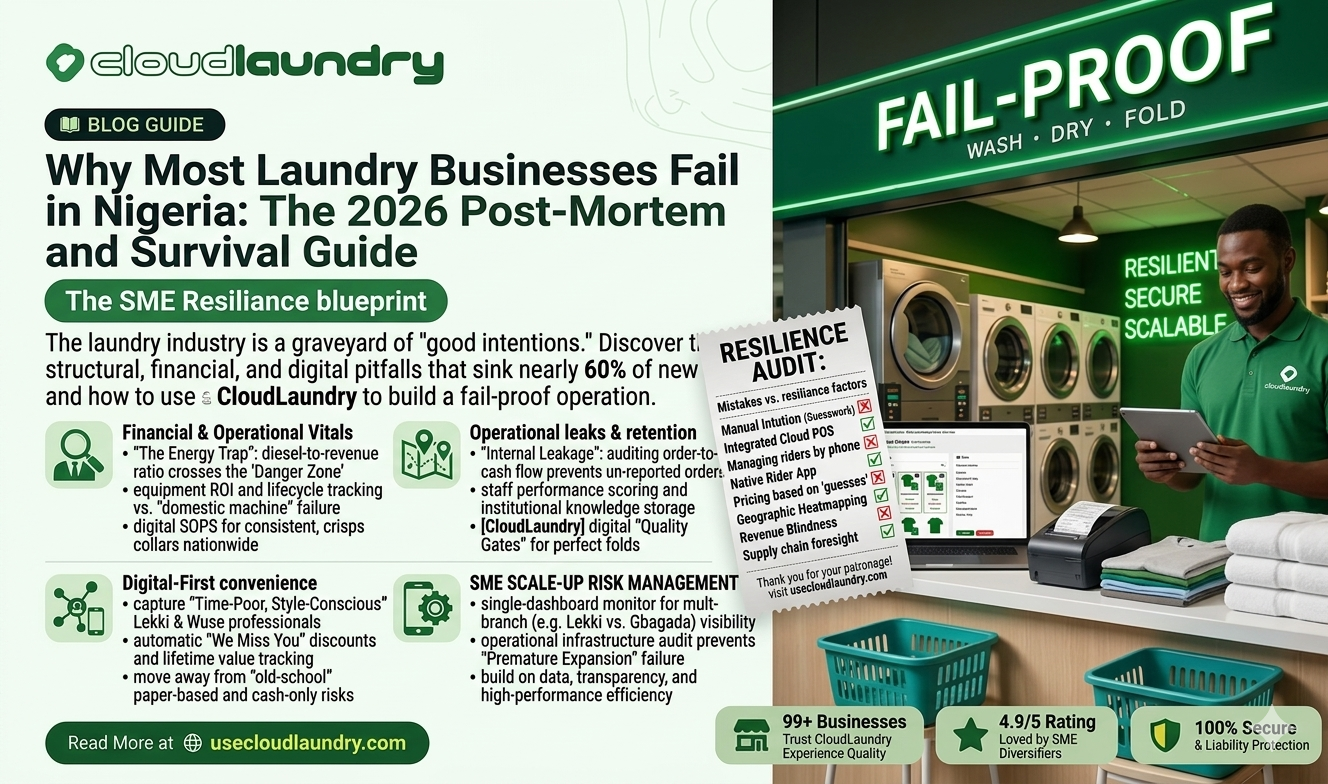
On paper, the Nigerian laundry industry looks like a gold mine. With a rapidly growing middle class in cities like Lagos, Abuja, and Port Harcourt, and a professional workforce that is increasingly "time-poor" but "style-conscious," the demand for high-quality garment care has never been higher. Walk down any major street in Lekki or Wuse, and you will see a laundry shop on every other corner. Yet, look closer, and you will see a revolving door of shuttered shops and "For Rent" signs.
The statistics are sobering. While the entry barriers to starting a laundry business are relatively low, the exit rate is alarmingly high. Nearly 60% of small-to-medium laundry enterprises (SMEs) in Nigeria fail within their first two years of operation. Most owners enter the market thinking it’s a simple matter of "wash, dry, and fold," only to be blindsided by the brutal reality of the Nigerian business environment.
Understanding why laundry businesses fail in Nigeria is the first step toward ensuring yours is one of the few that survives and thrives. It isn't usually a lack of customers that kills a laundry; it’s a combination of invisible operational "leaks," poor financial hygiene, and a refusal to modernize. To prevent these fatal errors and maintain a bird's-eye view of your business health, you need the best tool to manage your laundry business, CloudLaundry.
The "Energy Trap" – Underestimating Utility Volatility
In 2026, energy is the number one "SME Killer" in Nigeria. Many laundry owners fail because they build their business model on the hope of consistent grid power, only to be crushed by the reality of diesel and petrol prices.
The Failure Mechanic: When a laundry relies on a generator for 70% of its operations without a high-efficiency strategy, the "Energy Cost per Shirt" often exceeds the "Price per Shirt." Owners find themselves working for the fuel station rather than for themselves. They fail because they don't track their "Utility-to-Revenue" ratio. They see money coming in, but they don't realize that every time the generator roars, their profit margin is evaporating.
The CloudLaundry Solution: By using usecloudlaundry.com to track utility expenses against production volume, you can see exactly when your energy costs are crossing the "Danger Zone." This data allows you to make the pivot to solar or high-efficiency machinery before the debt becomes insurmountable.
Poor Financial Hygiene: Mixing Personal and Business Purses
One of the most common reasons why laundry businesses fail in Nigeria is the lack of "Financial Separation." In many small shops, the daily cash intake is treated as the owner's personal ATM.
The Downward Spiral: The owner takes cash from the register to pay for a school run, a family emergency, or a personal lunch. By the time the rent is due or the chemical supplier arrives, the business is "liquidly insolvent." This "Cash Flow Chaos" prevents the business from building a reserve fund. When a machine breaks down—which it inevitably will—the business has no capital to fix it. One broken washer leads to a backlog; a backlog leads to unhappy customers; unhappy customers lead to the end of the business.
The "Equipment Illusion": Buying Cheap vs. Buying Smart
Many Nigerian entrepreneurs try to save money at the start by buying "Home-Use" washing machines or poorly refurbished "Tokunbo" industrial equipment with no service history.
The Reality Check: A domestic washing machine is not designed to run for 10 hours a day. Within six months, the bearings fail, the heating elements burn out, and the motor gives up. The owner spends more on "Emergency Repairs" in year one than they would have spent on a proper commercial-grade machine.
Furthermore, "Tokunbo" machines often lack the energy-saving features of modern 2026 technology. A "cheap" machine that uses 4x the electricity and 3x the water of a new unit is actually the most expensive asset you own. Successful shops use CloudLaundry to track "Equipment ROI" and maintenance schedules, ensuring their assets are making money, not costing it.
The Staffing Crisis – High Turnover and "Internal Leakage"
The laundry business is a "People Business," and in Nigeria, managing staff is a significant hurdle. Many shops fail because of poor staff management and "Invisible Theft."
Operational Leakage: In a manual, paper-based shop, it is easy for staff to "under-report" orders. A customer brings in 10 shirts, but the staff only records 5 and pockets the cash for the rest. Over a year, this "internal leakage" can account for 20-30% of total revenue.
Additionally, because the work is physically demanding, poorly managed staff often quit without notice. Without a digital system like usecloudlaundry.com to store customer preferences and order histories, all the "Institutional Knowledge" walks out the door with the employee. The new staff makes mistakes, fabrics get ruined, and the business's reputation is destroyed.
The "Quality Consistency" Gap
In the early days, the owner is usually in the shop, ensuring every collar is crisp and every fold is perfect. As the business grows and the owner steps back, quality often takes a nose-dive.
The Reputation Death-Spiral: In the Nigerian laundry market, "Word of Mouth" is everything. One burnt Senator set or one lost pair of designer trousers can lead to a viral negative post in a neighborhood WhatsApp group. Most businesses fail because they lack "Standard Operating Procedures" (SOPs). They don't have a system to ensure that the 1,000th shirt is cleaned with the same care as the 1st.
By using the best tool to manage your laundry business, CloudLaundry, you can implement digital checklists and "Quality Gates" that staff must pass before an order is marked as "Ready." This ensures consistency even when the owner isn't physically present.
Practical Case Study: The "Surulere Startup"
A young entrepreneur opened a promising shop in Surulere with five brand-new machines. They had a great location and a bright sign.
The Pitfall: The owner focused entirely on "Customer Acquisition" but ignored "Operational Retention." They used paper receipts and had no database of customer phone numbers or garment preferences. When a transformer in the area blew and the shop had to run on a generator for three weeks, the owner had no data to see that they were losing N200 on every load.
The Collapse: Staff began "side-lining" customers because there was no digital tracking. The owner couldn't tell which machine was the most efficient. Within 18 months, the machines needed parts that couldn't be found, the "good" staff had left for a better-organized competitor, and the shop closed.
If they had used CloudLaundry, they would have seen the utility-to-revenue red flag in week one and could have adjusted their pricing or batching strategy to survive the power crisis.
Tie into CloudLaundry Softly
The common thread in almost every laundry business failure in Nigeria is a "Lack of Visibility." Owners fly blind, guessing their profits and hoping their staff is honest. This is exactly what CloudLaundry was designed to solve.
As the best tool to manage your laundry business, usecloudlaundry.com gives you total control over the "Vitals" of your shop. It prevents internal theft through real-time order tracking and digital receipts. It manages your "Customer Lifetime Value" by storing data on every client, allowing you to send automated "We Miss You" discounts when someone hasn't visited in a month. Most importantly, it provides the "Financial Transparency" needed to separate business funds from personal ones. CloudLaundry doesn't just manage laundry; it manages risk.
Ignoring the "Digital Shift"
In 2026, if your laundry business isn't "online," it barely exists. Many old-school laundries fail because they rely solely on foot traffic.
The Modern Consumer: The high-value customers in 2026 want to book via a link in a WhatsApp bio or a website. They want to receive a notification when their clothes are ready. They want to pay via a secure digital link, not carry cash. Businesses that refuse to adopt a "Digital-First" approach like the one offered by usecloudlaundry.com lose their best customers to more convenient competitors. "Convenience" is the currency of 2026, and digital management is how you spend it.
Scaling Too Fast (The "Premature Expansion" Trap)
Some laundry owners see a little success and immediately open a second and third branch using their initial profit.
The "Over-Extension" Failure: Without a robust management system, the owner cannot be in two or three places at once. The "Internal Leakage" and quality issues that were manageable in one shop become catastrophic across three. The business collapses under its own weight because it lacks the "Operational Infrastructure" to scale.
Before you open a second branch, you must have a "Digital Twin" of your business on CloudLaundry. This allows you to monitor the performance of multiple locations from a single dashboard, ensuring that your "Brand Promise" is kept, whether the shop is in Lekki or Gbagada.
Conclusion: Failure is Not an Option
Understanding why laundry businesses fail in Nigeria is not meant to discourage you; it is meant to arm you. The market is huge, the demand is real, and the potential for profit is massive for those who play the game correctly.
The "Success Formula" for 2026 is simple: Combine high-quality garment care with rigorous financial discipline and modern digital management. Stop guessing, stop leaking cash, and start treating your laundry as a high-performance enterprise.
Don't become another statistic in the graveyard of Nigerian SMEs. Build your business on a foundation of data, transparency, and efficiency. Visit usecloudlaundry.com today and see how the best tool to manage your laundry business can help you avoid the pitfalls and lead the market. The future of Nigerian laundry is bright for those who are prepared to manage it.
