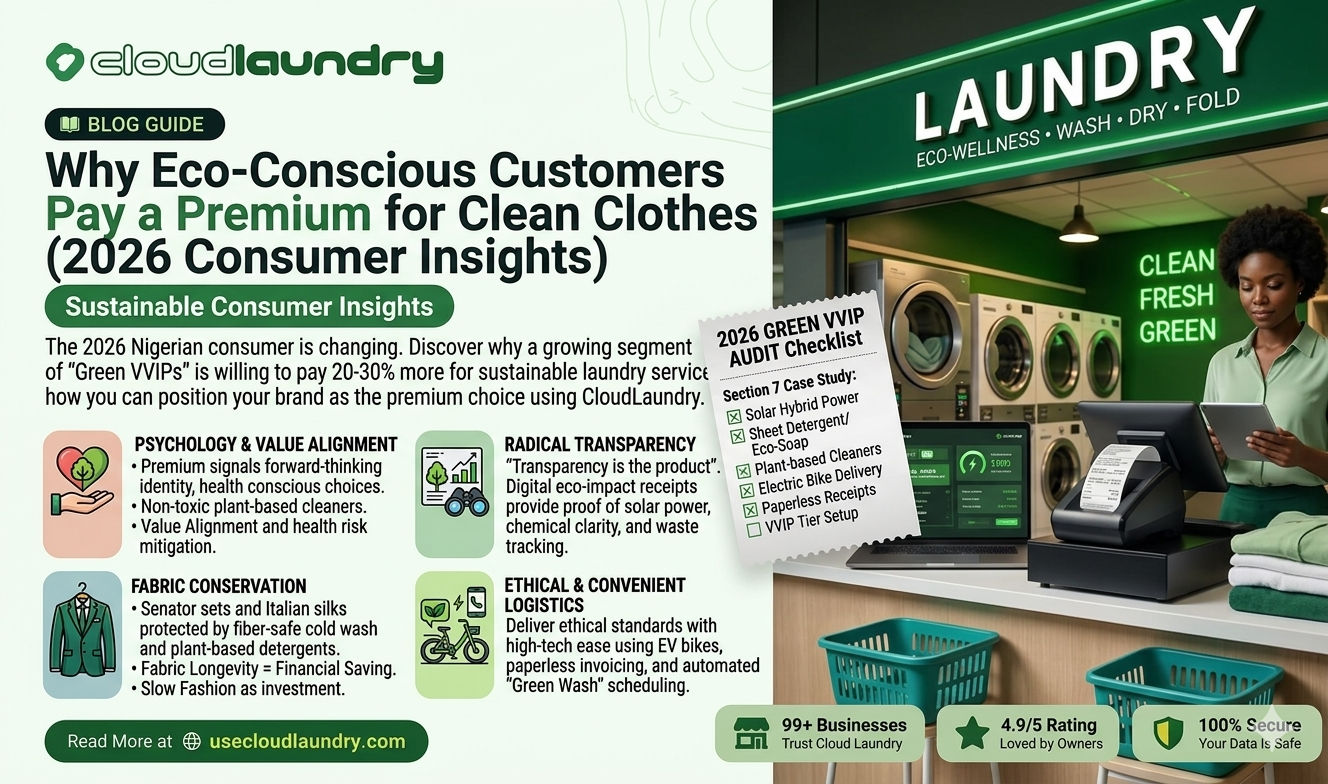
The Nigerian laundry market in 2026 is no longer a simple race to the bottom on price. For years, laundry owners in Lagos, Abuja, and Port Harcourt have been locked in a "Price War," slashing their margins to compete with the neighbor’s shop. But while many are fighting over N500 shirts, a new, sophisticated segment of the market has emerged and they aren't looking for the cheapest price. They are looking for the "Cleanest Conscience."
Eco-conscious laundry customers represent the fastest-growing demographic in the premium service sector. These are professionals, entrepreneurs, and families who are deeply aware of the environmental crisis. They see the plastic-clogged gutters of Lekki and the erratic weather patterns in the North, and they are making a conscious choice to spend their money with brands that offer a solution rather than a problem. To them, a "Clean Shirt" is only clean if it wasn't washed with toxic chemicals, packed in single-use plastic, or powered by a smoke-belching generator.
The fundamental shift is this: Sustainability has moved from being a "charity" to being a "luxury." This group is not just willing to pay a premium; they expect to pay one for a service that protects their health and their environment. Understanding why they pay more and how to speak their language is the key to escaping the "Cheap Price Trap." To capture and manage this high-value audience, you need the best tool to manage your laundry business, CloudLaundry.
The Psychology of the "Eco-Premium"
Why would a customer pay N2,500 for a wash-and-press when the shop next door offers it for N1,800? It comes down to "Value Alignment."
The Identity Factor: For the 2026 eco-conscious consumer, their spending is an extension of their identity. When they carry a garment bag made of compostable starch instead of shiny polybags, it signals to the world that they are educated, responsible, and forward-thinking. In social circles in Victoria Island or Maitama, being "Green" is a status symbol.
Risk Mitigation: These customers view traditional laundry chemicals as a risk to their personal health. They associate "traditional" detergents with skin allergies and respiratory issues. Paying a premium for plant-based, non-toxic cleaning is seen as an "Insurance Policy" for their skin and their family’s wellness. When you use usecloudlaundry.com to provide transparent ingredient lists or "Eco-Certificates," you are fulfilling a psychological need for safety that price-cutters simply cannot meet.
Fabric Longevity as a Financial Justification
Eco-conscious customers are often also "Slow Fashion" advocates. They invest in high-quality, expensive fabrics—Senator sets, Italian silks, and hand-woven Aso-oke and they want them to last for years, not months.
The Math of Quality: They understand that the heat and harsh chemicals used in low-cost laundries destroy fibers. If a N150,000 outfit lasts for 50 washes instead of 10 because you used a "Cold Wash" and plant-based detergents, the "Premium" they paid you is actually a massive saving in the long run.
By marketing your service as "Garment Conservation" rather than just "Laundry," you shift the conversation from cost to investment. CloudLaundry allows you to track the "Garment History" for these clients, proving through data that their clothes remain in "Like New" condition after multiple visits.
The Demand for Radical Transparency
One of the core reasons eco-conscious laundry customers pay a premium is for "The Truth." They have been burned by "Green-washing" (brands that claim to be eco-friendly but aren't).
What They Are Paying For:
Proof of Solar Power: They want to know you aren't running on a 24/7 diesel generator.
Chemical Clarity: They want to know exactly what is in your soap.
Waste Tracking: They want to know where the water goes.
In 2026, transparency is the product. By providing digital receipts through usecloudlaundry.com that detail the "Eco-Impact" of the order (e.g., "This load saved 40 liters of water"), you provide the tangible proof they need to justify the higher spend. They aren't just paying for the soap; they are paying for the data that proves they made the right choice.
The Convenience of "Ethical Logistics"
The modern Nigerian green consumer is often a "Time-Poor" professional. They want to be eco-friendly, but they don't have the time to drive across town to a specialized shop.
The Hybrid Value Proposition: They pay a premium for a brand that combines "Ethical Standards" with "High-Tech Convenience." This means:
Electric Delivery: Using EV bikes for pickups.
Paperless Communication: No printed tags or paper invoices.
Automated Scheduling: Being able to book a "Green Wash" in 30 seconds via an app.
When you use the best tool to manage your laundry business, CloudLaundry, you provide the seamless digital experience that these tech-savvy, eco-conscious customers demand. They pay the premium because you’ve made it easy to be ethical.
The "Community Impact" Hook
In Nigeria, "Community" is everything. Eco-conscious customers pay more when they know their money is staying local and doing good.
The Social ROI: If your laundry business employs local youth, uses Nigerian-made plant-based soaps, and supports local water conservation projects, you must communicate this. The premium is seen as a "Community Tax" that the customer is happy to pay because they trust that your business is a "Force for Good" in Lagos or Abuja.
Practical Case Study: The "Ikoyi Eco-Elite"
A laundry in Ikoyi was struggling to keep up with the rising costs of diesel and imported chemicals. They were priced at N2,000 per shirt, while a competitor was at N1,500.
The Intervention: The owner rebranded as an "Eco-Wellness Laundry." They switched to detergent sheets, moved to a solar-hybrid system, and increased their price to N2,800. They launched a "Zero-Plastic Challenge" using CloudLaundry to track how many kilograms of plastic their customers were helping to divert from the ocean.
The Result: They lost about 15% of their "Price-Sensitive" customers (who were high-maintenance and low-margin anyway). However, they gained a 40% increase in "High-Value" clients from the surrounding estates who were attracted by the "Non-Toxic" and "Zero-Waste" promise. Their total revenue increased, but more importantly, their profit per order doubled. They were doing less work but making more money, all because they tapped into the eco-conscious laundry customers psychology.
Tie into CloudLaundry Softly
Capturing a premium market requires a premium management system. You cannot promise a "modern, eco-friendly experience" and then hand the customer a handwritten paper receipt. This is where CloudLaundry becomes the backbone of your premium strategy.
As the best tool to manage your laundry business, usecloudlaundry.com allows you to customize your service tiers. You can create a "Green VVIP" membership level with specific "Eco-Preferences" (e.g., "No Scent," "Compostable Bag Only," "Cold Wash Only"). The system ensures these instructions are followed perfectly by the staff, preventing the "Brand Promise Failure" that happens when a green customer receives their clothes in a plastic bag by mistake. CloudLaundry ensures that the premium your customers pay is reflected in every digital and physical touchpoint.
How to Justify the Price Increase (The Messaging)
If you are worried about raising your prices to accommodate eco-friendly practices, use the "Transparency Technique."
Don't say: "Prices are up because of the economy." Do say: "We have upgraded to 100% plant-based detergents and solar power to ensure your clothes are cleaned without toxins or carbon emissions. This investment ensures your fabrics last longer and our community stays cleaner."
When you explain the why, the premium becomes a logical choice for the customer, not an arbitrary cost. Use the automated email and SMS features in CloudLaundry to send these "Educational Updates" to your database.
The "Wellness" Overlap
In 2026, "Green" and "Health" are the same thing. Many eco-conscious laundry customers are also fitness enthusiasts, healthy eaters, and yoga practitioners.
The Strategy: Position your laundry as part of their "Wellness Routine." Use phrases like "Breathable Clean," "Skin-Safe," and "Chemical-Free Sleep" for bedding. This positions your service alongside their organic groceries and gym memberships—items they already pay a premium for without hesitation.
Conclusion: The Future belongs to the Purpose-Driven
The eco-conscious laundry customers of 2026 are not a "trend"; they are the new standard for the high-end market. They pay a premium because they value quality, health, and the future of Nigeria more than they value a N500 discount.
By pivoting your business toward sustainability, you are doing more than just helping the environment; you are "Filtering" your customer base. You are letting go of the customers who don't value your work and attracting the ones who will stay loyal for years because of your shared values.
Combine your commitment to the planet with the operational precision of CloudLaundry to build a brand that is both profitable and purposeful. Stop competing on price and start leading on principle. Visit usecloudlaundry.com today to see how we can help you transition to a premium, eco-friendly model that wins the hearts and wallets of the 2026 consumer.
