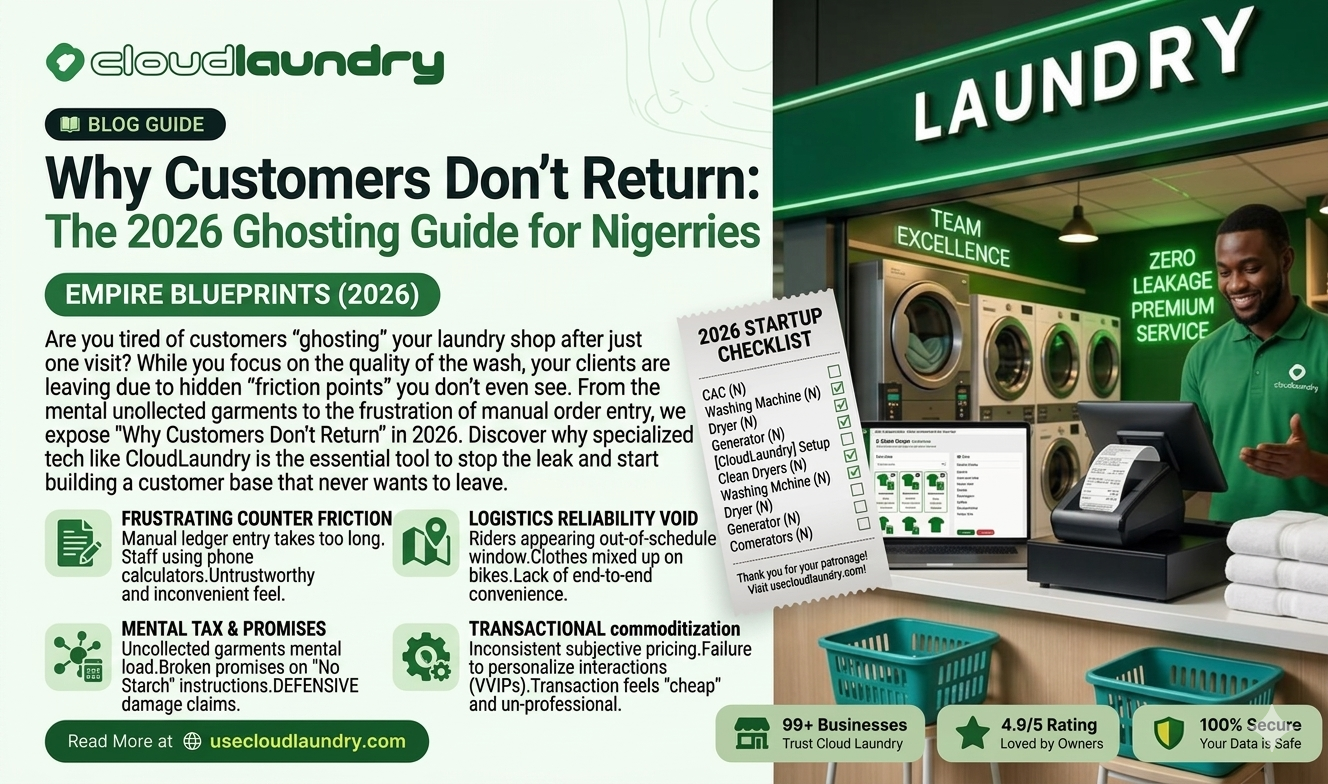
In the highly competitive Nigerian business environment of 2026, many laundry owners have become expert marketers but poor operators. They run aggressive Instagram campaigns, offer first-time discounts, and hand out flyers in premium estates. The "Input" is high—they are getting people through the door. Yet, the "Output" is stagnant. The reason is a quiet, deadly drain on their success: the lack of repeat business.
The question of why customers don’t return is rarely a single, catastrophic event like burning an expensive suit. Instead, loyalty is eroded by a thousand small, invisible points of friction that occur long before the soap touches the clothes. In an era where convenience is the primary currency, a "perfect wash" is merely the table stakes. To truly build a scalable brand, you must provide a total digital experience that removes the stress of getting laundry done.
To move beyond the cycle of expensive customer acquisition and toward the profit of customer retention, you need the best tool to manage your laundry business, CloudLaundry. This guide performs a forensic audit of the laundry customer journey, identifying the "Retention Killers" you need to eliminate today.
The Frustration of "Counter Friction"
Friction at the point of sale is the first and most lasting reason why customers don’t return.
The Friction Point: Imagine a customer on a busy Tuesday morning. They arrive with a bag of clothes, expecting a quick transaction. Instead, they are met with a staff member struggling with a physical ledger, manually writing down descriptions, and laboriously calculating totals on a phone calculator. This manual order entry can take ten minutes. To the modern customer, this signals that your business is stuck in the past, inconvenient, and untrustworthy.
The Correction: CloudLaundry eliminates the wait. A digital check-in by phone number takes less than 30 seconds. Drop-down menus capture all modifiers (starch levels, express service), and the price is calculated instantly and accurately. When you respect your customer's time, you remove the first barrier to their return.
The Mental Tax of the "Uncollected Garment"
Customers don't forget their clothes; they are waiting for you to remember them.
The Friction Point: In 2026, the average Nigerian consumer is managing a high-stress life. Remembering to pick up laundry is not a priority. When they do remember, they might call the shop, only to be met with busy lines or vague answers like "Is it ready?" Driving to the shop only to find their clothes aren't ready is a major aggravation. The stress of managing the relationship with you is often a major reason why customers don’t return.
The Correction: Automated updates from usecloudlaundry.com plug this leak. Notifying the customer via WhatsApp the second their order is clicked as "Ready" removes the mental load. It makes pickup proactive rather than reactive. By managing the communication, you prove that you are a service partner, not just a service provider.
The "Broken Promise" on instructions
Loyalty dies when customers feel unheard.
The Friction Point: A customer explicitly requests "No Starch" or "Hand Wash Only," but because you are using a manual system (a notebook or verbal instructions), that request is lost in the backroom chaos. When the customer picks up their garments and finds their preference ignored, the "Broken Promise" erodes their trust. They don’t just see a stiff collar; they see that you don't care about their specific needs.
The Correction: Specialized tools like CloudLaundry make modifiers "Digital and Persistent." When instructions are attached to the garment's profile and visible to the production staff on their dashboard, consistency becomes guaranteed. Technology enforces the customer's choice, ensuring every promise is kept.
Lack of Transparency in Garment Handling
Nothing kills trust faster than a "Damage Claim" gone wrong.
The Friction Point: When an item goes missing or a pre-existing stain is claimed to be "new," the dynamic usually shifts to "He Said, She Said." Manual shops often become defensive because they have no data. This defensive posture makes the customer feel like they are being called a liar, leading to a permanent departure. The perceived lack of transparency is a leading reason why customers don’t return.
The Correction: Specialized software like CloudLaundry enables photo-intake. Documenting stains or tears at the point of drop-off protects both the business and the customer. When a dispute happens, you don't argue; you review the visual data. Professionalism in the face of conflict builds a foundation for long-term loyalty.
The Stigma of Inconsistent Pricing
In Nigeria, subjective pricing is perceived as unfair.
The Friction Point: In a manual shop, prices often depend on who is at the counter. One staff member charges N1,000 for a shirt, another charges N1,200. This inconsistency makes the customer feel like you are "estimating" or "trying to cheat them." A modern consumer in 2026 demands the comfort of standardized, digital pricing.
The Correction: usecloudlaundry.com enforces standardized pricing across all locations. The system calculates the total based on your preset digital rates, ensuring fairness and consistency. Transparency is the bedrock of recurring trust.
Failure to Personalize the Relationship
In 2026, every business knows their customers. Why don't you?
The Friction Point: If a customer has used your service ten times, they shouldn't feel like a stranger. Manual shops cannot track customer history, frequency, or average spend. This inability to personalize interactions or offer a small loyalty perk makes the customer feel underappreciated. If they feel like a transactional commodity, they will treat you the same way switching to a competitor for a slight discount.
The Correction: Your database in CloudLaundry is your relationship engine. You can filter for "Dormant Customers" and send them a targeted "We Miss You" discount. You can identify your "VVIPs" and offer them priority handling. Knowing your customer is the prerequisite for keeping them.
The Reliability Void in Logistics
As delivery becomes the baseline for service, bad logistics is a direct driver of churn.
The Friction Point: If your delivery service is unreliable riders showing up outside of scheduled windows, clothes getting mixed up on the bike, or a lack of visibility on transit status you are creating a new form of stress at the customer's doorstep. Bad delivery is often more damaging than a bad wash because it invades the customer's home or office space.
The Correction: The rider management module in CloudLaundry professionalizes your logistics. By organizing pickups and deliveries on a dedicated digital interface, you provide the seamless, end-to-end convenience that modern Nigerian consumers demand.
Ignoring the "Transaction Feel"
Profit in 2026 is often found in the non-washing aspects of the business.
The Friction Point: Many owners focus 100% on the wash quality, but ignore the presentation. If the clothes are returned in a plain bag, with a flimsy handwritten tag, the customer doesn't "feel" the value they paid for. The overall transaction feels "cheap" and "unprofessional," reducing the perceived value of your service.
The Correction: usecloudlaundry.com elevates the presentation. Professional digital tagging and instant WhatsApp receipts create a "premium digital overlay" for your service. People aren't just paying for clean clothes; they are paying to feel like they are dealing with a professional, modern enterprise.
Case Study: The "Recovery" Operation
A medium-sized laundry in Gbagada was struggling with declining revenue despite having high-volume walk-ins.
The Audit: Using the analytics in CloudLaundry, the owner realized that 60% of their new customers never returned for a second visit. The main reason cited in a follow-up survey was “Friction” they were tired of the manual check-in process and the lack of updates on Ready Status.
The Fix: They implemented CloudLaundry. Check-in dropped to 45 seconds. Automated WhatsApp messages went out the second items were ready. Within 90 days, their customer return rate increased by 20%, and overall revenue began to grow sustainably. They didn't need more customers; they just needed to plug the leaks.
Conclusion: Stop Running a Transactional Business
The answer to why customers don’t return is that you are likely prioritizing the "transaction" over the "relationship." In 2026, a high-quality wash is expected; but a low-friction, transparent, and proactive experience is appreciated—and rewarded with loyalty.
Stop treating your business like a series of one-time events. You deserve the best tool to manage your laundry business. You deserve CloudLaundry. By digitizing your operation, you aren't just buying a POS; you are investing in a system that turns first-time visitors into lifelong advocates. Visit usecloudlaundry.com today and let us help you plug the leaks, remove the friction, and build the kind of scalable laundry empire that customers never want to “ghost.”
