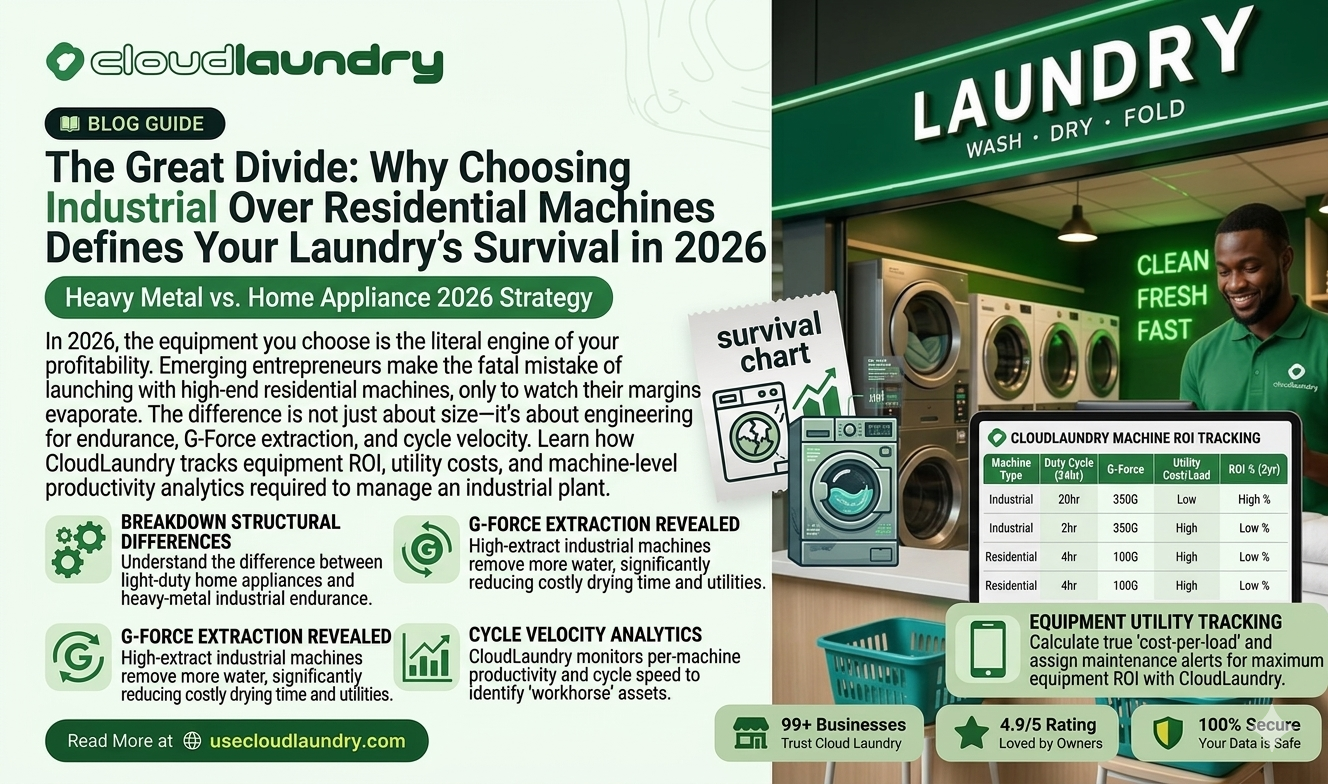
By 2026, the Nigerian laundry market has no room for "Amateur Infrastructure." As energy costs rise following subsidy removals and customer expectations for 24-hour turnarounds become the norm, the hardware you use determines your ceiling. A common trend among new entrants is the “Residential Start” buying three or four high-end home washing machines because they are familiar, easy to source, and have lower upfront costs.
However, residential vs industrial laundry machines 2026 is a comparison of two entirely different philosophies. A residential machine is designed to look good in a kitchen and handle 5 to 7 loads a week. An industrial machine is a piece of "Capital Equipment" designed to run 20 hours a day, 7 days a week, for 15 years. Using a home appliance for a business is like using a family sedan to run a cross-country haulage company it will break, it will be slow, and it will eventually cost you more in repairs than the original purchase price. To manage this high-performance environment, the best tool to manage your laundry business, CloudLaundry, allows you to track "Machine Hours," "Utility Consumption," and "Maintenance Cycles," ensuring that your industrial investment remains a profit-generating asset rather than a depreciating liability.
Structural Integrity and the "Duty Cycle"
The first and most obvious difference is the “Duty Cycle” the amount of work a machine is designed to perform without a cooling-off period or mechanical failure.
The Engineering Gap:
Residential Machines: Built with plastic tubs, belt-driven motors, and light-duty suspension. They are designed for a "Life Expectancy" of roughly 5,000 cycles. In a busy laundry shop, you could hit 5,000 cycles in less than 18 months.
Industrial Machines: Constructed with 304-grade stainless steel tubs, heavy-duty bearings, and "Direct Drive" or high-torque motors. These are built for a life expectancy of 30,000 to 60,000 cycles.
The Business Impact: When a residential machine breaks, it often stays broken because parts are proprietary or hard to find. Industrial machines are modular; a trained technician can swap a bearing or a drain valve in 30 minutes, keeping your "Work-in-Progress" moving through CloudLaundry.
G-Force and the "Extraction" Advantage
In 2026, the biggest cost in a laundry is not the wash it is the dry. Electricity and gas for dryers are expensive. This is where industrial machines pay for themselves.
The Power of the Spin:
G-Force: Residential machines usually spin at low G-forces to protect delicate home plumbing and floors. Industrial "High-Extract" washers spin at up to 350G or 400G.
Moisture Retention: A high-extract industrial machine removes significantly more water from the fabric than a home unit.
The Dry-Time Domino Effect: Because the clothes come out of an industrial washer "near-dry," they spend 30% less time in the dryer. This saves you millions in annual gas/electricity bills and allows you to process more orders per day. CloudLaundry tracks these "Processing Times," showing you exactly how much faster your industrial line is compared to your old residential units.
Cycle Velocity: Time is Money
A residential wash cycle often takes 60 to 90 minutes. This is because home machines use small heating elements and slow-fill valves.
The Industrial Speed:
Rapid Fill and Drain: Industrial machines use large-diameter inlets and gravity-drain valves that can fill or empty a drum in seconds, not minutes.
Dual Heating: Many industrial machines can be connected to external hot water tanks or have high-kilowatt internal heaters, bringing the water to the "Hospital Sanitization" temperatures (as discussed in our previous guide) in a fraction of the time.
The Throughput: You can often complete two full industrial loads in the time it takes to do one residential load. When you are managing B2B contracts (Gyms, Spas, Hotels) via usecloudlaundry.com, this "Throughput" is the difference between meeting a deadline and losing a client.
Utility Efficiency and Chemical Dosing
Home machines are designed for "Water Conservation" in a way that often hinders professional cleaning. They use "Sensor-Fill" technology that might not provide enough water to properly emulsify heavy grease (see our Restaurant guide).
Professional Control:
Custom Wash Profiles: Industrial machines allow you to program the exact water level, temperature, and number of rinses for every fabric type.
Automated Chemical Injection: Most industrial washers have ports for external pumps. CloudLaundry can be used to track the chemical usage of these pumps, ensuring that you aren't wasting expensive detergents through "Manual Over-pouring" by staff.
Volume Efficiency: Washing 20kg in one industrial machine is significantly cheaper in terms of water and soap than washing 5kg in four residential machines.
The "Repair vs. Replace" Paradox
In 2026, the "Right to Repair" is a major economic factor. Residential machines are increasingly “sealed” if a bearing goes, you often have to throw away the whole outer tub assembly.
The Industrial Lifecycle:
Serviceability: Industrial machines are designed to be serviced from the front or back without moving them. Parts like belts, gaskets, and seals are standardized.
Cloud-Based Maintenance: Using CloudLaundry, you can set "Preventative Maintenance" alerts. After 500 hours of operation, the system tells your manager to grease the bearings. This "Proactive" care extends the machine's life to 20 years, whereas a residential machine is usually "e-waste" after 3 years of commercial use.
How CloudLaundry Manages Your Machine Assets
Hardware is the body, but software is the brain. In 2026, you cannot manage a professional plant with "vibes" and paper logs.
As the best tool to manage your laundry business, usecloudlaundry.com provides the "Hardware Intelligence" suite:
- Machine Assignment: You can assign specific orders to specific machines in CloudLaundry. This allows you to see which machine is your "Workhorse" and which is underperforming.
- Productivity Tracking: If Machine #4 is completing 10 loads a day while Machine #1 is only doing 5, the system flags the discrepancy. Is Machine #1 broken? Is the operator slow? CloudLaundry gives you the answer.
- Utility Cost Attribution: By logging the "Cycle Type" in CloudLaundry, you can calculate the "True Cost" of an order. You’ll know exactly how much electricity was used for that 100kg hotel sheet run.
- Downtime Logging: When a machine goes out of service, you mark it in CloudLaundry. This automatically re-adjusts your "Pickup Availability" for customers, preventing you from over-booking your capacity. By using CloudLaundry, you turn your machines into "Data Points" that drive your financial strategy.
The Dryer: The Real Energy Hog
We often focus on washers, but the difference between a residential and industrial dryer is even more stark.
The Airflow Factor:
Axial vs. Radial Airflow: Industrial dryers are engineered for "Airflow Volume." They move massive amounts of hot air through the fabric, lifting and separating items to prevent "bunching."
The "Cool-Down" Cycle: Professional dryers have a timed cool-down phase that prevents "thermal shock" and minimizes wrinkles. This reduces the amount of time your staff spends at the ironing board.
Lint Management: Residential lint filters are small and easily clogged, leading to fire risks. Industrial dryers have large "Lint Drawers" that can handle 10kg of towel fluff without losing efficiency.
Pricing the Depreciation
When you buy an industrial machine for ₦5,000,000, you must account for its "Replacement Cost" in your pricing.
The Capex Math:
Use usecloudlaundry.com to track the "Asset Life." If you know the machine will last 50,000 cycles, you can calculate the "Equipment Cost per Load" (e.g., ₦100).
Add this ₦100 to every order price. This ensures that when the machine finally reaches the end of its life in 15 years, you already have the cash in the bank to buy the next one. Residential machines break so randomly that this kind of financial planning is impossible.
Scaling for the Future: Modular Growth
One of the best things about industrial equipment is that it is designed to be part of a "Battery."
The Professional Layout:
Stackability: Many industrial brands offer "Stack Wash/Dry" units that provide commercial power in a residential footprint. This allows you to increase your capacity in a small shop without moving to a larger, more expensive building.
Consistency: When you have five identical industrial machines, your "Wash Quality" is consistent across every order. With four different brands of home machines, every load is a gamble.
Conclusion: Building for the "Long Run"
In the final analysis of residential vs industrial laundry machines 2026, the choice is between a "Job" and a "Business." If you want a job, buy a residential machine and spend your days fixing it. If you want a business, invest in industrial machinery and spend your days scaling your brand.
Industrial machines are the "Armor" of the modern laundry entrepreneur. They protect your margins, they protect your time, and they protect your reputation for reliability.
Don't let the "sticker shock" of industrial equipment stop you. Harness the ROI-tracking and maintenance power of the best tool to manage your laundry business, usecloudlaundry.com, to justify and manage your infrastructure. Visit CloudLaundry today and see how CloudLaundry can help you turn "Heavy Metal" into "Hard Cash." The machines are ready. Are you?