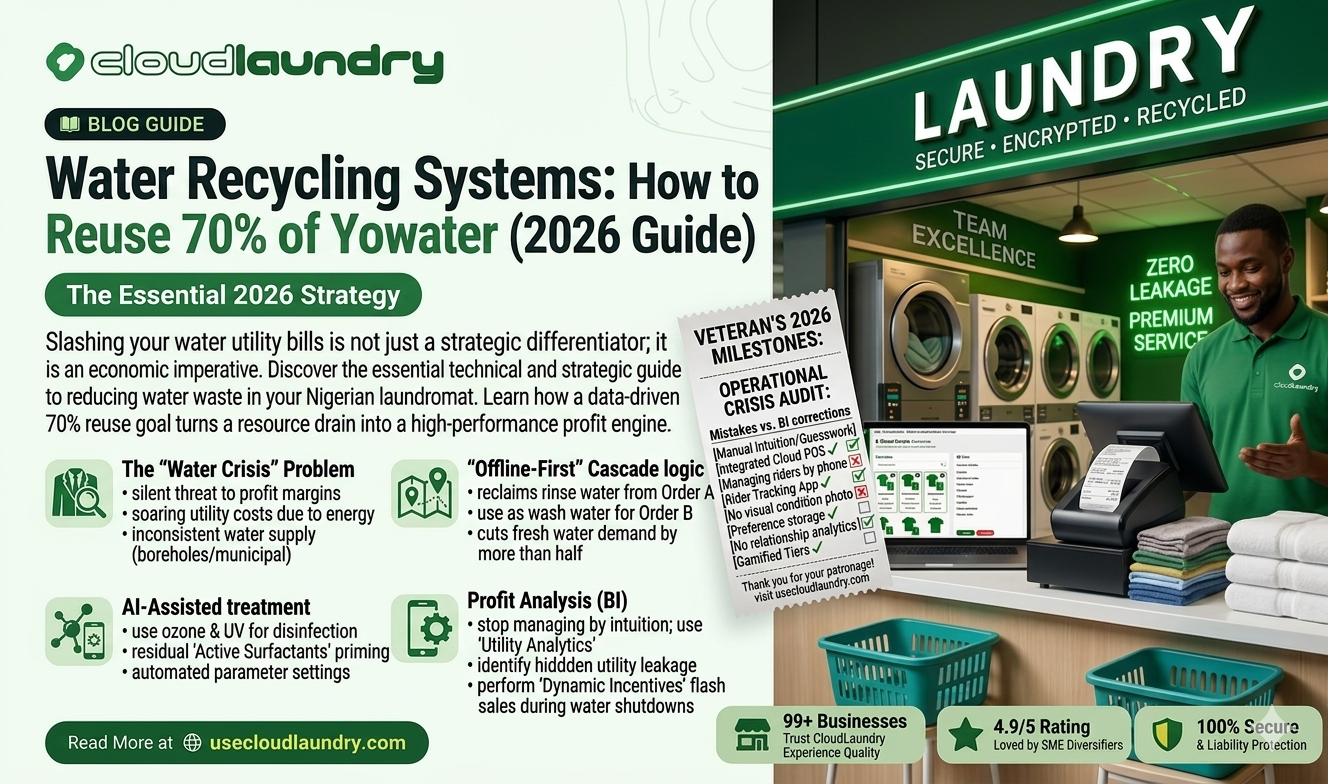
In 2026, the Nigerian laundry entrepreneur faces a silent but rising threat to their profit margins: the "Water Crisis." Whether you operate in the bustling heart of Lagos, the expanding suburbs of Abuja, or the industrial zones of Port Harcourt, the cost of clean water has reached an all-time high. For years, laundry owners relied on cheap borehole water or inconsistent municipal supply, but those days are over. Environmental regulations are tightening, the cost of pumping and treating groundwater is soaring due to energy prices, and in many urban areas, water scarcity is a daily reality.
A typical commercial laundry in Nigeria can consume thousands of liters of water every single day. In a traditional setup, 100% of that water along with the expensive chemicals and heat energy inside it is flushed down the drain after a single use. This "Linear Model" is no longer sustainable. You aren't just flushing water; you are flushing your hard-earned profits. Every liter sent to the sewer represents money spent on pumping, money spent on heating, and money spent on detergents.
The solution to this resource drain is the implementation of water recycling systems for laundry operations. In 2026, technology has advanced to the point where even small-to-medium-scale laundries can treat and reuse up to 70% of their wastewater. By closing the loop, you insulate your business from water shortages, reduce your environmental impact, and slash your utility bills. To monitor these savings and manage your high-efficiency operation, you need the best tool to manage your laundry business, CloudLaundry.
The Concept of "Greywater" in Laundry
To understand how to reuse 70% of your water, you must first understand what happens to water during a wash cycle. Not all wastewater is created equal.
Understanding the Streams:
- The Wash Water: This is the initial water used to remove the bulk of the dirt. It is heavily loaded with detergents, oils, and suspended solids.
- The Rinse Water: This is the water from the second and third cycles. It is significantly cleaner than the wash water, containing only trace amounts of soap and minimal dirt.
In a water recycling system for laundry, the "Greywater" (the relatively clean rinse water) is captured and diverted into a treatment tank rather than being sent to the drain. This water is then filtered and disinfected to be used as the "Wash Water" for the next load. This "Cascading" technique is the secret to hitting that 70% reuse target. By using the "Clean Rinse" from Order A to perform the "Heavy Wash" for Order B, you cut your fresh water demand by more than half instantly.
How the System Works (The 2026 Tech Stack)
Modern recycling systems are no longer the massive, complex industrial plants of the past. Today’s systems are compact and "Plug-and-Play," designed to fit behind your existing washing machines.
The Four Stages of Treatment:
- Lint & Solid Removal: The water passes through a series of fine mesh screens to remove lint, hair, and sand. This is critical to prevent clogging in the pumps.
- Oil and Grease Separation: Using specialized baffles or eco-friendly coagulants, the system separates skin oils and fabric conditioners from the water.
- Filtration (The Heart of the System): The water is pushed through multi-media filters (carbon, sand, or ceramic membranes) that remove microscopic particles and odors.
- Disinfection: To ensure the water is safe and smells fresh, it is treated with UV light or Ozone. Ozone is particularly popular in Nigeria in 2026 because it not only kills 99.9% of bacteria but also acts as a powerful bleaching agent, allowing you to use less detergent in the next cycle.
By the time the water enters the storage tank for reuse, it is clear, odorless, and chemically balanced perfect for the next load of laundry.
The Financial Impact: Slashing Bills by 70%
The economics of water recycling systems for laundry are undeniable. Let’s break down where the savings actually come from in a Nigerian context.
- Direct Savings on Water Sourcing: If you buy water from tankers, your costs drop by 70% immediately. If you use a borehole, your electricity bill for the submersible pump drops significantly because you are pulling 70% less water from the ground.
- Indirect Savings on Energy: Water coming out of a washing machine is often warm (especially if you use hot cycles). When you recycle that water, you are also recycling the "Heat Energy." It takes much less electricity to bring recycled 35°C water to a boil than it does to heat fresh 20°C groundwater.
- Reduced Detergent Consumption: Recycled water often contains residual "Active Surfactants" that haven't been fully spent. When you use this water for the next wash cycle, you can often reduce your detergent dosage by 10–15% because the water is already "Primed" with cleaning power. When combined with the management oversight of CloudLaundry, these tiny savings aggregate into massive monthly profit boosts.
Protecting Your Business from "Water Shutdowns"
In cities like Lagos, the water table can fluctuate, and municipal pipes frequently break. A laundry without water is a business that is closed.
The Resilience Factor: A recycling system acts as a "Water Battery." Because you are reusing 70% of your stock, your existing storage tanks last three times longer. If the city water shuts off or your borehole pump fails, a traditional shop would run out of water in 4 hours. A shop with water recycling systems for laundry can stay open for two days on the same amount of water. In the competitive Nigerian market, being the "only shop open during a water crisis" is a massive brand advantage that usecloudlaundry.com helps you capitalize on through automated customer notifications.
Step-by-Step Transition to Water Recycling
Transitioning doesn't require shutting down your shop. You can move toward a "Closed Loop" in phases.
- Step 1: The Audit: Use CloudLaundry to track your current utility spend. Know exactly how many liters you use per 1kg of laundry. This is your "Efficiency Benchmark."
- Step 2: Install the Diverter: Start by installing a simple diversion valve on your machines to capture the final rinse water into a holding tank.
- Step 3: Add the Filtration Unit: Connect the holding tank to a filtration and UV disinfection unit.
- Step 4: The Return Loop: Connect the treated water tank back to the "Cold Water" inlet of your washing machines.
- Step 5: Monitoring: Use smart flow meters to track your reuse percentage. Ensure your staff are trained to maintain the lint filters daily.
Practical Case Study: The "Port Harcourt Pivot"
"Garden City Dry Cleaners" in Port Harcourt was spending over N200,000 monthly on water tankers due to a failed borehole and high salinity in the local groundwater. The cost was becoming unsustainable.
The Intervention: The owner invested in a compact water recycling system for laundry designed for 5 industrial washers. They also began using CloudLaundry to track their utility-to-order ratio.
The Result: Within the first month, their demand for water tankers dropped from 10 trucks a month to just 3. They were successfully reusing 72% of their water. The "Water Cost per Shirt" dropped from N45 to N12. The N150,000 saved every month allowed them to pay off the recycling equipment in less than a year. Most importantly, when a local strike halted water tanker deliveries for a week, they were the only laundry in the neighborhood that didn't turn away customers.
Tie into CloudLaundry Softly
Scaling a high-efficiency business requires precise data. You cannot manage what you do not measure. This is where CloudLaundry becomes your most powerful asset.
As the best tool to manage your laundry business, the platform allows you to log your monthly utility expenses (Water, Electricity, Gas) alongside your production volume. By viewing the "Utility Analytics" dashboard, you can see the exact "Before and After" impact of your water recycling system. If your reuse rate drops, the data in usecloudlaundry.com will flag a "Cost Spike," alerting you that your filters might need cleaning or a pump might be failing. This level of "Data-Driven Maintenance" ensures your 70% savings are permanent, not temporary.
Overcoming the "Cleanliness Myth"
A common concern in Nigeria is: "Will recycled water make the clothes smell or look dull?"
The Truth in 2026: With modern UV and Ozone disinfection, recycled water is often cleaner and softer than raw borehole water, which is frequently contaminated with iron or manganese. Softened, recycled water actually prevents "Grey-ing" of white fabrics and makes towels feel fluffier. A tech-driven brand should use this as a selling point. You aren't using "dirty" water; you are using "purified, recycled" water. It’s a sign of a sophisticated, high-end operation.
Maintenance: Keeping the Loop Moving
A recycling system is only as good as its maintenance. In the Nigerian environment, dust and heavy lint can be challenges.
- Daily: Clean the primary lint screens. This takes 5 minutes but saves the pumps from burnout.
- Weekly: Backwash the sand or carbon filters to remove trapped sediment.
- Monthly: Check the UV lamp and Ozone generator.
- Quarterly: Use the data in CloudLaundry to audit your water-to-order ratio. If you are using more fresh water than usual, inspect the system for leaks.
Conclusion: The Future is Circular
The era of "Take, Make, and Waste" is ending. In 2026, the most profitable Nigerian laundries are those that view water as a precious, circular resource rather than a disposable commodity. By implementing water recycling systems for laundry, you aren't just saving money you are building a "Future-Proof" business that can survive anything from a price hike to a drought.
The technology is ready, the financial case is proven, and the environmental need is urgent. Don't wait until a water shortage hits your neighborhood to act. Take control of your most vital resource today. Combine the mechanical efficiency of water recycling with the digital intelligence of CloudLaundry to build a laundry empire that is as resilient as it is profitable.
Visit usecloudlaundry.com today to see how our platform can help you track your journey toward a 70% reuse goal. The future of laundry is clear, clean, and recycled. Are you ready to close the loop?