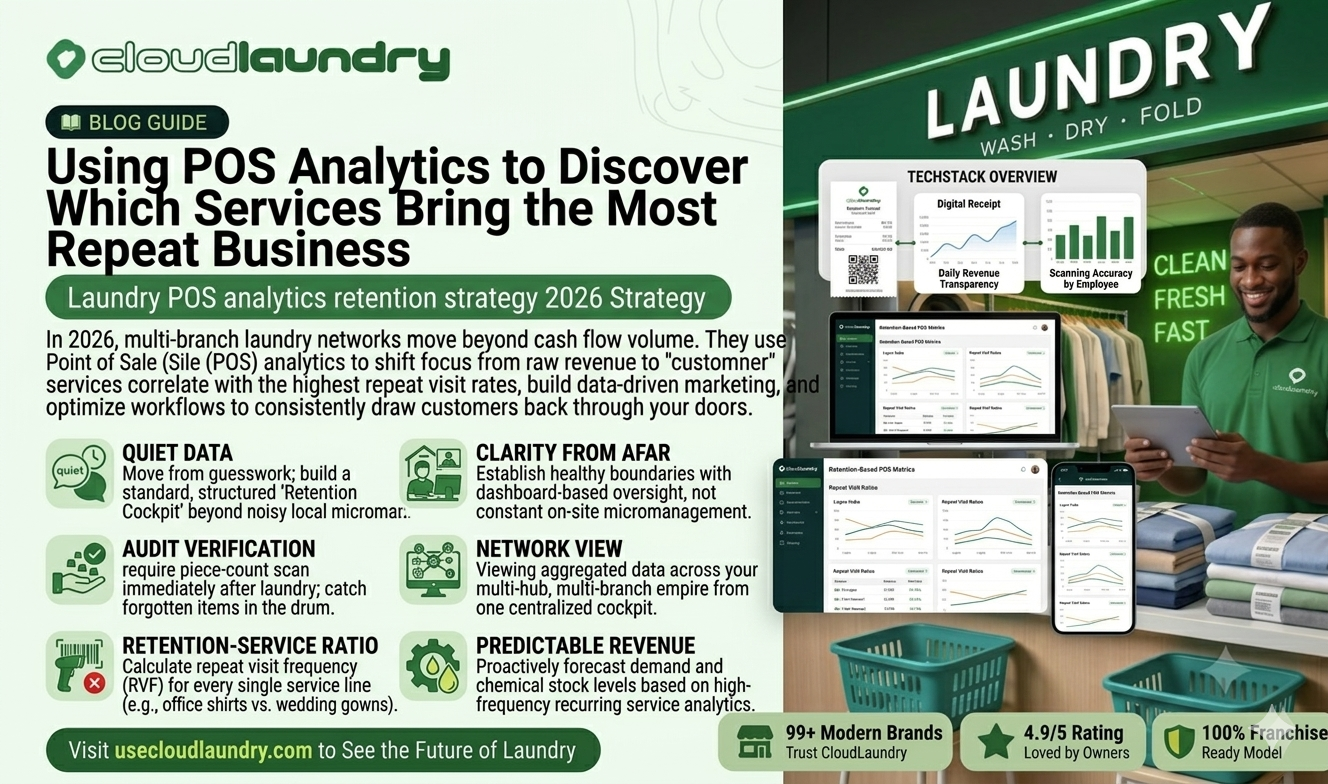
It is a common temptation to focus exclusively on high-ticket, high-margin services like wedding gown cleaning or specialized curtain care. While these services contribute significantly to your monthly top-line revenue, they are rarely the drivers of daily, weekly, or monthly repeat business. If you ignore the “anchor services” those routine chores that force a customer into a consistent, recurring habit you are leaving your retention rate to chance.
Laundry POS analytics retention strategy 2026 is the practice of uncovering the "Retention Drivers" in your laundry business. By diving into the data collected by your CloudLaundry point of sale, you can map the specific services that lead to second, third, and tenth visits. When you know which services act as the "hook" for your clients, you can design your marketing, your staffing, and your shop layout to highlight those offerings, turning your laundry into an essential, habit-forming utility rather than an occasional stop.
Defining the "Retention-Service" Ratio
Not all transactions are equal in their ability to build habits. To understand your business, you must categorize your services into two groups: "Transaction Services" and "Retention Services."
Categorization Logic:
Transaction Services: These are high-value, low-frequency tasks (e.g., blanket cleaning, curtain pressing, heavy-duty dry cleaning). They provide cash flow but do not foster a regular schedule.
Retention Services: These are essential, high-frequency tasks (e.g., office shirt laundering, daily wash-and-fold, school uniform maintenance). They are the "sticky" services that force a customer to interact with your brand on a consistent cycle.
The Analytics Metric: Use CloudLaundry to calculate the "Repeat Visit Ratio" for each service. Divide the number of customers who have used a service more than three times by the total number of customers who have used that service once. The results will surprise you.
Using CloudLaundry to Extract Behavioral Insights
The raw data in your POS is useless without a framework to interpret it. Your goal is to move from "what happened today" to "what drives tomorrow’s traffic."
Analytical Framework:
Cohort Analysis: Track groups of customers who first came in for a specific service. Did the "Wash-and-Fold" cohort return within 14 days? Did the "Dry Cleaning" cohort take 60 days to return? This tells you exactly which service is the better "Customer Acquisition" tool.
Service Sequencing: Analyze the sequence of orders. Do customers who start with dry cleaning eventually transition to wash-and-fold? Knowing the natural "customer journey" allows you to build a roadmap that nudges them toward your most frequent service.
Branch-Level Variance: Compare the retention performance of services across your different branches. You may find that a service which drives high retention in a residential neighborhood performs poorly in a corporate district, allowing you to tailor your local offerings.
The Role of Retention-Based Marketing
Once your POS data identifies your retention drivers, you should realign your marketing budget to emphasize these services, rather than focusing on the high-margin, low-frequency tasks.
Realigning Your Focus:
The "Lead-Magnet" Service: If your data shows that customers who come in for "Office Shirt Ironing" are 4x more likely to return within a week, that service is your lead magnet. Stop advertising your wedding gown service as your primary hook and start marketing your professional shirt care.
Cross-Selling at the POS: When a customer comes in for a "Transaction Service," use the POS as an opportunity to present your "Retention Service." "Since you’re here for your heavy blankets, would you like to drop off your weekly wash-and-fold bundle to save time later this week?"
Incentivizing the Habit: Offer a "Subscription discount" or a "Loyalty Bundle" for your retention services. By making your most frequent services more affordable, you encourage a deep, long-term commitment from the client.
Optimizing Production for Frequency
High-frequency services require a different production approach than specialized services. Your POS data helps you understand where to invest in your production capacity.
Operational Strategy:
Production Speed vs. Precision: Retention services must be fast and reliable. Use the insights from CloudLaundry to identify which services require the most throughput. If you know that "Weekly Wash-and-Fold" is your retention champion, invest in faster machines and optimized workflows for that specific service.
Inventory Forecasting: High-frequency services consume more detergents and packaging materials. Use your POS-based demand forecasting to maintain the correct stock levels, ensuring you never have to turn away a customer due to a supply shortage.
Staff Specialization: If your retention is driven by a specific service, train a dedicated "Retention Team" that is highly efficient at handling that service. This specialization will boost your turn-around times, which in turn reinforces customer loyalty.
Mitigating the Risk of Service Drift
Sometimes, a service that used to drive retention starts to underperform. POS analytics acts as your early-warning system.
The Alerting Protocol:
Monitoring the Decline: Configure CloudLaundry to track the "Average Days Between Orders" for your retention services. If this number begins to creep up, it’s a red flag.
Probing the Cause: If a service's repeat rate drops, investigate immediately. Is the quality slipping? Are competitors offering a better price? POS data gives you the "what" and "when," prompting you to investigate the "why."
Agility in Pricing: Use your analytics to test price sensitivity for your high-retention services. Small, calculated price adjustments can sometimes significantly affect repeat frequency, and the POS will track exactly how your customers react.
Designing a Loyalty Program Based on Data
Most laundry loyalty programs are generic. Use your POS analytics to build a program that actually rewards the behavior you want to drive: repeat, high-frequency visits.
Data-Backed Loyalty:
Frequency Rewards: Instead of rewarding total spend, reward the number of visits. This encourages customers to drop off smaller, more frequent loads—exactly the type of behavior that creates a habit.
"Service Milestone" Rewards: Use the POS to track when a customer hits a milestone, such as their 10th shirt-pressing order. Send them a personalized voucher for that specific service, cementing their commitment to that routine.
Tiered Membership: Offer a "VIP Membership" that grants a discount on your retention services, effectively turning your most frequent customers into "subscribers" who have no reason to look elsewhere.
Connecting Frequency to Lifetime Value (CLV)
Retention services are not just about daily visits; they are the fundamental components of your customer’s long-term lifetime value.
The CLV Link:
Calculating the Impact: Compare the total lifetime spend of a "Retention-Service" user vs. a "Transaction-Service" user. You will likely find that the Retention-Service user provides a significantly higher CLV over a 12-month period.
Focusing on the High-Value Asset: Your POS analytics will show you which customers are your most loyal. Use this to prioritize your resources, focusing your best branch staff and your premium service quality on these high-frequency clients.
Strategic Growth: Once you know the services that build the highest CLV, you can focus your entire business expansion model on finding more customers who share those behavioral characteristics.
Scaling Your Analytics Nationally
As your brand grows into a national player, your POS analytics must provide a consistent view across all your branches, allowing you to replicate your retention-service success in every new city.
The National Analytical Standard:
Benchmarking Retention: Compare the service-repeat rates across different cities. Does a service that works in Lagos also drive retention in Kano? Use these insights to optimize your national marketing strategy.
Standardizing the Service Mix: Your national brand should be famous for the services that drive your retention. Use your POS data to determine which core service-set every single branch in the country should offer.
Centralized Reporting: CloudLaundry gives you a bird's-eye view of your national analytics, allowing you to manage your entire network as one unified, high-performing retention engine.
Handling the "New Service" Experiment
When you launch a new laundry service, you need to know immediately if it is a "Retention Driver" or just a "Transaction Distraction."
The Launch Protocol:
Baseline Benchmarking: Use the POS to track the repeat rate of the new service from day one. Compare it against your baseline retention services.
Iterative Marketing: If a new service shows potential for high retention, double down on your marketing and focus on building the customer habit.
Failing Fast: If the POS data shows the new service is a one-off hit with no repeat behavior, do not waste your marketing budget. Pivot to something else.
Conclusion: Data-Driven Loyalty
In the final analysis of laundry POS analytics retention strategy 2026, the key to success is to stop guessing what keeps your customers coming back and start measuring it. When you focus your operations on the services that build habits, you transform your business from a volatile shop-front into a stable, profitable network.
The power of your point-of-sale data is fully realized through the analytics, reporting, and customer insights of the best tool to manage your laundry business, usecloudlaundry.com. You gain the clarity to make better decisions, the distance to think strategically, and the intelligence to build a service model that your customers can't live without.
Don't let your business growth be fueled by guesswork. Harness the power of POS analytics to identify, nurture, and grow the services that truly drive repeat business. Visit CloudLaundry today and turn your transaction data into your competitive advantage. Your empire is growing; keep your focus on the services that keep your customers coming back.
