By 2026, the distinction between "Retail" and "Commercial" laundry in Nigeria has become a canyon of differing strategies. While retail pricing is built on high margins per piece and personal customer service, B2B pricing is built on "Velocity" and "Utilization." Many laundry owners struggle with the concept of volume discounts, fearing that lowering their per-unit price is a "race to the bottom." In reality, in the 2026 landscape, a well-structured volume discount is the only way to secure the long-term, high-tonnage contracts that allow a business to scale.
B2B laundry pricing volume discounts 2026 is not an act of desperation; it is an act of "Operational Optimization." When you secure a contract for a gym, a hotel, or a restaurant (as discussed in our previous guides), you are not just buying "work"; you are buying "Efficiency." A machine that runs at 100% capacity with one type of fabric is significantly more profitable than a machine that runs at 40% capacity with twenty different garment types. To manage these complex, multi-tiered price lists without manual errors, the best tool to manage your laundry business, CloudLaundry, serves as your financial architect. It allows you to build automated, tiered pricing structures that reward your largest clients while protecting your core margins.
The "Fixed Cost" Fallacy
The primary reason owners resist volume discounts is that they apply "Retail Math" to "Commercial Reality." If it costs ₦200 in chemicals and electricity to wash a shirt, they believe they must charge ₦800 to make a profit, regardless of whether it is one shirt or a thousand.
The Reality of Industrial Scale:
Fixed vs. Variable Costs: Your rent, your manager’s salary, and your CloudLaundry subscription are "Fixed Costs." They stay the same whether you wash 10 items or 10,000.
The "Marginal Profit" Concept: Once your fixed costs are covered by your retail base, every additional B2B item only incurs "Variable Costs" (chemicals, water, electricity, and a fraction of labor).
The Goal: B2B volume allows you to "spread" your fixed costs over a much larger number of units, effectively lowering your total cost per item. This is why you can afford to give a 30% discount to a hotel and still make more total profit at the end of the month than you would from ten retail customers.
Why Discounts are "Non-Negotiable" for the Client
In 2026, every procurement officer at a hospital or spa is being pressured to cut costs. They are not looking for a "vendor"; they are looking for a "Solution" that fits their budget.
The Client's Perspective:
Predictability: A volume discount usually comes with a contract. The client wants to know that if they send more work, their unit cost goes down. This "Cost Certainty" allows them to price their own hotel rooms or gym memberships.
The "Hassle" Premium: By giving you their entire volume, the client is saving you the cost of marketing to 500 individual people. They know this, and they expect to be "paid" for that marketing saving in the form of a discount.
The Loyalty Incentive: A volume discount is a "Golden Handcuff." If a competitor tries to steal your hotel client, the client will look at their current "Tier 3" discount with you and realize the competitor would have to offer an impossible price to beat the "Volume Benefit" they already enjoy.
The Three Types of Volume Discounts
Not all discounts are created equal. In 2026, you must use the right "Pricing Lever" for the right client.
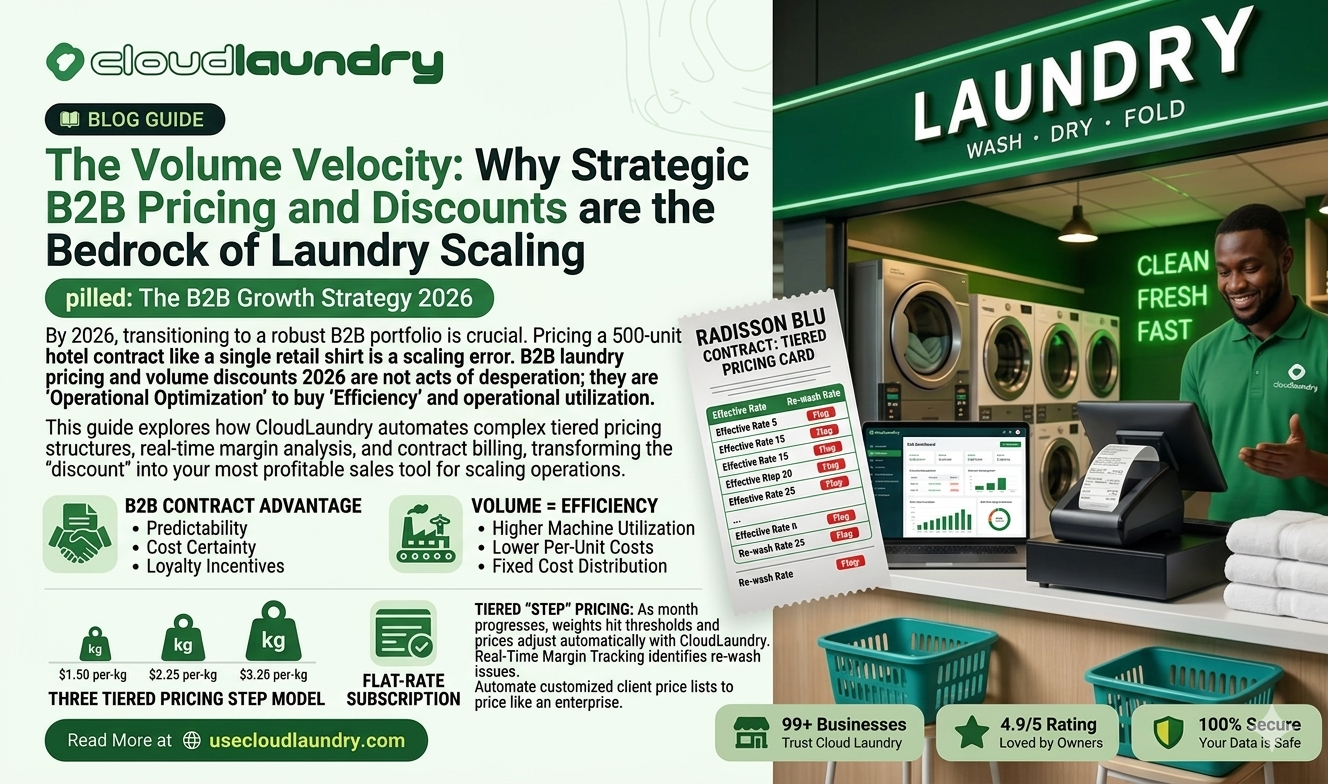
1. The Tiered "Step" Discount: The more they wash, the less they pay.
0–500kg per month: ₦1,200/kg
501–1,000kg per month: ₦1,000/kg
1,001kg+ per month: ₦850/kg CloudLaundry automates this. As the month progresses and the "Weight Log" hits a new threshold, the system automatically adjusts the price on the next invoice.
2. The "Flat-Rate" Subscription: Best for gyms and small spas. They pay ₦150,000 a month for "up to" a certain volume. This provides "Zero-Friction" billing and guaranteed cash flow for the laundry.
3. The "Service-Based" Discount: You offer a discount not because of the amount of clothes, but because of the type of clothes. For example, a restaurant that only sends polyester napkins (easy to wash/dry) gets a better rate than one sending silk-blend tablecloths.
Calculating Your "Floor Price"
Before you offer a discount, you must know your "Point of No Return." This is the price below which you are actually losing money with every wash.
The "Floor" Audit:
Energy Audit: How much fuel does your boiler/generator use for a 25kg load?
Chemical Audit: What is the exact cost of the "Restaurant Grease" chemical stack (as discussed in our previous guide)?
Labor Audit: How many "Man-Hours" does it take to fold 100 hotel sheets? Once you have this "Hard Cost," add a 15–20% "Safety Margin." This is your Floor Price. Never go below this, no matter how big the contract is. CloudLaundry helps here by providing "Cost-per-Order" analytics, ensuring you stay in the green.
How CloudLaundry Manages B2B Pricing Complexity
Managing five different B2B clients with five different discount structures on a spreadsheet is a recipe for a financial meltdown. In 2026, manual billing is an "operational risk."
As the best tool to manage your laundry business, usecloudlaundry.com provides the "B2B Financial Engine":
- Custom Price Lists per Client: Within CloudLaundry, you can assign a unique "Rate Card" to every B2B account. When the driver scans a bag for "Radisson Blu," the system applies their specific contract prices instantly.
- Automated Threshold Alerts: The system can notify you when a client is approaching a new discount tier. This is a powerful "Sales Tool." You can call the client and say: "You are only 20kg away from the Tier 2 discount. Send us your staff uniforms this week and you'll save 15% on the whole month!"
- Real-Time Margin Tracking: CloudLaundry tracks the "Effective Rate" you are getting after discounts. If a client’s re-wash rate is too high (eating into your discount margin), the system flags it so you can renegotiate.
- Bulk Invoicing and Reconciliation: It aggregates 30 days of pickups into one click. No more "Missing Invoice" disputes. The CloudLaundry portal provides the client with a transparent record of every gram of laundry they paid for. By using CloudLaundry, you remove the "Human Error" from B2B commerce. You act like an enterprise-level corporation, which is exactly what big B2B clients want to see.
The "Utilization" Bonus: Pricing for Efficiency
You can offer deeper discounts to clients who help you run your business more efficiently.
The "Operational" Discount:
Off-Peak Pickups: Offer an extra 5% discount if the hotel allows you to pick up at 11 PM instead of 8 AM. This keeps your machines running during the "Night Shift."
"Fold-Only" Service: If a spa wants to save money, they can choose a "No-Iron" discount. You wash and dry, they handle the presentation.
Direct-to-Plant Delivery: If the client has their own van and drops the laundry at your factory, you pass the "Logistics Saving" back to them.
Negotiating the "Annual Increase" Clause
Inflation in the 2026 Nigerian economy is a reality. A volume discount that looks good in January might be a loss-maker by December if fuel prices double.
The "Inflation-Proof" Contract: Never sign a B2B contract with a "Fixed Price" for 12 months. Your volume discount must be tied to an "Escalator Clause."
Fuel Indexing: "If the price of Diesel/Petrol increases by more than 15%, the B2B rate card will be adjusted by 5%."
Standard Annual Review: Use usecloudlaundry.com data to conduct a "Quarterly Business Review" (QBR) with your B2B clients. Show them the volume they’ve achieved and discuss how the pricing reflects current market costs.
The Danger of "The One Big Client"
While volume is great, relying on one massive B2B contract for 80% of your revenue is dangerous. If they leave, your business collapses.
The "Portfolio" Balance:
The 30% Rule: No single B2B client should represent more than 30% of your total revenue.
Diversify the Tiers: Use CloudLaundry to track your "Revenue Mix." You want a healthy blend of high-margin retail, steady-margin gyms/spas, and high-volume/lower-margin hotels. This balance ensures that your "Fixed Costs" are always covered, while your "Growth" is driven by the volume tiers.
Using Discounts to Win Tenders
When you bid for a government or corporate tender in 2026, the "Volume Discount" section of your proposal is the most scrutinized.
The "Winning" Bid Structure:
Don't just give a single price. Show them a "Value Roadmap."
"At 5,000 units, your price is X. At 10,000 units, we invest in a dedicated delivery van for you and the price becomes Y." This shows the client that you are a "Growth Partner." You aren't just selling a discount; you are selling a "Scalable Future." Use the professional reporting from CloudLaundry to back up your claims of efficiency and reliability.
Conclusion: Pricing for the Long Haul
In the final analysis of B2B laundry pricing volume discounts 2026, a discount is not a “loss” it is an "Investment in Stability."
By strategically lowering your per-unit price in exchange for massive, predictable volume, you create a "Moat" around your business. You allow your machines to reach their full "Earning Potential," and you build relationships with institutions that will sustain your brand for decades.
Don't let the fear of "lower prices" stop you from winning big. Harness the financial and B2B automation power of the best tool to manage your laundry business, usecloudlaundry.com, to build a tiered pricing strategy that wins contracts and protects your profits. Visit CloudLaundry today and see how CloudLaundry can help you master the "Math of the Market." The volume is out there; make sure your price is the one that captures it.