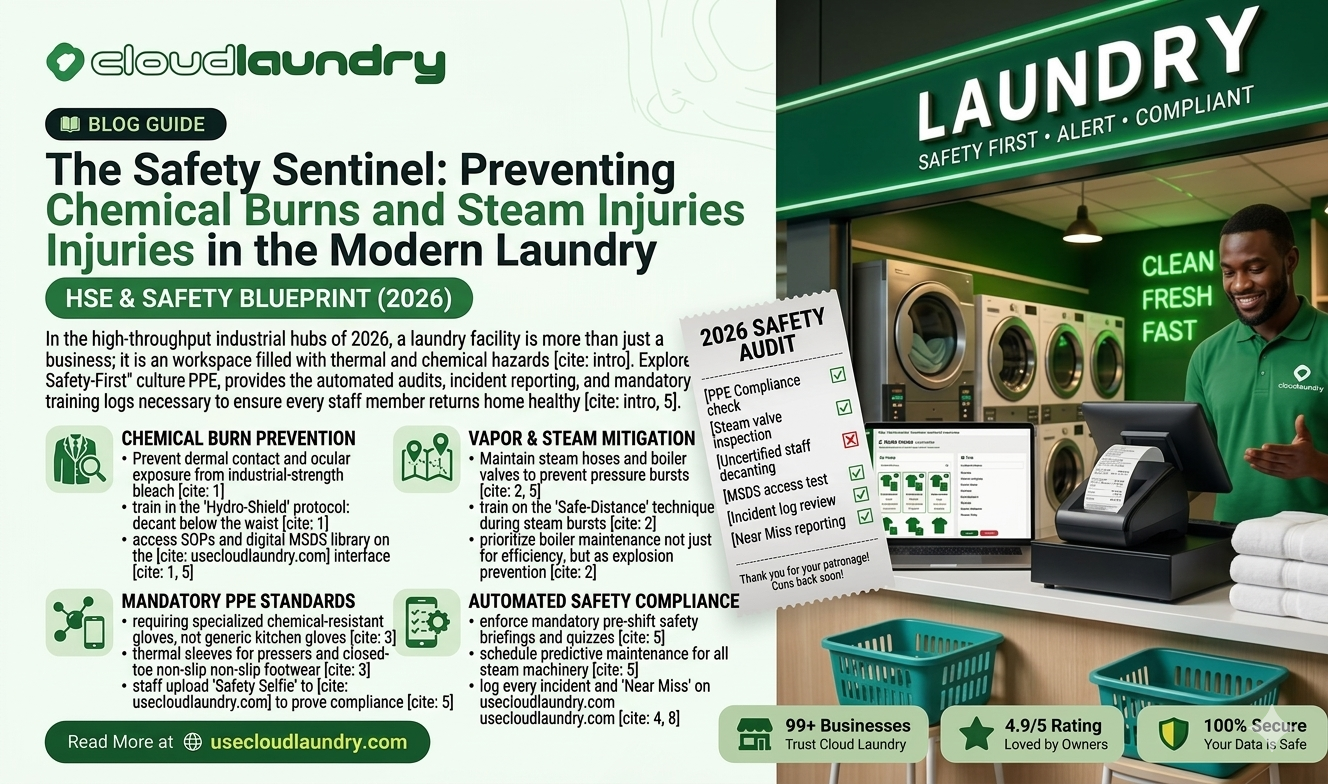
By 2026, the laundry industry in Nigeria has scaled significantly, moving from small manual operations to high-throughput industrial hubs. With this growth comes an increase in the concentration of chemicals and the power of steam machinery. In the rush to meet "Next-Day Delivery" deadlines, safety is often the first casualty. However, in the modern economy, a "Safety-Second" mindset is a catastrophic business risk.
Laundry safety training chemical steam injuries 2026 is not a luxury; it is an operational mandate. The chemicals used to achieve that “perfect white” from industrial-strength bleaches to specialized solvents are highly corrosive. Simultaneously, the steam generated for pressing is often at temperatures exceeding 150°C, capable of causing third-degree burns in a fraction of a second. To manage these risks without slowing down production, the best tool to manage your laundry business, CloudLaundry, integrates safety protocols directly into the digital workflow. It ensures that safety isn't just a poster on the wall, but a mandatory step in every staff member’s daily digital task list.
The Chemistry of Danger: Preventing Chemical Burns
Modern stain removal and whitening require a cocktail of alkaline builders, surfactants, and oxidizing agents. When handled correctly, they are miracles of science; when mishandled, they are weapons.
The Three Routes of Chemical Injury:
Dermal (Skin) Contact: Many laundry detergents are highly alkaline. Prolonged exposure or a sudden splash of concentrated bleach can eat through skin layers before the worker even feels the "sting."
Ocular (Eye) Exposure: A single droplet of a solvent like Perchloroethylene or a concentrated surfactant can cause permanent blindness.
Inhalation: Mixing certain chemicals (like bleach and ammonia-based cleaners) creates toxic chlorine gas, which can be fatal in enclosed facility spaces.
The "Hydro-Shield" Protocol: Staff must be trained in the "Decanting Standard." Never pour chemicals at chest height. Always pour below the waist to prevent splashes to the face. Every chemical station must have a "SOP" (Standard Operating Procedure) visible on the CloudLaundry interface, reminding the worker of the specific hazards of that substance.
Mastering the Vapor: Steam Injury Prevention
Steam is an invisible killer. Unlike a hot stove, which radiates heat you can feel from a distance, a steam leak or a misdirected iron burst can strike without warning.
The High-Pressure Hazard Zone:
The "Iron Kickback": If a steam iron’s hoses are not properly maintained, a sudden pressure surge can cause the hose to "whip," spraying scalding water and steam on the operator's arms.
Vacuum Table Burns: If the vacuum suction on a pressing table fails, the steam used to press the garment has nowhere to go but "up" into the face of the presser.
The Boiler Room: This is the heart of the facility. In 2026, boiler maintenance is not just about efficiency; it’s about preventing a pressure-vessel explosion.
The "Safe-Distance" Technique: Staff must be trained to keep their faces at least 18 inches away from the pressing board during a steam burst. They must also be taught the "Hand-Check" for hoses never touching a steam hose with a bare hand to check for leaks, but using a specialized heat-detection tool or a visual steam-wand.
PPE: The Employee’s Last Line of Defense
Personal Protective Equipment (PPE) is not a suggestion; in 2026, it is a condition of employment.
The Essential Safety Kit:
Chemical-Resistant Gloves: Not generic kitchen gloves, but nitrile or neoprene gloves that can withstand industrial pH levels.
Splash-Proof Goggles: Full-seal goggles are mandatory during the "Mixing Phase" of the wash cycle.
Thermal Sleeves: For pressers, lightweight, heat-resistant sleeves protect the forearms from accidental contact with the edges of the iron or the hot-head press.
Closed-Toe Non-Slip Footwear: To prevent slips on wet floors and to protect feet from chemical spills or falling heavy irons.
The "Emergency First-Aid" Response
If an accident happens, the first 60 seconds determine the severity of the long-term damage.
The Response Curriculum:
Chemical Splashes: "Flush, Flush, Flush." Every facility must have a dedicated eye-wash station and a deluge shower. Staff must be trained to flush the affected area with cool water for a minimum of 15 minutes.
Steam Burns: Immediately remove the heat source and run cool (not ice-cold) water over the burn. Never apply "home remedies" like butter or toothpaste, which can trap heat and worsen the injury.
The "Incident Log": Every injury, no matter how small, must be logged in usecloudlaundry.com. This allows management to track "Hazard Hotspots" and prevent a minor burn today from becoming a major injury tomorrow.
How CloudLaundry Automates Safety Compliance
Safety training is notoriously difficult to enforce because it feels like "extra work." In 2026, the solution is to make safety "part of the work."
As the best tool to manage your laundry business, usecloudlaundry.com provides the "Safety Guardrails" for your facility:
- Mandatory Safety Briefings: Before a staff member can "Clock-In" on the CloudLaundry app, the system can prompt them with a 15-second "Safety Tip of the Day" or a 1-question quiz on chemical handling.
- Maintenance Scheduling: CloudLaundry tracks the "Service Life" of your steam hoses and boiler valves. The system sends an automated alert when it's time for an inspection, preventing equipment-failure injuries before they happen.
- PPE Compliance Photos: You can require staff to upload a "Safety Selfie" to usecloudlaundry.com at the start of their shift, proving they are wearing their goggles and gloves. This creates a culture of accountability.
- Digital MSDS Library: Instead of a dusty binder in the corner, every chemical’s "Material Safety Data Sheet" (MSDS) is stored in the CloudLaundry cloud. If a spill occurs, a worker can instantly access the "Emergency Response" steps on their tablet. By using CloudLaundry, you move from "Passive Safety" to "Active Protection." You show your team that you value their life as much as your profit. CloudLaundry makes compliance effortless and tracking absolute.
Standardizing the "Mixing Station"
The area where chemicals are measured and combined is the most dangerous part of the shop.
The "Safe-Zone" Design:
Ventilation: In 2026, every mixing station must have high-velocity exhaust fans to remove chemical fumes.
Spill Containment: The station should be built with a "lip" or "bund" to contain any accidental spills, preventing them from spreading across the floor.
Color-Coding: Standardizing buckets and measuring cups (e.g., Red for acids, Blue for alkalines) prevents accidental mixing of incompatible substances.
Training for the "Invisible Leak"
Steam leaks can be so high-pressure that they are invisible to the naked eye, yet sharp enough to cut through skin like a knife.
The "Broom Test": Train your maintenance staff to never walk toward a suspected steam leak. Instead, they should pass a broom in front of them. If the broom bristles are suddenly cut or melted, they have found the leak at a safe distance. This "Low-Tech" trick, combined with the "High-Tech" monitoring of CloudLaundry, creates a multi-layered safety net.
The "Safety Committee" and Staff Ownership
Safety shouldn't be "Top-Down" only. Your staff on the floor see the hazards before you do.
The Peer-Review Model: Every month, appoint a different staff member as the "Safety Warden." Their job is to perform a daily 5-minute walk-through and log any "Near Misses" into usecloudlaundry.com.
The "Near Miss" Culture: Reward staff for reporting a "Near Miss" (e.g., "I almost tripped over this loose steam hose"). This allows you to fix the problem before an injury occurs. If you punish "Near Misses," staff will hide them, and an accident becomes inevitable.
Signage and Visual Cues in 2026
In a multi-lingual and high-speed environment, visual symbols are more effective than long paragraphs of text.
The Universal Safety Language:
High-Heat Zones: Use bright yellow-and-black floor tape around steam presses. This is a "No-Distraction Zone" where other staff are forbidden from talking to the presser while the machine is engaged.
Digital Warnings: In CloudLaundry, use high-contrast red alerts for orders requiring hazardous chemicals (like heavy-duty degreasers). This forces the worker to "Pause and Think" before proceeding.
Conclusion: The Moral and Financial Imperative
In the final analysis of laundry safety training chemical steam injuries 2026, safety is the ultimate expression of professional leadership. A business that burns its employees is a business that burns its future.
The financial cost of an injury medical bills, lost productivity, lawsuits, and the cost of hiring and training a replacement is ten times higher than the cost of high-quality PPE and training. But more importantly, the moral cost of a preventable injury is something no brand can afford.
Protect your people, and they will protect your brand. Harness the organizational power of the best tool to manage your laundry business, usecloudlaundry.com, to build a facility where excellence and safety go hand-in-hand. Visit CloudLaundry today and see how CloudLaundry can help you automate your safety logs and protect your team. Because a clean shirt is never worth a scarred hand.
