In 2026, the Nigerian laundry industry is facing a massive environmental and logistical reckoning. For decades, the standard operating procedure involved purchasing massive 25-liter plastic kegs of liquid detergent or heavy 50kg plastic bags of powdered soap. While effective at cleaning, these traditional formats carry a hidden "tax" that is increasingly difficult for modern business owners to ignore: the astronomical cost of storage, the physical toll of moving heavy containers, and the mounting pressure of plastic waste management in urban centers like Lagos and Abuja.
Walk into almost any traditional dry cleaning plant in Nigeria today, and you will see “Plastic Graveyards” piles of empty yellow and blue kegs taking up valuable square footage that could be used for extra ironing stations or garment racks. Furthermore, liquid detergents are primarily composed of up to 90% water, meaning laundry owners are essentially paying high shipping costs to transport water from a factory to their shop. In an economy where every square meter of rent and every liter of fuel for delivery counts, this "water-heavy, plastic-heavy" model is becoming obsolete.
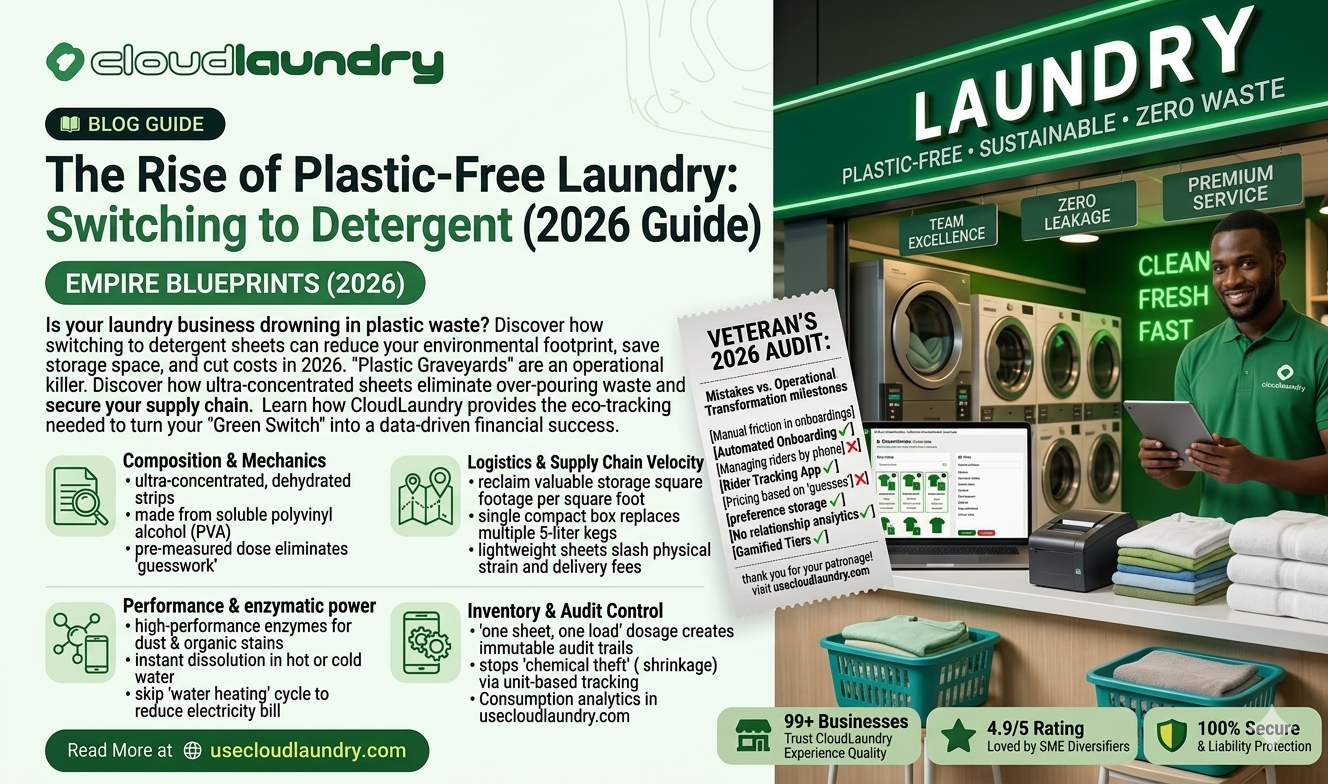
The solution is the rise of plastic-free laundry detergent sheets. These ultra-concentrated, dehydrated strips of cleaning power are disrupting the industry by offering a zero-waste, space-saving alternative that cleans just as effectively as the old-school chemicals. By switching to sheets, you aren't just “going green” you are optimizing your entire supply chain for the 2026 economy. To manage this transition and track your supply efficiency, you need the best tool to manage your laundry business, CloudLaundry.
What Exactly Are Detergent Sheets?
Detergent sheets represent the ultimate evolution of laundry chemistry. Imagine all the active cleaning agents in a cup of liquid detergent—the surfactants, enzymes, and fragrances—dehydrated and compressed into a thin, biodegradable paper-like strip.
The Mechanics:
- Composition: Usually made from a resin like polyvinyl alcohol (PVA), which is completely water-soluble and non-toxic.
- Dissolvability: They dissolve instantly in both hot and cold water, leaving zero residue on clothes or inside the drum of your high-end industrial washers.
- Concentration: One small sheet (often the size of a business card) is precisely measured for one standard 7kg load.
For the Nigerian laundry owner, this removes the "Guesswork" and "Over-Pouring" that leads to chemical waste. In a manual shop, staff often pour "a little extra" soap to be safe, which actually damages fabric fibers and wastes money. With sheets, the dose is pre-set, ensuring perfect consistency across every branch.
The Economic Advantage of Weight and Space
The primary reason to switch to plastic-free laundry detergent sheets in 2026 isn't just the environment; it’s the bottom line.
- Storage Optimization: A single box of 100 detergent sheets is roughly the size of a small book. To get the same number of washes from liquid detergent, you would need multiple 5-liter kegs. In many Nigerian shops where rent is calculated per square foot, reclaiming the "Detergent Corner" allows for better workflow and more garment storage. You can store a year’s worth of detergent in a single kitchen cabinet, whereas liquid or powder would require an entire storeroom.
- Logistics and Shipping: Because sheets are lightweight and contain no water, shipping costs are slashed. If you are ordering supplies from a central distributor to multiple branches across Nigeria, the "Weight-to-Wash" ratio of sheets is 90% better than liquid. This means lower delivery fees and less physical strain on your staff, reducing the risk of workplace injuries caused by lifting heavy 20kg bags or kegs.
Cleaning Performance in the Nigerian Context
A common concern among Nigerian dry cleaners is: "Can a tiny paper sheet handle the dust of Abuja or the humidity of Lagos?" The answer lies in the enzyme concentration.
- Enzymatic Power: Modern detergent sheets are formulated with high-performance enzymes designed to break down organic stains (like sweat and food) and inorganic stains (like the red dust typical of many Nigerian regions). Because they are concentrated, they hit the stains with a higher density of active ingredients the moment they dissolve.
- Cold Water Efficiency: In 2026, energy costs are a major concern. Detergent sheets are engineered to work perfectly in cold water. This allows you to skip the "Water Heating" cycle on your machines for 80% of your loads, further reducing your electricity or gas bill. When you combine the savings on detergent waste with the savings on energy, the "Green Switch" becomes your most profitable decision of the year.
Eliminating "Chemical Theft" and Waste
In the laundry industry, internal shrinkage specifically the theft or "borrowing" of detergent is a real issue.
- The Traditional Problem: It is very easy for a staff member to pour a liter of liquid detergent into a small bottle to take home. Because it’s a liquid, it’s hard for an owner to track exactly how many milliliters were used versus how many should have been used.
- The Sheet Solution: Detergent sheets are "Unit-Based." This makes them incredibly easy to audit. If CloudLaundry tells you that you processed 50 loads of laundry yesterday, there should be exactly 50 sheets missing from the box. This level of inventory precision makes "detergent theft" almost impossible. By moving to a unit-based supply, you tighten your internal controls and ensure that every kobo you spend on supplies is actually going into a customer’s wash.
The Marketing Power of "Zero Plastic"
The 2026 Nigerian consumer is increasingly conscious of plastic pollution. From the "Ban on Single-Use Plastics" in various states to the general global trend toward sustainability, being a "Green Laundry" is a massive competitive advantage.
- Branding the Switch: When you switch to plastic-free laundry detergent sheets, you shouldn't keep it a secret. Use it as a marketing pillar.
- WhatsApp Updates: Send a message to your database: "We’ve gone plastic-free! Your clothes are now cleaned with zero-waste technology that’s better for the planet and gentler on your skin."
- The "No-Keg" Look: Show off your clean, organized shop floor on Instagram. A shop without piles of plastic kegs looks more professional, modern, and high-end.
- Skin Sensitivity: Many detergent sheets are hypoallergenic and fragrance-free, making them a perfect selling point for parents cleaning baby clothes or customers with sensitive skin.
Practical Case Study: The "Lekki Green" Transition
"Lekki Cleaners," a medium-scale laundry in Lagos, was struggling with rising supply costs and a cramped washing floor. The owner was spending N120,000 monthly on liquid detergent and had no space left for a new dryer because empty kegs were piled up in the corner.
- The Intervention: In January 2026, the owner switched entirely to high-performance detergent sheets. They also implemented CloudLaundry to track the transition.
- The Result:
- Space: By removing the plastic kegs, they cleared enough room to install a second stackable dryer, increasing their daily capacity by 25%.
- Cost: Their monthly detergent spend dropped to N85,000 because they eliminated "over-pouring" waste.
- Audit: The owner noticed that for the first time in years, the inventory levels matched the sales reports perfectly.
- Customer Growth: After advertising their "Eco-Friendly" status on WhatsApp, they saw a 15% uptick in new customers who cited "plastic-free" as the reason they chose the shop over a cheaper competitor.
Tie into CloudLaundry Softly
Transitioning to a new supply model requires careful monitoring of your margins. You need to know if the cost per wash is actually decreasing. This is where CloudLaundry shines.
As the best tool to manage your laundry business, the platform allows you to log your new inventory units (sheets instead of liters) and automatically calculate your "Consumable Cost per Order." By comparing your historical data from the "Liquid Era" to your new "Sheet Era" data, you can see the exact impact on your profitability. CloudLaundry helps you turn a "Green Initiative" into a "Data-Driven Success," ensuring that your commitment to the planet also results in a healthier bank account.
The Logistics of the Switch (Step-by-Step)
If you are ready to make the switch, follow this 4-step plan to ensure a smooth transition:
- The "Shadow Phase": Don't throw away your liquid yet. Use sheets on 50% of your loads for one week to train staff on how to place them in the drum (never in the dispenser drawer).
- Staff Training: Explain the "One Sheet, One Load" rule. Ensure they understand that more sheets do not mean "cleaner" clothes it only means wasted money.
- Inventory Update: Update your stock list in usecloudlaundry.com. Set up "Low Stock Alerts" so you never run out of your new compact boxes.
- Customer Communication: Use the automated messaging features in CloudLaundry to tell your customers about the switch. Explain the benefits: gentler care, no chemical residues, and a cleaner environment for Nigeria.
Overcoming Potential Challenges
While the switch is largely positive, there are a few things to keep in mind:
The "Suds" Myth: Traditional soaps have "Suds-ing Agents" that create lots of bubbles. Detergent sheets are often low-suds. Your staff must be taught that "No Bubbles" does not mean "No Cleaning." In fact, low-suds is better for modern high-efficiency machines.
Heavy Soiling: For extremely stained mechanic overalls or oil-stained industrial wear, you may need to use two sheets or a natural "stain stick" pre-treatment. For 95% of standard laundry, one sheet is sufficient.
Conclusion
The rise of plastic-free laundry detergent sheets is not just a trend for the "eco-warriors"; it is a strategic move for the business-minded laundry owner in 2026. By eliminating the bulk, waste, and guesswork of liquid and powder soaps, you are positioning your business as a leader in efficiency and sustainability.
In a competitive market like Nigeria, the "winner" is usually the shop that finds a way to cut costs while improving the customer's perception of the brand. Detergent sheets allow you to do both. They simplify your operations, protect your machines, and show your customers that you care about the future of our environment.
Combine this revolutionary supply shift with the management power of CloudLaundry to build a shop that is clean, green, and incredibly profitable. The future of laundry is thin, paper-light, and plastic-free. Are you ready to lead the way?
