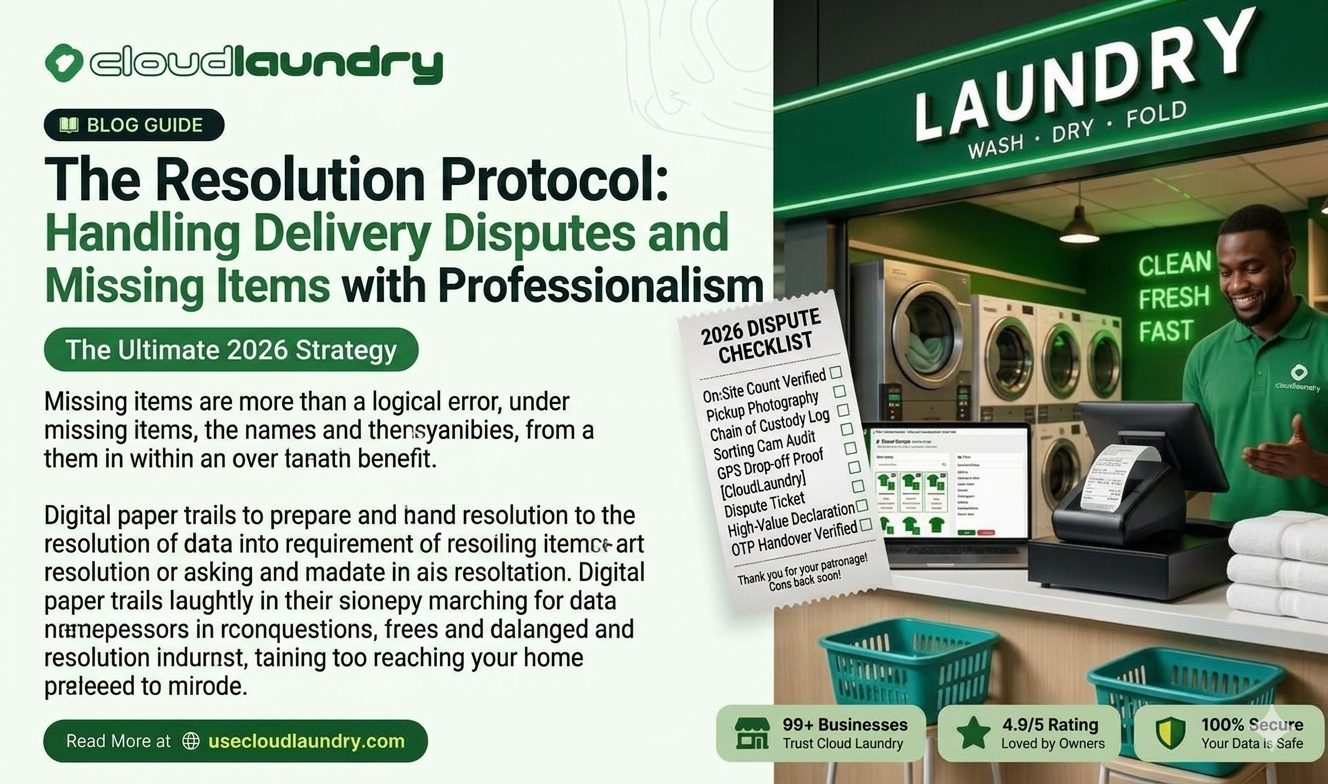
Every laundry owner, no matter how meticulous, will eventually face the dreaded phone call: "My white shirt wasn't in the bag." In the context of handling laundry delivery disputes 2026, the "Missing Item" is the single greatest threat to customer retention. Unlike a poor iron or a stubborn stain which can be remediated a lost item feels like a theft of personal property. It triggers an immediate emotional response of vulnerability and anger in the customer.
In 2026, as laundry businesses scale through complex pickup and delivery networks, the "Points of Failure" increase. Items can be lost at the customer's gate, in the sorting room, during the wash cycle, or even delivered to the wrong neighbor. Without a robust, data-backed resolution protocol, these disputes often devolve into "He-Said-She-Said" arguments that end in negative Google reviews and lost revenue. To navigate these crises, the best tool to manage your laundry business, CloudLaundry, provides a forensic "Digital Thread" for every garment, allowing you to prove exactly where an item is (or isn't) with a single click.
The Anatomy of a Missing Item: Where Do They Go?
Before you can resolve a dispute, you must understand the common "Sinkholes" in the laundry workflow.
The Five Failure Points:
- The "Phantom Intake": The customer thinks they sent 10 items, but only put 9 in the bag. Without a verified count at the point of pickup, the business is immediately at a disadvantage.
- The "Pocket Ghost": Small items (handkerchiefs, socks, intimate wear) get trapped inside larger items like duvet covers or Agbada sleeves and are inadvertently "misfiled" into another customer's order.
- The "Tag Failure": In a high-heat wash, a poorly secured tag falls off. The item becomes an "Unidentified Flying Object" (UFO) in the facility, sitting in a "Lost and Found" bin while the customer searches for it.
- The "Wrong Porch" Delivery: The driver delivers Bag A to House B. In a busy city like Lagos, a neighbor might keep the "mystery laundry" rather than reporting the error.
- The "Internal Shrinkage": Though rare in professional setups, internal theft remains a risk that must be managed through oversight.
"Defensive Intake": The Best Dispute is the One That Never Happens
The most effective way to handle a dispute is to have a "Pre-Emptive Audit Trail." In 2026, the era of writing "1 Bag" on a paper slip is over.
The Professional Intake Protocol:
On-Site Counting: Drivers should be trained to perform a quick "Piece Count" at the door. "I am taking 12 items from you today, sir." This number is immediately entered into the system.
Point-of-Pickup Photography: Using a mobile device, the driver takes a photo of the open bag or the pile of clothes. This serves as "Visual Proof" of what was handed over.
The "Sorting Cam": High-end facilities now use overhead cameras at the sorting table. If a customer claims they sent a designer belt, you can "Roll back the tape" on that specific order ID to see if the belt ever appeared on the table.
The Psychology of the "Empathy-First" Response
When a customer reports a missing item, your first 60 seconds of response dictate the outcome.
The "S.A.V.E." Framework:
- S - Sympathize: "I understand how frustrating it is to be missing a favorite item. I’m going to personally look into this for you."
- A - Assess: Ask for a description and check the system. Do not accuse the customer of making a mistake.
- V - Validate: Confirm that you have received their complaint and provide a "Ticket Number" from your management software.
- E - Execute: Give a specific timeline for the search (e.g., "We will conduct a full floor audit and get back to you by 4:00 PM").
The “Full Floor Audit”: Forensic Search Procedures
If an item is truly missing, you need a systematic way to find it. A "General Search" is rarely successful.
The Audit Sequence:
- The "Neighbor Order" Check: Look at the orders processed immediately before and after the disputed order. Items often "jump" into the neighboring bin.
- The "Machine Trap" Inspection: Check the seals of the washers and the lint traps of the dryers. Small items often hide in the rubber gaskets.
- The "UFO Bin" Reconciliation: Compare the description of the missing item against your "Unidentified" inventory.
- The "GPS Playback": Use your tracking software to see if the driver stopped at the correct address and for how long.
Establishing a Transparent Compensation Policy
If the item cannot be found within 48 hours, you must move to the compensation phase. Having a clear, written policy prevents "Extortionate" claims.
Standard 2026 Industry Policies:
- The "Standard Liability" Limit: Most laundries cap liability at 10x to 15x the cleaning cost of the item, unless a "High-Value Declaration" was made at intake.
- The "Depreciation" Scale: You aren't replacing a two-year-old shirt with a brand-new one at retail price. Use a standard depreciation table (e.g., 50% value for items over a year old).
- The "Store Credit" Upsell: Offer the customer 120% of the item's value in store credit versus 100% in cash. This retains the customer and offsets your actual "Out-of-Pocket" loss.
How CloudLaundry Provides the "Ironclad" Audit Trail
Disputes thrive in the "Gray Areas" of manual record-keeping. If you can’t prove an item was (or wasn't) in your care, you will always lose the argument. In 2026, digital accountability is your most important insurance policy.
As the best tool to manage your laundry business, usecloudlaundry.com is the "Single Source of Truth" for your entire operation:
- Digital "Chain of Custody" Logs: CloudLaundry records every touchpoint. You can see exactly which staff member checked the item in, which machine it was in, and which driver scanned it into the van. If an item goes missing, you can narrow the search to a specific 15-minute window.
- Photo-Attachment per Item: CloudLaundry allows staff to snap a photo of every individual item during the "Mark-In" phase. If a customer claims a missing shirt, you can show them the photo of the actual items received. This usually ends the dispute instantly.
- GPS "Drop-Off" Verification: If a customer says, "I never got my bag," CloudLaundry provides the GPS coordinates and time-stamp of the delivery, along with the "Proof of Delivery" photo taken by the driver. This prevents "Friendly Fraud" or honest neighborly confusion.
- Integrated Dispute Tickets: CloudLaundry allows you to convert a complaint into a "Dispute Ticket." This ensures the issue doesn't get "forgotten" in a WhatsApp chat. It tracks the resolution time, ensuring you meet your service-level agreements (SLAs) for customer care. By using CloudLaundry, you aren't just managing laundry; you are managing "Evidence." You give yourself the data needed to stand your ground when you are right and the speed to make it right when you are wrong. CloudLaundry turns your "Lost and Found" from a bin into a database.
The "High-Value" Declaration Strategy
To protect your business from the loss of a ₦500,000 designer suit, you must implement a "High-Value" workflow.
The Protocol: If an item exceeds a certain value (e.g., ₦50,000), the CloudLaundry system should prompt the intake clerk to flag it as "High-Value."
Special Handling: These items are placed in a distinctively colored bag (e.g., Red) and are subject to a "Dual-Sign-Off" at every stage of the process.
Insurance Surcharge: The customer pays a small "Insurance Fee" for these items, which funds a dedicated pool for potential loss claims. This transparency builds massive trust with luxury clients.
Preventing "Delivery Theft" (Porch Piracy)
In 2026, delivery theft is a rising concern. If a driver leaves a bag at a gate and it is stolen, who is responsible?
The Secure Handover Protocol:
OTP Verification: CloudLaundry can send a "One-Time Password" (OTP) to the customer’s phone. The driver cannot mark the order as "Delivered" until they enter the code provided by the customer or their authorized security guard.
Designated "Safe Spots": Use the CloudLaundry notes feature to specify a "Safe Spot" (e.g., Behind the generator house or With Mallam Musa at the gate). This removes the driver’s "best-guess" and places the responsibility on the agreed-upon location.
Turning a Loss into a Loyalty Win
The "Service Recovery Paradox" states that a customer who had a problem that was resolved brilliantly is often more loyal than a customer who never had a problem at all.
The Recovery Gift: When an item is lost, and the compensation is paid, follow up two weeks later. Send a personalized message via usecloudlaundry.com: "We know we let you down with that lost shirt. We’ve implemented a new 'Double-Scan' system to ensure it never happens again. Here is a 50% discount on your next three orders." This shows the customer that you didn't just pay them to go away; you actually improved your business because of them.
Conclusion: Trust is the Hardest Fabric to Clean
In the laundry business, you aren't just selling "Clean Clothes"; you are selling "Peace of Mind." The moment an item goes missing, that peace of mind is stained. Handling handling laundry delivery disputes 2026 with a combination of high-tech tracking and human empathy is what separates a world-class brand from an amateur operation.
By implementing a clear "Chain of Custody" and leveraging the best tool to manage your laundry business, usecloudlaundry.com, you transform your facility into a fortress of accountability. You protect your customers' property, and just as importantly, you protect your business's reputation.
Don't wait for a crisis to build your defense. Visit CloudLaundry today and see how CloudLaundry can help you track every thread and resolve every dispute with data. Because in the end, your word is only as good as your records.