By 2026, the laundry industry has moved beyond simply "cleaning" clothes. We are in the era of "Fabric Restoration." For the premium customer in Nigeria’s urban centers, the value of their dry-cleaning bill is justified not by the soap used, but by the "Crispness" of the finish. However, the greatest challenge for any growing laundry business is the "Skill Gap." If your lead presser, "Mr. Sunday," produces perfect results, but your weekend relief staff produces wrinkled collars and double-creased trousers, your brand has a terminal problem.
Standardizing laundry pressing quality 2026 is the process of removing "individual flair" and replacing it with "systemized precision." In a world where customers pay a premium for perfection, your business cannot afford to be personality-dependent. You need a model where the quality is baked into the workflow, not just the hands of the worker. To achieve this, the best tool to manage your laundry business, CloudLaundry, serves as the "Digital Supervisor," providing every staff member with the visual guides, timing protocols, and accountability loops needed to deliver a world-class finish every time.
The Philosophy of the "Uniform Finish"
Standardization begins with a mindset shift: the belief that there is only one correct way to press a specific garment.
The Three Pillars of Standardization:
- The "Master Sample": Every facility must have a "Gold Standard" for each garment type (the Executive Shirt, the Traditional Agbada, the Evening Gown). This sample is what every staff member aims to replicate.
- The "Zero-Tolerance" Crease: In 2026, professional pressing is defined by the absence of "Shadow Creases" (double lines on sleeves or trousers). A standardized system treats a double crease not as a minor error, but as a "Failed Order."
- The "Fabric-First" Protocol: Staff must be trained to identify fabric composition (Polyester vs. Silk vs. Linen) before the iron touches the cloth. Standardization means every staff member uses the exact same heat and steam settings for the same fabric type.
The Anatomy of the Perfect Executive Shirt
The white executive shirt is the "Litmus Test" of a laundry’s quality. If you can standardize the shirt, you can standardize the business.
The Sequential Pressing Method:
- The Collar and Cuffs: Always pressed first, from the edges toward the center to prevent "Puckering."
- The Yoke (Shoulders): Positioned over the edge of the board to ensure a smooth transition to the back.
- The Sleeves: The most difficult part. Staff must be trained in the "Seam-to-Seam" alignment to ensure a single, razor-sharp crease.
- The Body: Pressed in three panels (Front-Left, Back, Front-Right), ensuring the placket (where the buttons are) is perfectly flat and never "Bowed."
Mastering the Traditional Agbada and Senator Wear
In the Nigerian market of 2026, the "Senator Suit" and "Agbada" represent a significant portion of high-margin revenue. These garments require specialized, standardized care.
The "Flowing" Standard:
- Embroidery Protection: Staff must be trained to press embroidery from the reverse side on a soft pressing pad. This prevents the "Crushing" of the thread and maintains the 3D texture of the design.
- The "Weight" Factor: Heavy cotton Agbadas require high-pressure steam but must be allowed to "Set" and cool on the board before being moved. Standardizing the "Cool-Down Time" is just as important as the "Pressing Time."
- Symmetry Check: Standardizing the alignment of the shoulder folds ensures that when the customer puts it on, the garment "Drapes" perfectly, as intended by the tailor.
Heat, Steam, and Vacuum: The Holy Trinity
A professional pressing station in 2026 is more than just an iron; it is a thermal management system.
Technical Standards:
- The Vacuum Table: Staff must use the vacuum pedal to "Suck" the heat and moisture out of the garment instantly. This "Freezes" the fibers in their flat state. Standardization requires that every presser uses the vacuum for a minimum of 3 seconds after the iron is lifted.
- The Steam-to-Dry Ratio: Too much steam leaves the garment damp (leading to "Travel Wrinkles"); too little steam fails to break the fiber bonds. Standardizing the "Steam Burst" duration ensures consistent crispness.
- Plate Maintenance: A dirty iron plate leaves "Shine Marks" on dark fabrics. Daily cleaning of the iron shoe must be a standardized part of the morning "Start-Up" routine.
The "Quality Control" (QC) Bridge
Quality doesn't happen at the iron; it happens at the "QC Station." This is the invisible wall that an order cannot cross unless it meets the brand's standard.
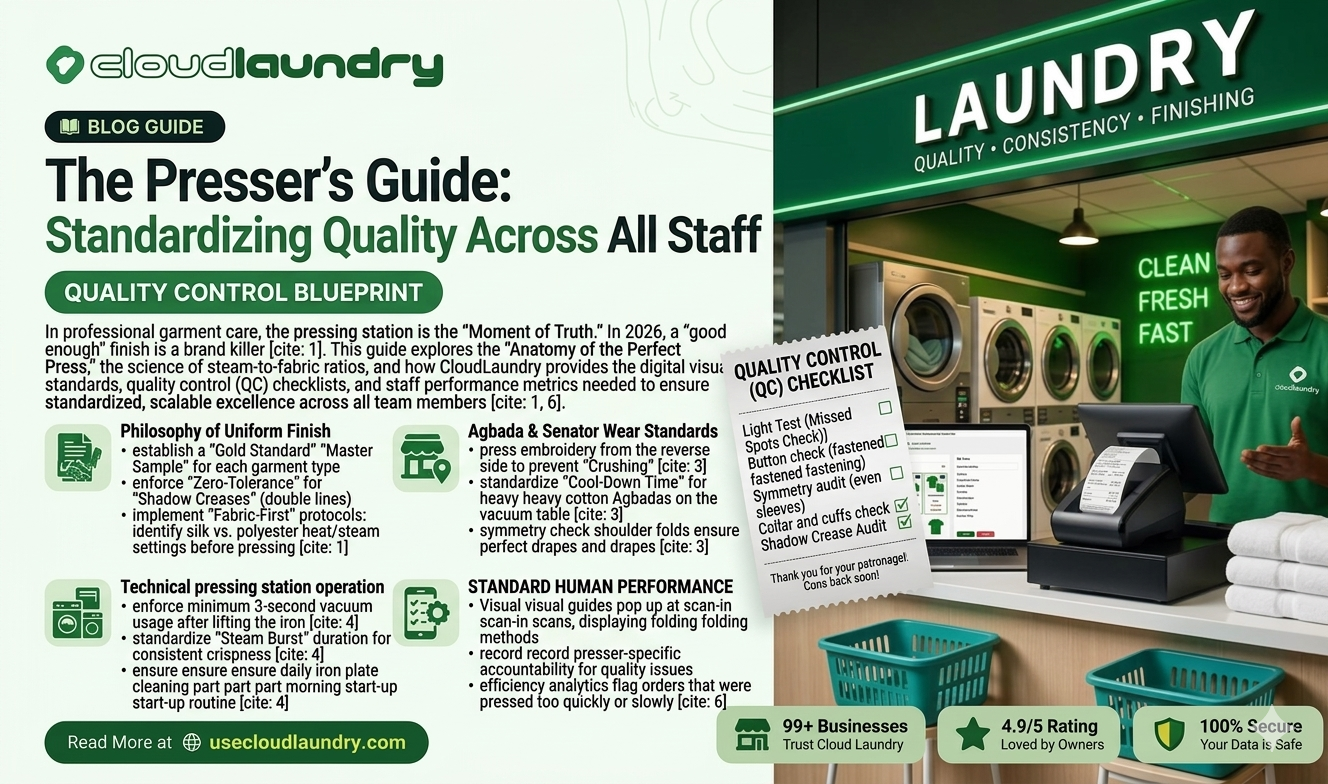
The 2026 QC Checklist:
- The "Light Test": Garments are hung against a high-intensity LED backlight to reveal any faint wrinkles or missed spots.
- The "Button Check": Are all buttons present? Are they all fastened correctly?
- The "Symmetry Audit": Are the sleeves the same length? Is the collar balanced? By using CloudLaundry, this checklist becomes a digital requirement. The QC officer must check off each point on a tablet before the system allows the order to be marked as "Ready for Delivery."
How CloudLaundry Standardizes Human Performance
Training staff is one thing; ensuring they follow that training when the manager isn't looking is another. This is where digital oversight becomes essential.
As the best tool to manage your laundry business, usecloudlaundry.com provides the "Digital SOP" (Standard Operating Procedure) infrastructure to ensure uniform quality:
- Visual "How-To" Pop-ups: When a staff member scans a "Silk Gown" at the pressing station, CloudLaundry can display a 15-second video or a high-res photo showing the exact way that specific item must be folded or hung. This removes "Guesswork" for junior staff.
- Presser-Specific Tracking: CloudLaundry records which staff member pressed which garment. If a customer complains about a wrinkled shirt, you can trace it back to the exact individual. This "Granular Accountability" encourages staff to take pride in their work.
- Efficiency vs. Quality Analytics: CloudLaundry measures how long a staff member takes to press an item. If a presser is "too fast," the system flags them for a QC audit, as speed often comes at the expense of detail. If they are "too slow," they may need re-training on their "Pressing Flow."
- Digital QC "Reject" Loop: If the QC officer finds a mistake, they mark the item as "Rejected" in usecloudlaundry.com and take a photo of the error. The system automatically sends the item back to the original presser's queue. This creates a "Self-Correcting" culture where staff learn from their mistakes in real-time. By using CloudLaundry, you aren't just managing people; you are managing "Standards." You turn your facility into a factory of precision where the software acts as the "Guardian of the Brand." CloudLaundry ensures that the "Sunday Standard" is the "Everyday Standard."
The "Pressing School": Onboarding New Hires
In 2026, you cannot wait six months for a new hire to become "good." You need them "Brand-Ready" in six days.
The Accelerated Training Model:
- Day 1-2 (Shadowing): The trainee watches a master presser and follows the CloudLaundry digital guides.
- Day 3-4 (Simulated Production): The trainee presses "Internal Linens" (towels, shop rags, staff uniforms). There is no risk to customer garments here, but the standards remain high.
- Day 5 (The Certification Test): The trainee must press 10 different garment types. The QC manager and the CloudLaundry photo-audit system verify the results. Only after "Graduation" are they allowed to handle customer orders.
Preventing "Burn-Out" and "Auto-Pilot"
Pressing is repetitive, hot, and physically demanding. When staff get tired, quality "Drifts."
The Ergonomic Standard:
- Mandatory Rotation: Every two hours, staff should rotate between "Heavy Pressing" (suits/coats) and "Light Folding" (t-shirts/linens). This prevents the mental fatigue that leads to double-creases.
- The "Cooling Zone": Ensure the pressing area has high-velocity extraction fans. A comfortable staff member is a detailed staff member.
- Hydration Protocol: Standardizing "Water Breaks" ensures that staff remain alert enough to spot the small stains or loose threads that a fatigued brain would miss.
Standardizing the "Final Presentation" (The Handoff)
The presser's job isn't done until the item is packaged. Standardizing the "Fold" and the "Hang" is the final step in the quality chain.
The Presentation Guide:
- Hanger Orientation: All hooks must face the same direction.
- The "Puff" Technique: Using tissue paper inside the sleeves or chest of a suit to maintain the "Shape" created by the press.
- The "Scent Signature": Standardizing the distance and amount of "Fabric Freshener" sprayed on the finished garment. CloudLaundry can include a "Scent Check" in the final QC list.
Conclusion: The Power of the Perfect Crease
In the competitive landscape of 2026, your business is only as good as your worst presser. One wrinkled collar can undo ten years of brand building. Standardization is not about making people into robots; it is about giving them the "Blueprints" to be masters.
Mastering standardizing laundry pressing quality 2026 is the foundation of a scalable empire. It allows you to open a second, third, or tenth branch with the total confidence that the quality in Lekki will be identical to the quality in Abuja.
Don't let your quality be a variable. Harness the power of the best tool to manage your laundry business, usecloudlaundry.com, to build a culture of "Unshakable Excellence." Visit CloudLaundry today and see how CloudLaundry can help you turn your pressing station into a center of standardized perfection. Because when the clothes look this good, the brand looks even better.
