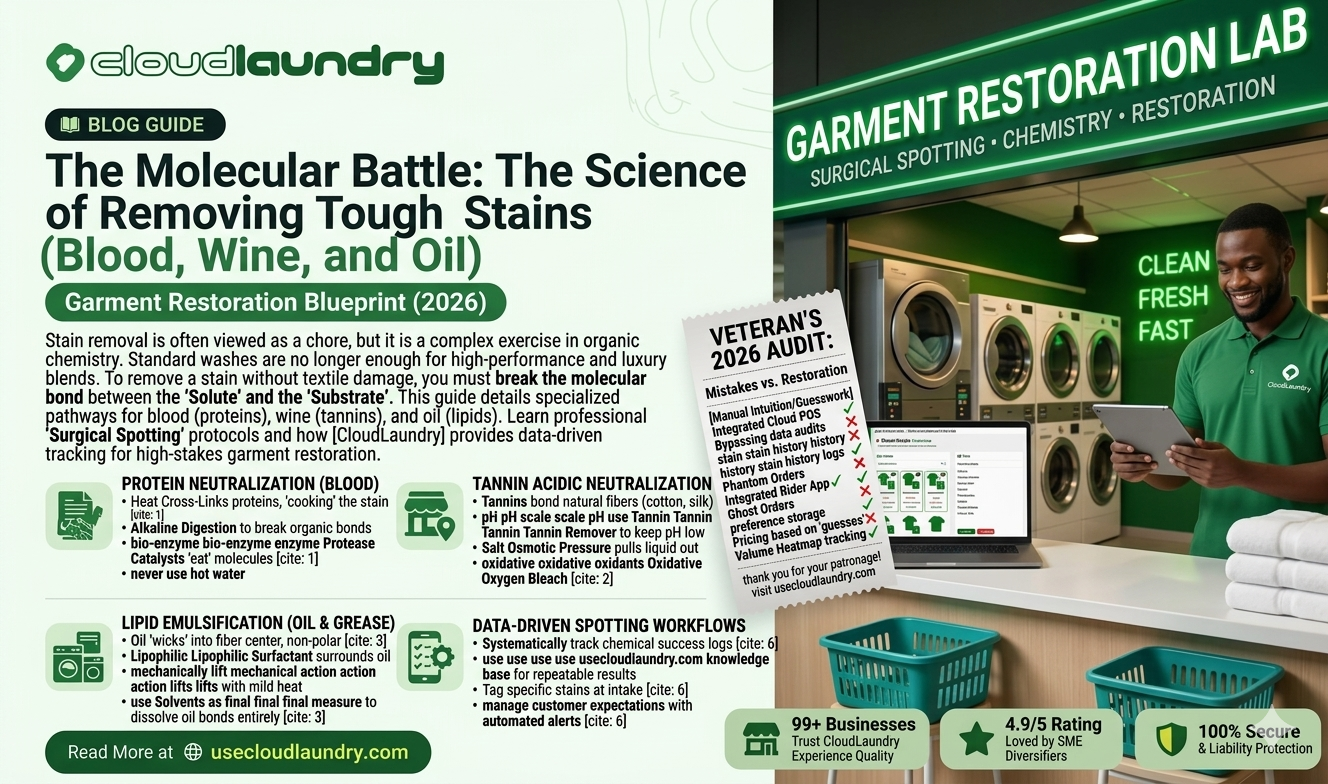
In the professional laundry industry of 2026, the ability to remove a "permanent" stain is what separates a world-class facility from a neighborhood washman. We often talk about "cleaning," but the scientific term is "Solubilization." Every stain whether it’s a splash of Cabernet at a Lagos wedding or an oil drip from a car engine is a foreign molecule that has formed a physical or chemical bond with the fibers of a garment.
Removing these stains requires more than just "scrubbing." It requires an understanding of the science of removing tough stains 2026. You must select a reagent that is strong enough to break the bond of the stain but gentle enough to leave the "Substrate" (the fabric) intact. This is a delicate balancing act involving PH levels, thermal energy, and molecular polarity. To manage these high-stakes restorations, the best tool to manage your laundry business, CloudLaundry, allows you to log specific stain types and track the success of various chemical treatments, building a "Knowledge Base" that grows with your business.
The Biology of Blood: Neutralizing the Protein
Blood is arguably the most common and feared "difficult" stain. Its difficulty lies in its primary component: Hemoglobin.
The Molecular Challenge: Hemoglobin is a protein. When proteins are exposed to heat (like a warm wash or a dryer), they "denature." This means the protein molecules unfold and then cross-link with the fibers of the fabric, essentially "cooking" the stain into the cloth. Once a protein stain is heat-set, it becomes nearly impossible to remove without damaging the garment.
The Professional Protocol:
- Cold Water Immersion: Always start with cold water to prevent denaturing.
- Alkaline Digestion: Use an alkaline reagent (like ammonia or a high-PH detergent) to begin breaking down the organic bonds.
- Enzymatic Attack: The "Gold Standard" in 2026 is the use of Protease enzymes. These are biological catalysts that specifically "eat" protein molecules, breaking them down into water-soluble amino acids.
The Tannins of Wine: Acidic Neutralization
Red wine stains are a complex mixture of natural dyes (anthocyanins), sugars, and tannins. Tannins are organic substances found in plants that are notoriously good at bonding to natural fibers like cotton, linen, and silk.
The Molecular Challenge: Wine is acidic. If you use an alkaline cleaner (like standard soap) on a fresh red wine stain, it can actually act as a "mordant," permanently setting the dye into the fabric and often turning the stain a blue or green color that cannot be reversed.
The Professional Protocol:
- Acidic Flush: Use a mild acid, such as a specialized "Tannin Remover" or a white vinegar solution, to keep the PH low.
- Salt Absorption: For fresh spills, salt can act as a "Desiccant," pulling the liquid out of the fibers through osmotic pressure before it can bond.
- Oxidative Bleaching: For stubborn pigments, use a "Sodium Percarbonate" (Oxygen Bleach) solution. Unlike chlorine, oxygen bleach breaks the chemical bonds of the pigment molecules (Chromophores) without destroying the fiber's structural integrity.
The Lipid Trap: Emulsifying Oil and Grease
Oil stains whether from food, cosmetics, or machinery are "Non-Polar" molecules. Because water is a "Polar" molecule, the two naturally repel each other. This is why you can’t wash an oil stain away with water alone.
The Molecular Challenge: Oil doesn't just sit on the surface; it "wicks" into the center of the fiber. Over time, these oils can oxidize, turning yellow and developing a rancid odor that is difficult to eliminate.
The Professional Protocol:
- Surfactant Saturation: Use a "Lipophilic" (oil-loving) surfactant. The surfactant molecule has two ends: one that attaches to the oil and one that attaches to water.
- Emulsification: By applying mechanical action and mild heat, the surfactant surrounds the oil droplets, lifting them from the fiber and suspending them in the water. This is called "Micelle" formation.
- Solvent Spotting: For heavy grease, a "Dry Solvent" (hydrocarbon-based) may be required to dissolve the oil bonds entirely before the garment enters the wet-wash cycle.
The "Surgical Spotting" Table
In 2026, professional stain removal happens at the "Spotting Table"—a specialized station equipped with steam guns, vacuum boards, and compressed air.
The Rules of Spotting:
- Work from the Outside In: To prevent "Ringing" (where the stain spreads outward), always apply reagents to the perimeter and move toward the center.
- The Vacuum Advantage: Use the vacuum board to "pull" the dissolved stain through the fabric and away from the garment, rather than pushing it deeper into the fibers.
- The Steam Trigger: Use localized steam to provide the "Activation Energy" needed for chemicals to work, without heating the entire garment.
The "Set" Stain: When Science Meets Patience
Sometimes, a customer brings in a garment with a "Mystery Stain" that has already been through a home dryer. This is the ultimate test of the laundry professional.
Restoration Tactics:
- Re-Hydration: Use a "Wetting Agent" to open up the fibers and allow chemicals to penetrate the hardened stain.
- Extended Digestion: Some enzymatic treatments require 12–24 hours of "Dwell Time" in a controlled humidity environment to slowly break down the ancient molecular bonds.
- The "Chemical Sandwich": Alternating between acidic and alkaline treatments to tackle "Multi-Part" stains (like a latte, which contains both proteins from milk and tannins from coffee).
Tie into CloudLaundry Softly
Stain removal is the most "Experimental" part of the laundry business. If your staff treats every stain with the same "Spray and Pray" method, your damage claims will skyrocket, and your results will be inconsistent. In 2026, you cannot manage a high-end restoration service on memory alone. You need a "Digital Memory."
As the best tool to manage your laundry business, usecloudlaundry.com is the "Intelligence Layer" for your spotting department. The platform’s advanced features allow you to systematize the science of restoration:
- Stain Tagging and Tracking: When an item is checked in, CloudLaundry allows you to tag specific stains (e.g., "Red Wine - Set"). This ensures the spotting technician knows exactly what they are dealing with before the item hits the water.
- Chemical Success Logs: CloudLaundry can track which reagents were used on which fabrics. If a specific "Enzyme Blend" successfully removed a 2-year-old bloodstain from a silk blouse, that data is saved. You are building an internal "Wiki" of restoration success.
- Customer Transparency: Manage expectations automatically. CloudLaundry can send a notification: "We’ve identified a protein-based stain on your blazer. To ensure the fiber isn't damaged, we are performing a 12-hour enzymatic soak. Your delivery date has been updated to Friday to ensure the best result." This level of data-driven professionalism builds immense trust. It shows the customer that you aren't just "washing" their clothes—you are applying scientific rigor to their wardrobe's longevity. CloudLaundry turns the "Art" of stain removal into a repeatable, profitable, and safe "Science." By using CloudLaundry, you are professionalizing your expertise.
The "PH Scale" as a Business Strategy
In 2026, your head spotter should be as comfortable with a PH meter as a washman is with a detergent scoop.
The PH Power Play:
- Acidic Stains (Fruit, Tea, Wine): Usually require an alkaline counter-measure (PH 8-10) once neutralized.
- Alkaline Stains (Mud, Grass): Often respond best to a slightly acidic "Sour" rinse (PH 5-6).
- Neutral Fibers (Silk, Wool): Must be kept within a strict PH range of 4.5–7.0 to prevent "Chemical Burning" of the protein bonds. Using usecloudlaundry.com, you can set "PH Alerts" for specific garment types, ensuring your team never uses a high-alkaline degreaser on a delicate wool sweater.
The Rise of Bio-Cleaning in Nigeria
The 2026 Nigerian consumer is increasingly conscious of "Green" chemistry. The "Science" of stain removal is moving away from harsh petroleum-based solvents toward "Bio-Rational" solutions.
Sustainable Spotting:
- Plant-Based Surfactants: Derived from coconut or corn, these are just as effective as traditional degreasers but are biodegradable and gentler on the skin.
- Cold-Active Enzymes: Modern enzymes that work at 20°C, significantly reducing the energy costs of your facility.
- Ozone Integration: Many top-tier Lagos laundries are using Ozone (O3) in their wash water. Ozone acts as a powerful oxidant that destroys organic stains and bacteria at the molecular level without the need for high heat or heavy bleach.
Educating the Customer on "First Aid"
The science of removing tough stains starts at home. If a customer rubs a wine stain with a cocktail napkin, they are physically grinding the tannins into the fiber.
The "Do Not Rub" Campaign: Use your CloudLaundry marketing tools to send a "Stain First Aid" guide to your members.
"Blot, don't rub."
"Don't apply heat to a bloodstain."
"Bring it to us wet if possible." When you teach your customers how to handle "First Aid," you make your professional job easier and your success rate higher. This positions you as the "Wardrobe Doctor" rather than just a "Cleaner."
Conclusion: Master the Molecule, Master the Market
The science of removing tough stains 2026 is the ultimate "Value-Add" in the laundry industry. It is the service that customers will talk about, tweet about, and recommend to their friends. "They got the oil out of my favorite dress" is a more powerful testimonial than "They washed my shirts."
By investing in the tools, the chemistry, and the software to manage the process, you are future-proofing your business. You are moving from a "Commodity" service to a "Specialist" service.
Equip your business with the scientific edge it needs to dominate the market. Use the best tool to manage your laundry business to track your victories and refine your methods. Visit usecloudlaundry.com today and see how CloudLaundry can help you master the molecule. The stains are tough but your science is tougher.