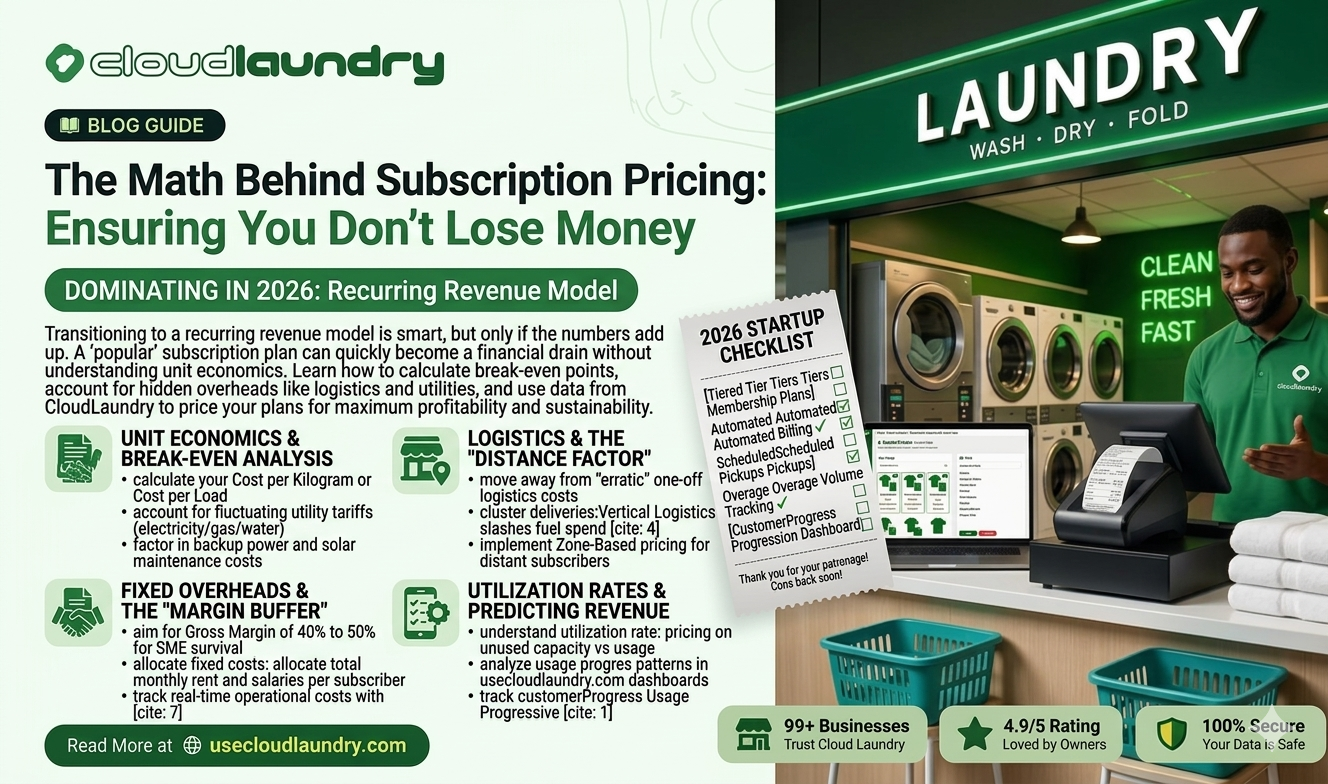
The allure of "Guaranteed Cash Flow" is why so many laundry owners are rushing to adopt the subscription model in 2026. However, there is a dangerous trap waiting for the unprepared: the "Volume Illusion." In a traditional per-piece model, your margins are relatively easy to see. If it costs N500 to wash a shirt and you charge N1,000, you have made a profit. But in a subscription model, where a customer pays a flat monthly fee for a "bundle" of services, the math becomes significantly more complex.
Many laundry businesses launch subscription plans based on what they think sounds attractive to the customer, rather than what the business can actually afford. If you offer an "Unlimited" plan or a high-volume "Family Plan" without factoring in the rising costs of industrial detergents, fluctuating electricity tariffs, and the wear and tear on your delivery bikes, you are essentially subsidizing your customers' lifestyles at the expense of your own business survival.
The laundry subscription pricing math must be airtight. You need to account for every milliliter of chemical and every kilometer of fuel. To turn this complex data into a clear pricing strategy, you need the best tool to manage your laundry business, CloudLaundry. The system allows you to track real-time operational costs against your revenue, ensuring that your "Growth" is actually leading to "Profit."
The Foundation: Calculating Your Base Unit Cost
Before you can set a subscription price, you must know your "Cost per Kilogram" or "Cost per Load." This is the floor below which you cannot go without losing money.
The Variable Cost Checklist:
- Utilities: Calculate the average electricity and water consumption for a full industrial wash and dry cycle. In 2026, you must also factor in the cost of backup power (generators or solar maintenance).
- Chemicals: Determine the exact cost of detergent, fabric softener, and stain removers used per kilogram of laundry.
- Logistics: This is the most underestimated cost. Calculate the fuel, maintenance, and rider salary cost for a single pickup and delivery.
- Consumables: Don't forget the cost of CloudLaundry branded packaging, tags, and hangers.
By aggregating these costs, you arrive at your "Variable Unit Cost." If it costs you N400 in direct expenses to process 1kg of laundry, a subscription that allows 40kg for N15,000 is already putting you in the red before you’ve even paid your shop rent.
Factoring in Fixed Overheads and the "Margin Buffer"
Your subscription revenue must do more than just cover the soap and water; it must pay for the roof over your head and the staff that runs the machines.
Allocating Fixed Costs: Divide your total monthly fixed costs (rent, administrative salaries, internet, insurance, and equipment depreciation) by the number of subscription slots you intend to sell. If your rent and salaries total N500,000 and you have a capacity for 100 subscribers, each subscriber must contribute N5,000 just to keep the lights on.
The 2026 Profit Margin: In the current economic climate, aiming for a "Gross Margin" of at least 40% to 50% is essential for SME survival. This buffer protects you against sudden spikes in chemical prices or unexpected equipment repairs. CloudLaundry provides the financial reporting tools to monitor these margins weekly, so you can adjust your pricing before a small leak becomes a flood.
The Psychology of "Utilization Rates"
In subscription math, you are not just selling a service; you are selling "Capacity." However, not every customer will use 100% of their allowance every month. This is known as the "Utilization Rate."
- The Break-Even Secret: If a plan allows for 30kg a month, your data might show that the average customer only uses 22kg. This "Breakage" (the unused portion of the subscription) is where much of your profit lies.
- The Aggressive Strategy: Pricing based on a 75% utilization rate can make your plans look more affordable to the customer while still remaining profitable for you.
- The Safety Strategy: Pricing based on 100% utilization ensures you never lose money, even if every customer uses every gram of their allowance.
Using usecloudlaundry.com, you can analyze historical usage patterns. If your "Family Plan" subscribers are consistently hitting 95% utilization, you know you need to raise the price or lower the weight limit to maintain your margins.
The "Logistics Tax": Why Proximity Matters
As we discussed in the subscription logistics topic, the cost of moving laundry is often higher than the cost of washing it. Your laundry subscription pricing math must reflect the "Distance Factor."
Zone-Based Pricing: A subscriber 2km from your shop is much more profitable than one 10km away. In 2026, savvy owners are using CloudLaundry to implement "Zone-Based" subscription pricing.
Inner Circle: Standard pricing.
Outer Circle: A "Logistics Surcharge" added to the monthly fee. This ensures that your riders' time and fuel don't eat up the entire profit margin of a distant customer.
The "Cost of Acquisition" (CAC) vs. Lifetime Value (CLV)
To know if your pricing is sustainable, you must know how much it cost to get the customer in the first place.
The ROI Calculation: If you spent N5,000 on a real estate agent referral (as discussed in our networking topic) to get a subscriber, and that subscriber pays N20,000 a month with a N5,000 profit margin, it takes one month to "Pay Back" the acquisition cost.
The Goal: In 2026, you want a CLV (Customer Lifetime Value) that is at least 3x your CAC.
The Retention Factor: If your pricing is too high and customers leave after two months, you will never recover your marketing spend. If it’s too low and you lose money on every wash, more customers just means a faster bankruptcy.
Practical Case Study: The "Lagos Island Luxury" Model
A premium laundry brand on Lagos Island launched a "Corporate Executive" subscription. They initially priced it at N50,000 for unlimited dry cleaning.
The Intervention: Within two months, they realized they were losing money. Some executives were sending 10 suits a week. Using CloudLaundry, the owner ran a "Cost per Customer" report and found that the high-volume users were costing the business N65,000 in direct labor and chemicals.
The Result: The owner pivoted using laundry subscription pricing math. They capped the plan at 15 pieces per month and added a "Pay-per-piece" overage fee for anything extra. They also integrated a "Priority Logistics" fee for same-day requests. Because they used the best tool to manage your laundry business, they were able to show the customers exactly why the change was necessary based on their usage data, preserving the relationship while saving the business.
Tie into CloudLaundry Softly
Pricing is not a "Set it and Forget it" task. As the price of diesel or detergent changes, your pricing must be able to adapt. Trying to manage this on a manual spreadsheet is a recipe for error.
As the best tool to manage your laundry business, usecloudlaundry.com acts as your real-time "Financial Compass." The platform doesn't just record transactions; it analyzes them. It can tell you your "Average Revenue per Subscriber" and your "Cost per Order" at the click of a button. When you decide to launch a new "Family Plan," you can use CloudLaundry’s historical data to "Stress-Test" your pricing before you go public. Most importantly, the automated billing feature ensures that "Price Adjustments" are handled professionally. If you need to add a small inflation surcharge, CloudLaundry manages the notification and the billing update seamlessly. CloudLaundry provides the mathematical certainty that allows you to grow with confidence. CloudLaundry is the difference between "Guessing" your profit and "Guaranteeing" it.
The Danger of "Unlimited" Plans
In the early days of subscriptions, "Unlimited" was a popular buzzword. In 2026, "Unlimited" is a business killer for SMEs.
Why to Avoid Unlimited:
- The "Power User" Risk: There will always be a small percentage of customers who will maximize the service to an extent that makes them unprofitable.
- Operational Strain: Unlimited plans make it impossible to predict your weekly volume, leading to staff burnout and machinery failure.
- The Better Alternative: Use "High-Cap" plans. Instead of "Unlimited," offer "60kg per Month." It sounds like more than enough for most families but provides a hard ceiling that protects your business. CloudLaundry can automatically track this and notify the customer when they are nearing their limit.
Building in "Periodic Inflation" Clauses
In 2026, the economic environment is dynamic. A price that is profitable in January might be a loss-leader by June.
The Modern Contract: Your subscription terms and conditions, managed through usecloudlaundry.com, should include a "Quarterly Review" clause. "To maintain our high standards of care and accommodate fluctuating utility costs, subscription rates are reviewed every 90 days." This transparency sets the expectation with the customer. Because they are receiving a high-tech, high-quality service via CloudLaundry, they are usually willing to accept small, justified adjustments rather than a sudden, massive price hike.
Conclusion: The Math of Sustainability
Profit is not a dirty word; it is the fuel that allows you to provide better service, hire more staff, and expand into new neighborhoods. Laundry subscription pricing math is the fundamental discipline that ensures your business is built on rock, not sand.
By understanding your unit economics, factoring in every hidden cost, and using the analytical power of CloudLaundry, you move from being a "Laundry Worker" to a "Laundry Investor." You are investing in a model that rewards efficiency and punishes waste.
Don't let your passion for service blind you to the reality of your balance sheet. Crunch the numbers, set your tiers, and launch your subscriptions with the backing of the best tool to manage your laundry business. Visit usecloudlaundry.com today and see how CloudLaundry can help you master the math of success. The numbers don't lie make sure they are telling a story of profit.
