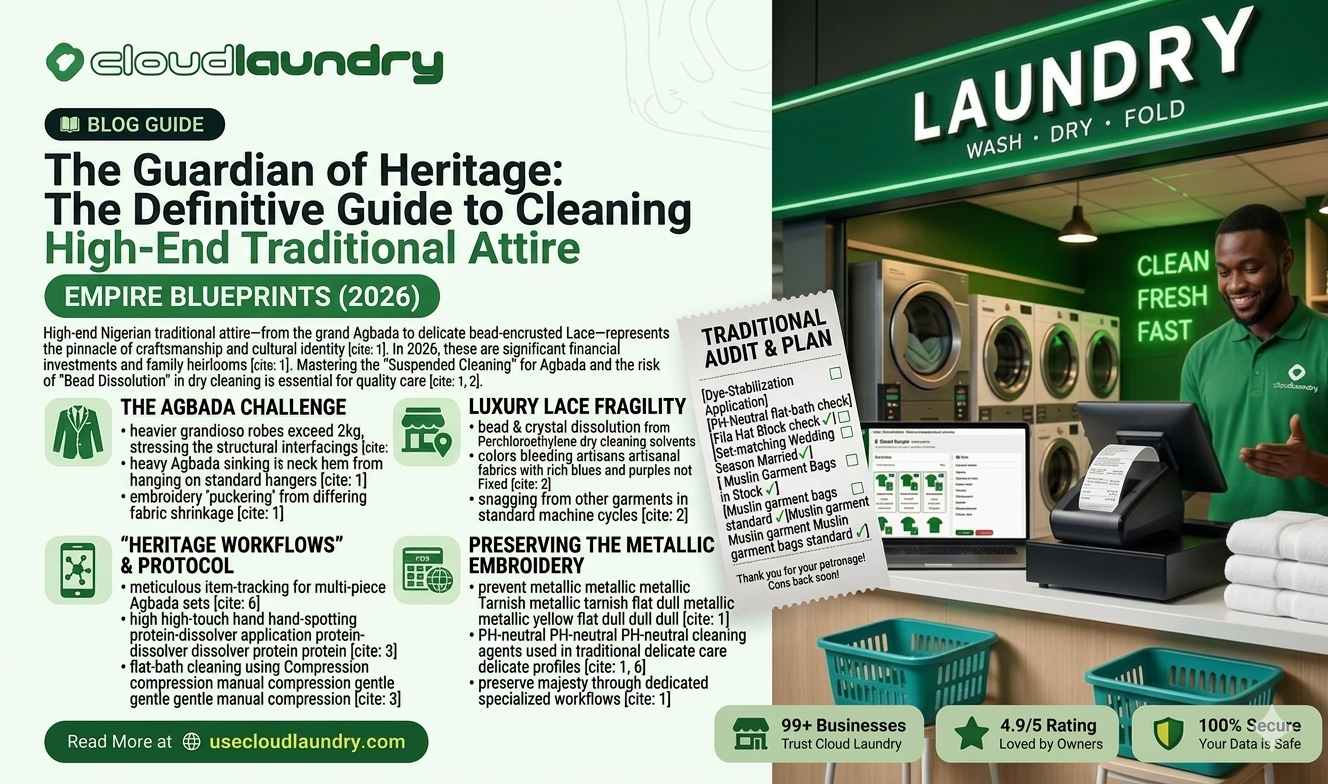
In the Nigerian social landscape of 2026, traditional attire remains the ultimate expression of status, celebration, and heritage. Whether it is the stiff, structural elegance of an Aso-Oke, the flowing grandiosity of a seven-piece Agbada, or the intricate "Swiss Lace" used for high-society weddings, these garments are the crown jewels of a customer’s wardrobe. They are often custom-made, hand-embroidered, and cost hundreds of thousands of Naira.
The challenge for the modern laundry professional is that traditional attire does not follow the rules of industrial manufacturing. You are dealing with "mixed-media" garments—fabric paired with plastic beads, metallic lurex, glass crystals, and heavy structural interfacings. Cleaning high-end traditional attire 2026 requires a specialized set of skills that bridges the gap between a chemical technician and a fashion curator. To handle the unique complexities of these pieces, the best tool to manage your laundry business, CloudLaundry, enables you to create "Heritage Workflows" that prioritize manual inspection and specialized chemical handling, ensuring these symbols of culture remain untarnished.
The Agbada Challenge: Architecture in Motion
A grand Agbada is less of a shirt and more of a structural feat. The weight of the embroidery alone can often exceed two kilograms.
The Structural Risks:
- The "Sinking" Hem: If a heavy Agbada is hung on a standard hanger, the sheer weight of the embroidery on the chest and shoulders will stretch the neck and cause the hem to "sink" or become uneven over time.
- Embroidery "Puckering": The base fabric (often high-quality cotton or silk) and the embroidery thread (often synthetic or metallic) react differently to moisture and heat. Incorrect cleaning causes the base fabric to shrink while the embroidery stays the same size, leading to unsightly "bubbles" or puckering.
- Metallic Tarnish: The gold and silver threads used in premium Agbadas are often made of coated polymers. Standard high-PH detergents can strip this coating, turning "Gold" into a dull, flat yellow in a single wash.
Luxury Lace – The Fragility of the Filigree
High-end Lace, particularly "George" or "Cord Lace," is defined by its negative space—the holes in the fabric that create the pattern. These holes are the primary failure points during cleaning.
The Perils of Lace Care:
- Snagging: In a standard machine cycle, the "teeth" of a zipper or even the buttons of another garment can snag the delicate threads of the lace, causing a "run" that ruins the entire panel.
- Bead and Crystal Dissolution: In 2026, many decorative beads are glued rather than sewn. Most dry-cleaning solvents (like Perchloroethylene) are designed to dissolve oils, but they also dissolve the adhesives holding the crystals in place. You may start the cycle with a beaded gown and finish it with a pile of loose plastic at the bottom of the machine.
- Color Bleeding: Luxury lace often uses vibrant, high-saturation dyes. Because these are often artisanal fabrics, the dyes may not have been "fixed" with industrial heat, leading to massive color transfer the moment they touch water.
The "Cold-Immersion" and "Hand-Spotting" Protocol
For the highest tier of traditional wear, the machine is the enemy. The professional protocol in 2026 is a "High-Touch, Low-Motion" approach.
The Restoration Steps:
- Dye-Stabilization: Before cleaning, the professional applies a "Dye-Fixative" to prevent the rich blues, reds, and purples from migrating into the white embroidery.
- Surgical Spotting: Stains (often food-based from "Owambe" parties) are treated individually with a soft-bristle brush and a targeted protein-dissolver.
- Flat-Bath Cleaning: The garment is laid flat in a shallow bath of PH-neutral, surfactant-rich water. Instead of "tumbling," the professional uses "Gentle Compression"—manually pressing the water through the fabric to release dirt without stressing the seams.
The Art of Stiffening (Starching) Traditional Wear
In Nigeria, a "Limp" Agbada is a fashion failure. The garment must have "Body" and "Architecture."
The Professional Stiffening Technique: Standard spray starch is insufficient for the heavy cotton used in traditional wear. Professionals use a "Dipping" method with high-grade liquid sizing. The garment is immersed in the sizing solution, ensuring the fibers are saturated to the core. The real secret, however, is in the Drying Posture. To maintain the structure, Agbadas are often dried on a "Form Finisher"—an inflatable mannequin that uses warm air to dry the garment from the inside out, ensuring the embroidery stays flat and the shoulders stay sharp.
Handling Aso-Oke: The Hand-Woven Treasure
Aso-Oke is a thick, hand-loomed fabric. Its thickness makes it an "Oil Magnet," but its weave makes it prone to fraying.
Aso-Oke Preservation:
- Avoid the Dryer: High-heat drying will make Aso-Oke "brittle," leading to cracks in the fabric over time.
- Low-Moisture Finishing: Because of its thickness, Aso-Oke can take days to air-dry. Professionals use "Vacuum-Ironing" to pull moisture out of the thick weave instantly while flattening the surface.
How CloudLaundry Manages Traditional Complexity
The primary operational challenge with traditional wear is "Item Complexity." A single Agbada set can consist of four pieces: the outer robe, the inner tunic, the trousers, and the Fila (cap). If these pieces are separated during the process, or if the Fila is cleaned using a different method than the robe, the colors may no longer match. In a busy 2026 shop, keeping these sets "Married" is vital.
As the best tool to manage your laundry business, usecloudlaundry.com acts as the "Curator's Ledger" for your traditional attire department. The platform is built to handle the unique nuances of Nigerian fashion:
- "Set-Matching" Technology: CloudLaundry allows you to group multiple items under a single "Traditional Set" ID. The system ensures that the entire 4-piece Agbada set moves through the facility together, preventing the "different shade" problem caused by varying wash times.
- Fabric-Specific Risk Warnings: When a "Lace" item is scanned, CloudLaundry automatically generates a "Delicate/No-Tumble" tag. This ensures that even your newest staff member knows that this item requires the "Flat-Bath" treatment.
- Detail Inventory (Bead & Embroidery Check): The platform allows for a detailed "Before" checklist. Technicians can log: "14 gold beads missing on left shoulder upon intake," accompanied by photos. This protects you from liability regarding pre-existing damage common in older traditional wear.
- Premium Service Tracking: CloudLaundry allows you to apply "Traditional Surcharges" for the extra labor and specialized starching required, ensuring your pricing reflects the expertise of your staff. By using CloudLaundry, you transform the high-risk task of cleaning Aso-Ebi and Agbada into a high-profit, low-stress operation. You provide the digital "Chain of Custody" that gives luxury clients the confidence to hand over their most expensive garments. CloudLaundry ensures that your "Traditional Care" is as modern as your software.
The "Fila" (Cap) Restoration
The Fila is often an afterthought in the laundry room, but it is the "Crown" of the outfit. Traditional caps are often stiffened using internal cardboard or heavy glue, both of which dissolve in water.
The Professional Cap Clean:
- Internal Shaping: Caps are cleaned on a "Hat Block" or a specialized head-form to prevent them from losing their specific shape (e.g., the "Oyo" or "Kano" style).
- Surface Cleaning: Rather than immersion, the surface is cleaned using "Dry Foam" to lift oils without saturating the internal structure.
Storing Traditional Attire: The "Breathable" Standard
Once cleaned, traditional wear should never be handed back in a thin, plastic laundry bag for long-term storage.
The Preservation Delivery:
- Acid-Free Boxes: Heavy Agbadas should be delivered folded in large, acid-free boxes with tissue paper supporting the folds to prevent "Permanent Creasing."
- Muslin Garment Bags: For Lace, breathable cotton/muslin bags are the gold standard. They protect against dust while allowing the fabric to breathe, preventing the "Yellowing" caused by plastic off-gassing. CloudLaundry can manage the inventory of these premium packaging materials, ensuring you never run out during the busy wedding season.
The "Owambe" Emergency Service
In 2026, the most successful laundries offer a "Post-Event Recovery" package.
The Marketing Hook: Target the "Owambe" crowd. Offer a 24-hour "Stain-Neutralization" service for traditional wear. Because these events involve rich, oily foods and red palm oil, the stains must be treated within hours. Use usecloudlaundry.com to manage these high-priority "Rush" orders, positioning your shop as the first responder for the fashion elite.
Conclusion: Preserving the Fabric of Society
Cleaning traditional attire is a sacred trust. You aren't just removing dirt; you are maintaining the dignity of the wearer and the longevity of the garment's history. In 2026, the mastery of cleaning high-end traditional attire 2026 is the hallmark of a truly elite laundry business.
By combining traditional fabric knowledge with the best tool to manage your laundry business, usecloudlaundry.com, you can provide a service that is both culturally respectful and technologically advanced.
Equip your business to be the guardian of heritage. Visit CloudLaundry today and see how CloudLaundry can help you master the art of Agbada and Lace care. Because some garments are worth more than money they are worth the story they tell.