By 2026, the concept of "doing laundry" has begun to feel as archaic to the urban professional as "fetching water from a well." We have entered the era of Laundry-as-a-Service (LaaS). Much like Software-as-a-Service (SaaS) revolutionized how businesses operate by removing the need for local servers and maintenance, LaaS is removing the “Domestic Server” the washing machine from the modern home.
In the rapidly growing megacities of Nigeria, from the high-rises of Eko Atlantic to the sprawling estates of Abuja, space and time have become the most expensive luxuries. LaaS is the response to this scarcity. It is a model where the customer no longer buys a machine, detergent, or an afternoon of labor; they subscribe to an outcome: a continuous supply of clean, ready-to-wear clothing.
However, to provide a service that feels like a utility, the backend must be flawless. A utility cannot "forget" a pickup any more than a power grid can "forget" to provide electricity. This level of reliability requires a digital backbone. As the best tool to manage your laundry business, CloudLaundry is the operating system for the LaaS revolution, providing the automation and data integrity required to turn a neighborhood shop into a critical piece of urban infrastructure.
The Move to "Invisible Logistics"
The first pillar of the LaaS future is the disappearance of the transaction. In 2026, the goal is for the customer to forget that the laundry process even exists.
The Evolution of the User Journey:
- 2020: The customer calls a dry cleaner, describes the items, and waits for a manual pickup.
- 2023: The customer uses an app to book a specific slot and pays per item.
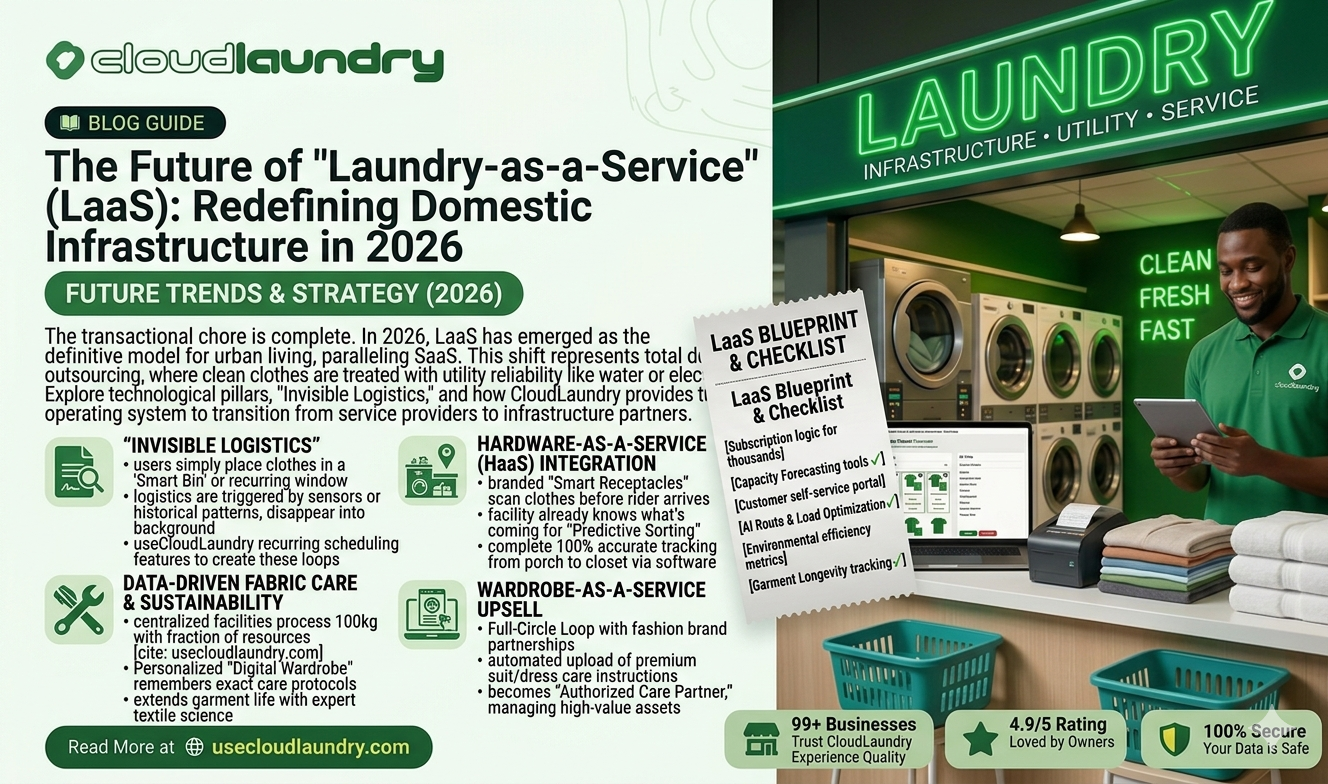
- 2026 (LaaS): The customer has a "Smart Bin" or a recurring pickup window. They simply place their clothes in the bag. The logistics happen in the background, triggered by sensors or historical usage patterns.
By utilizing the recurring scheduling features in usecloudlaundry.com, businesses can create these "Invisible" loops, where the service becomes a background rhythm in the customer’s life rather than an item on their to-do list.
Hardware-as-a-Service (HaaS) Integration
In the LaaS model, the relationship between the laundry provider and the customer’s home deepens. We are seeing the rise of branded "Smart Receptacles"—bags or bins provided by the laundry business that are equipped with RFID tags or QR codes.
The Smart Bin Concept: When a customer drops a garment into the bin, it is "pre-scanned." By the time your rider arrives, your facility already knows exactly what is coming. This allows for "Predictive Sorting." CloudLaundry integrates these hardware identifiers into the digital workflow, ensuring that from the moment the bag leaves the porch to the moment it returns to the closet, its status is tracked with 100% accuracy.
Data-Driven Fabric Care
In 2026, LaaS is not just about "washing"; it is about "Garment Longevity." With the rise of sustainable fashion and expensive designer wear in the Nigerian market, customers are looking for experts who understand the science of textiles.
Personalized Care Protocols: Through usecloudlaundry.com, LaaS providers maintain a "Digital Wardrobe" for each subscriber. The system remembers that Customer A’s shirts must be washed at exactly 30°C and Customer B’s lace traditional wear requires specialized hand-finishing. This isn't just service; it’s "Wardrobe Management." By treating clothes as assets to be preserved, LaaS providers justify their subscription fees by extending the life of the customer's clothing.
The Sustainability Mandate of LaaS
One of the major drivers of Laundry-as-a-Service (LaaS) trends in 2026 is environmental efficiency. Individual home washing machines are notoriously inefficient, wasting significant amounts of water and electricity per kilogram of clothing.
The Centralized Advantage: Industrial-scale facilities managed via CloudLaundry can process 100kg of laundry with a fraction of the water used by 20 individual home machines. LaaS providers are positioning themselves as the "Green" alternative. By subscribing, a customer is reducing their household's carbon and water footprint. CloudLaundry helps track these efficiency metrics, allowing businesses to provide "Sustainability Reports" to their eco-conscious members.
Practical Case Study: The "Eco-Atlantic" Smart Hub
A forward-thinking laundry brand established a "Micro-Hub" within a new luxury development in Eko Atlantic.
The Intervention: Instead of a storefront, they installed smart lockers on every floor. Residents subscribed to a "Daily Refresh" plan via CloudLaundry. There was no “Order Button” the rider checked the lockers daily at 9:00 AM.
The Result: The business achieved 95% penetration in the building. Because the logistics were hyper-local (vertical instead of horizontal), their delivery costs were nearly zero. The residents viewed the service as an integrated building amenity, like the gym or the pool. By using the best tool to manage your laundry business, the brand managed 500 units with just one onsite coordinator and a centralized processing plant.
Tie into CloudLaundry Softly
The jump from "Laundry Shop" to "LaaS Provider" is a jump in complexity. You are no longer managing orders; you are managing relationships and capacity. If your software is designed only for one-off tickets, it will break under the weight of a utility model. In 2026, your business is only as scalable as your data.
As the best tool to manage your laundry business, usecloudlaundry.com is built for the infrastructure era. It provides the "Command Center" necessary for LaaS:
- Subscription Logic: Easily manage thousands of recurring billing cycles without manual invoicing.
- Capacity Forecasting: The system analyzes your active subscriptions to tell you how much detergent, water, and labor you will need next Tuesday, preventing stockouts and overstaffing.
- Customer Self-Service: Through the CloudLaundry portal, subscribers can manage their own preferences, vacation holds, and upgrades, reducing your administrative overhead to near zero. The software turns your facility into a "Smart Factory." It provides the transparency that a utility model demands if a customer wonders where their "clean clothes supply" is, they can see the real-time status in the app. CloudLaundry makes the invisible logistics visible to you so they can remain invisible to the customer. By using CloudLaundry, you aren't just running a shop; you are operating a high-tech service network.
The "Wardrobe-as-a-Service" Upsell
As LaaS matures, the next frontier is "Wardrobe Integration." In 2026, some high-end LaaS providers are partnering with fashion brands.
The Full-Circle Loop: When a customer buys a premium suit or dress, the care instructions are automatically uploaded to their usecloudlaundry.com profile. The laundry provider becomes the "Authorized Care Partner." This creates a "Closed-Loop" ecosystem where the brand that sold the clothes and the service that cleans them work together to ensure the customer always looks their best.
Predictive Maintenance and AI Logistics
The future of LaaS is heavily dependent on AI. In 2026, the best tool to manage your laundry business uses machine learning to optimize every part of the day.
AI in Action:
- Route Optimization: CloudLaundry analyzes traffic patterns in Lagos or Abuja to ensure riders take the fastest route, reducing fuel costs and emissions.
- Load Balancing: The system suggests the optimal time to run heavy-duty cycles based on off-peak electricity rates, maximizing your margins.
- Churn Prediction: AI identifies subscribers whose usage has dropped, alerting you to send a personalized "Re-engagement" offer before they cancel.
The Social Impact of LaaS in Nigeria
Beyond the tech, LaaS is a massive job creator and a driver of formalization in the SME sector.
Building the Ecosystem: By moving the informal "Laundry Man" (Onyeze) into a tech-enabled LaaS environment like CloudLaundry, we are creating professionalized roles for riders, sorters, and quality controllers. It is a shift toward a more structured, reliable, and dignifying service economy. LaaS providers are becoming the anchor tenants of modern shopping malls and residential hubs, providing stable employment and essential services.
Conclusion: Becoming Essential
In 2026, the question is no longer "Will people pay for laundry?" But "How did we ever live without it?" Laundry-as-a-Service (LaaS) has transformed from a luxury for the elite into a standard for the urban middle class.
The businesses that thrive in this future will be those that stop thinking about "Bags of Laundry" and start thinking about "Service Reliability." You are building a domestic utility. You are providing the clean, crisp foundation upon which your customers build their professional and personal lives.
Step into the future of the industry. Abandon the transactional past and embrace the recurring, automated, and essential future of LaaS. With the best tool to manage your laundry business at your side, you have the power to redefine domestic life in your city. Visit usecloudlaundry.com today and see how CloudLaundry can help you become the infrastructure of tomorrow. The machines are humming; the future is clean.