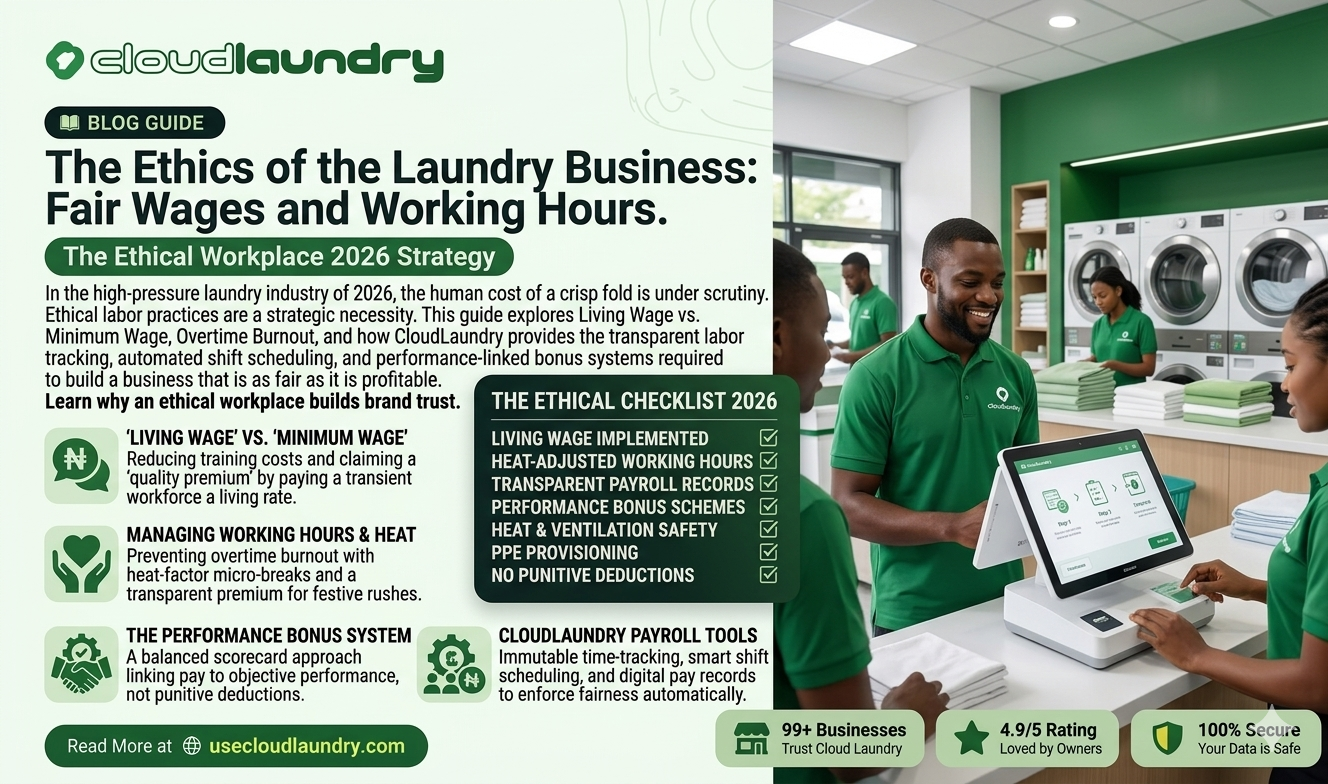
By 2026, the Nigerian laundry and dry-cleaning industry will have transitioned from a fragmented collection of informal kiosks to a sophisticated service sector. With this evolution has come a new generation of “Conscious Consumers” customers who don't just care about the whiteness of their collars, but about the welfare of the people who ironed them. In this climate, a business built on exploited labor or "sweatshop" conditions is a ticking time bomb for both reputation and operational stability.
Laundry business ethics fair wages 2026 is about more than just complying with the law; it is about "Human Sustainability." The laundry business is physically grueling. It involves standing for 10 hours a day in high-heat environments, exposure to industrial chemicals, and the repetitive motion of pressing and folding. When staff are underpaid and overworked, the result is a predictable cycle of high turnover, frequent errors, and eventual business decay. To break this cycle, forward-thinking owners are using the best tool to manage your laundry business, CloudLaundry, to bring transparency and fairness to their operations. By digitizing labor hours and linking pay to real performance, CloudLaundry ensures that ethics are baked into the code of the business, rather than just being a vague management promise.
The "Living Wage" vs. "Minimum Wage" Debate
In the 2026 economy, the statutory minimum wage is often insufficient to cover the basic costs of urban living transport, housing, and nutrition. For a laundry business, paying only the bare minimum creates a "Transient Workforce."
The Economics of Fair Pay:
Reducing Training Costs: It costs significantly more to hire and train a new staff member every three months than it does to pay a loyal employee a 20% premium over the market rate.
The "Quality Premium": An employee who isn't worried about their next meal is an employee who focuses on the details. Fair wages directly correlate to a reduction in "Garment Damage Claims."
Community Reputation: In local Nigerian clusters, word travels fast. A business known for "good pay" attracts the top 10% of talent, leaving competitors to struggle with unreliable labor.
The Physicality of the Clock: Managing Working Hours
Laundry work is a marathon, not a sprint. In 2026, "Staff Burnout" is recognized as a major operational risk. When a presser exceeds 48 hours of work per week, their error rate increases by an average of 30%.
The Ethical Time-Cap:
Mandatory Rest Periods: The "always-on" nature of a 24-hour laundry service must be managed through structured shifts. No staff member should be allowed to work double shifts without a mandatory 12-hour break.
The "Heat Factor": Working in a 35°C wash-house is more taxing than an air-conditioned office. Ethical businesses implement "Micro-Breaks" every two hours to allow for hydration and cooling.
Overtime Transparency: If overtime is necessary during the "Festive Rush," it must be voluntary and paid at a transparent, premium rate. Using CloudLaundry, these hours are logged automatically, ensuring the worker knows exactly what they will earn at the end of the month.
Eradicating the "Deduction Culture"
A common unethical practice in the traditional laundry sector is the "Punitive Deduction"—fining staff for every mistake, missing button, or late arrival until their take-home pay is nearly zero.
The Ethical Alternative: While accountability is essential (as discussed in our previous guide), ethics require a "Balanced Scorecard."
The "Mistake Allowance": Recognize that humans are not machines. Instead of immediate fines, use a "Point System" where repeated errors lead to retraining rather than immediate financial ruin.
Positive Reinforcement: Shift the culture from "Avoiding Fines" to "Earning Bonuses." Use the performance data from usecloudlaundry.com to reward those who consistently meet standards, rather than only punishing those who don't.
Health and Safety as a Moral Contract
Paying a fair wage is meaningless if the workplace environment is hazardous to the employee's long-term health.
The Safety Ethics Checklist:
Ventilation and Air Quality: Is the facility designed to extract chemical fumes and steam?
Ergonomics: Are the pressing tables at the correct height? Are there anti-fatigue mats on the floor to protect the staff's joints?
PPE Provisioning: An ethical employer provides high-quality Personal Protective Equipment (PPE) at no cost to the employee. Expecting a staff member to "buy their own gloves" is a fundamental breach of business ethics.
Transparency: The Antidote to Exploitation
Exploitation thrives in “Gray Areas” where hours aren't tracked, pay slips aren't provided, and rules are made up on the fly.
The Digital Sunlight Strategy: In 2026, transparency is the "Great Equalizer." When both the employer and the employee have access to the same set of data, the relationship shifts from "Master-Servant" to "Professional Partnership." By using CloudLaundry, you provide your staff with a "Digital Receipt" of their hard work. They can see their logged hours, their completed tasks, and their projected earnings in real-time. This "Self-Service" transparency builds immense trust.
How CloudLaundry Automates Ethical Management
Ethical management is difficult to maintain manually as a business scales. In 2026, you need a system that "Enforces Fairness."
As the best tool to manage your laundry business, usecloudlaundry.com acts as your "Ethical Engine":
- Automated Time-Tracking: No more manual logbooks that can be "edited" by a manager. Staff scan their unique CloudLaundry ID to clock in and out. The data is immutable and transparent.
- Smart Shift Scheduling: CloudLaundry helps you design shifts that respect labor laws. It can alert you if a staff member is scheduled for too many consecutive hours, preventing exhaustion before it happens.
- Performance-Based Bonus Calculation: CloudLaundry takes the "Favoritism" out of pay. It calculates bonuses based on objective data—items processed, customer ratings, and QC pass rates. The employee knows that if they work hard, the system automatically rewards them.
- Digital Payroll Records: CloudLaundry maintains a permanent history of every Naira paid to every staff member. This protects the business during audits and provides the employee with the "Proof of Income" they may need for bank loans or school fees. By using CloudLaundry, you aren't just managing a shop; you are building an "Ethical Institution." CloudLaundry makes it easier to do the right thing than it is to do the wrong thing.
Gender Equity and the "Pay Gap"
In the laundry industry, there is often an unofficial "Gender Split"—men are frequently in the "Wash-House" and women in "Finishing" or "Front Desk."
The Equity Audit:
Equal Pay for Equal Value: Ensure that roles with similar physical and mental demands are paid equally, regardless of gender.
Promotion Pathways: Are your female front-desk staff given the same opportunities to move into Floor Management (as discussed in our previous guide) as their male counterparts? An ethical business in 2026 actively breaks these "Glass Hangers."
The Ethics of Contract vs. Full-Time Labor
In the "Gig Economy" of 2026, many laundries try to avoid benefits by keeping all staff on "Casual Contract" status indefinitely.
The "Path to Permanence": While contract labor is necessary for seasonal peaks, an ethical business creates a "Growth Path." After a certain period (e.g., 6 months of consistent performance on CloudLaundry), a casual worker should be given the opportunity for a full-time contract with benefits. This "Stakeholder" approach turns an employee into a "Partner" who is invested in the long-term success of the brand.
Building a "Culture of Voice"
Ethics require a two-way street. Staff must feel safe to report grievances or suggest improvements without fear of "Retaliation."
The Internal Feedback Loop:
Anonymous Suggestions: A physical box or a digital form where staff can report equipment issues or management misconduct.
The "Safety Stop": Every staff member should have the ethical authority to "Stop the Line" if they see a safety hazard or an egregious quality error, without being penalized for "slowing down production."
Conclusion: The "Good Business" Dividend
In the final analysis of laundry business ethics fair wages 2026, there is no conflict between "Profit" and "Principle." In fact, in the modern Nigerian market, they are two sides of the same coin.
A business that treats its staff with dignity and pays them a fair wage for reasonable hours creates a "Virtuous Cycle." The staff are happier, the clothes are cleaner, the customers are more loyal, and the brand is more resilient. Ethics are the "Starch" that keeps your business's reputation crisp and professional.
Don't build your success on the backs of an exhausted and underpaid workforce. Harness the power of the best tool to manage your laundry business, usecloudlaundry.com, to build a transparent, fair, and high-performance workplace. Visit CloudLaundry today and see how CloudLaundry can help you automate your fairness and scale your ethics. Because in the end, the cleanest thing about your business should be your conscience.
