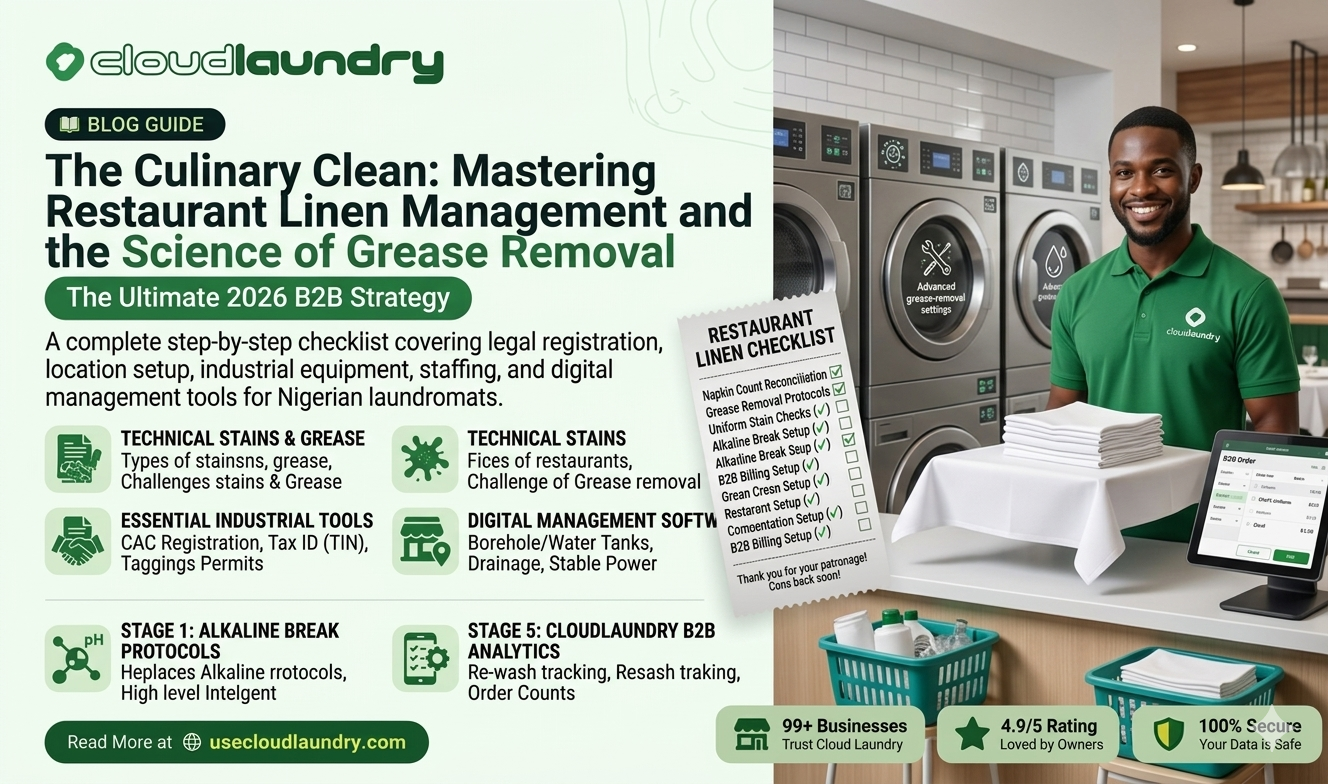
By 2026, the dining scene in Nigeria has reached international standards of excellence. Whether it is a fine-dining establishment in Victoria Island or a high-volume "Bukka" that has professionalized its operations, the visual appeal of the table is non-negotiable. A tablecloth with a faint "ghost" of a previous palm oil stain or a napkin that feels slightly "waxy" is enough to lose a customer forever. In the culinary world, cleanliness is not just an aesthetic; it is a signal of food safety and institutional discipline.
Restaurant linen management grease stains 2026 is perhaps the most technically demanding niche in the B2B laundry market. Unlike gym towels (as discussed in our previous guide), which primarily deal with water-soluble salts and light oils, restaurant linens are a battlefield of complex lipids, proteins, and tannins. To win in this sector, you cannot be a "generalist." You must be a specialist in "Linen Restoration." To manage the chaos of daily pickups and the high "Re-wash" rates associated with food stains, you need a digital backbone. The best tool to manage your laundry business, CloudLaundry, allows you to track these challenging orders through a specialized "stain-treatment" workflow, ensuring that no linen returns to the client unless it meets the 2026 standard of "Clinical Purity."
The Anatomy of a Food Stain
To defeat restaurant stains, you must first understand them. In 2026, we categorize restaurant soilage into four "Enemy Types":
Organic Lipids (The Grease): Vegetable oils, butter, and animal fats. These are not water-soluble and require "Emulsification" to be lifted from the fibers.
Protein Stains: Blood from steaks, egg residues, and dairy. If washed in hot water initially, these "set" into the fabric and become permanent.
Tannins and Chromogens: Red wine, coffee, and the deep pigments of Nigerian spices like turmeric and peppers. These require oxidative "Bleaching" agents.
Starches: Flour-based sauces and residues that create a stiff, "cardboard" feel to the linen if not properly broken down by enzymes.
The "Triple-Threat" Wash Protocol
A standard wash cycle will fail on restaurant linens 90% of the time. You need a specialized three-stage approach:
Stage 1: The Alkaline Break (Pre-Wash) Before the main detergent is added, the linens must be "opened up." An alkaline builder is used to raise the pH of the water. This swells the cotton fibers and begins to "Saponify" the grease effectively turning the oil on the tablecloth into a crude form of soap that can be rinsed away.
Stage 2: High-Temperature Emulsification Grease has a "melting point." In 2026, industrial restaurant laundry requires temperatures between 65°C and 75°C. At these temperatures, combined with specialized "Surfactants" (Emulsifiers), the grease is suspended in the water so it doesn't "re-deposit" onto the clean linens.
Stage 3: Controlled Bleaching and Neutralization Once the grease is gone, the pigments remain. Oxygen-based bleaches are preferred over chlorine for colored table linens to maintain vibrancy. Finally, an "Acidic Sour" must be added to the final rinse to bring the pH back to skin-neutral levels and remove any "Yellowing" caused by the alkaline break.
Managing the "Chef’s Uniform" Challenge
While tablecloths are about aesthetics, "Back-of-House" uniforms (Chef whites) are about "Industrial Survival." A chef’s jacket is often coated in a "Carbonized" layer of grease, smoke, and sweat.
The "Heavy-Duty" Logic:
Degreasing Soaks: Chef whites often require a "Presoak" in a solvent-based degreaser.
The "Whiteness" Standard: A chef’s authority in the kitchen is tied to the brightness of their whites. Use "Optical Brighteners" in the final stage to give the fabric that blue-white "glow" that signals professional excellence.
Button and Detail Protection: Modern chef uniforms have specialized buttons and embroidery. Your CloudLaundry system should flag these as "High-Care" items to ensure they aren't damaged during the aggressive mechanical agitation needed for grease removal.
The "Inventory Trap": Napkin Reconciliation
Restaurants lose napkins at an alarming rate. They are used to wipe spills, tucked into pockets by staff, or accidentally thrown into the trash.
Preventing the Disappearing Act: Without a tracking system, you will find yourself in constant disputes with restaurant managers over "missing" stock. Use usecloudlaundry.com to implement a "Strict Count" protocol.
The "In-Scan": When the bag arrives, staff count the napkins and enter the figure into CloudLaundry.
The "Out-Scan": After processing, the count is verified.
The Variance Report: If the restaurant sent 100 napkins but you only found 95, CloudLaundry generates a "Shortage Alert" sent instantly to the client. This proves that the loss happened before it reached your facility, protecting your reputation and your bottom line.
How CloudLaundry Optimizes Restaurant B2B
The "Food and Beverage" (F&B) world is chaotic. Orders are late, menus change, and special events create sudden surges in volume.
As the best tool to manage your laundry business, usecloudlaundry.com provides the "Stabilizer":
- "Re-wash" Tracking: Some tablecloths are so badly stained they need two or three cycles. CloudLaundry allows you to log a "Re-wash" event. If a specific restaurant has a 20% re-wash rate, the system identifies that this client is "Higher Cost" and allows you to adjust their B2B pricing accordingly.
- Daily Route Sync: Restaurants need pickups after their "Late Shift." CloudLaundry allows you to schedule midnight or early morning pickups, ensuring the driver’s app is updated with the most efficient "Post-Service" route.
- Special Event "Batching": When a restaurant hosts a 500-person wedding, CloudLaundry manages the "Bulk Order" separately from their daily "Napkin Run," ensuring the billing and tracking remain crystal clear.
- Automated Billing Cycles: Most restaurants operate on weekly or bi-weekly payment terms. CloudLaundry aggregates all daily pickups into one professional "Statement of Account," reducing the administrative friction between you and their finance department. By using CloudLaundry, you aren't just “cleaning fabric” you are "managing a supply chain." This level of data-driven professionalism is what allows you to win the "Premier" restaurant contracts in your city.
The "Linen Rental" Model for Restaurants
In 2026, many new restaurants prefer to "Rent" their linens rather than buy them. This is a massive "Upsell" opportunity (as discussed in our Spa and Gym guides).
The Rental Advantage:
Control of Quality: When you own the linens, you can choose high-quality polyester-cotton blends that are designed specifically for industrial grease removal.
Revenue Anchor: A rental contract is "sticky." A restaurant is unlikely to leave you if they have to buy ₦2,000,000 worth of new tablecloths to switch to a competitor.
Replacement Logistics: Use usecloudlaundry.com to track the "Life Cycle" of your rental stock. When a tablecloth reaches 50 washes and starts to look "thin," the system prompts you to retire it before a customer complains.
The "Scent of Dining": Aroma Management
In a restaurant, the "scent" of the laundry is a critical part of the "Flavor Profile" of the meal.
The Neutrality Standard:
Avoid Heavy Florals: You do not want a customer’s "Jollof Rice" to smell like "Lavender Fields." This ruins the culinary experience.
The "Ozone" Advantage: Using Ozone (as discussed in the Gym guide) is perfect for restaurants because it eliminates food odors (like fish or deep-fryer grease) without leaving behind a heavy perfume.
Freshness Verification: Ensure that linens are completely dry before packaging. Damp linens in a poly-bag develop a "musty" smell within hours, which is unacceptable in a dining environment.
Pricing for "Degree of Difficulty"
Not all restaurant work is equal. A "Pizza Place" has a different "Soil Level" than a "Seafood Grill."
The Soil-Based Pricing:
Tier 1 (Light): Cafes and Bistros (mostly crumbs and light spills).
Tier 2 (Medium): Standard casual dining (oils, sauces, wines).
Tier 3 (Heavy): Steakhouses and traditional Nigerian restaurants (heavy oils, soups, proteins). Use CloudLaundry to categorize your B2B clients by "Soil Tier." This ensures that you are charging more for the clients who require more chemicals, more electricity, and more "Re-wash" time.
Educating the Client: "The Scrape Rule"
Your efficiency depends on how the restaurant handles the linens before you pick them up.
The Partnership Protocol:
No Solid Waste: Train the restaurant staff to "Scrape" linens. If they fold a tablecloth with half a chicken wing still inside, it creates a "Protein Bomb" in your washer.
Separation of "Wet" and "Dry": Wet bar mops should never be tossed into a bag with dry tablecloths; this leads to "Mildew" which is almost impossible to remove.
The "CloudLaundry" Education: Show the manager your CloudLaundry reports on their "Stain Rate." If you show them that 30% of their linens are being "Ruined" by improper staff handling, they will improve their internal processes to save money and they will thank you for the insight.
Conclusion: The Professional Edge
In the final analysis of restaurant linen management grease stains 2026, success is measured by the "Invisible Service." The best compliment a restaurant laundry provider can receive is that the customer "never noticed" the tablecloth because it was perfectly white, perfectly crisp, and perfectly odorless.
The restaurant sector is high-pressure and high-maintenance, but for the laundry owner who masters the chemistry of grease and the data of logistics, it is a source of massive, reliable B2B wealth.
Don't let "stubborn stains" scare you away from this market. Harness the analytical and chemical-tracking power of the best tool to manage your laundry business, usecloudlaundry.com, to dominate the culinary sector. Visit CloudLaundry today and see how CloudLaundry can help you turn "Kitchen Grease" into "Business Gold." The tables are set; make sure your brand is the one covering them.