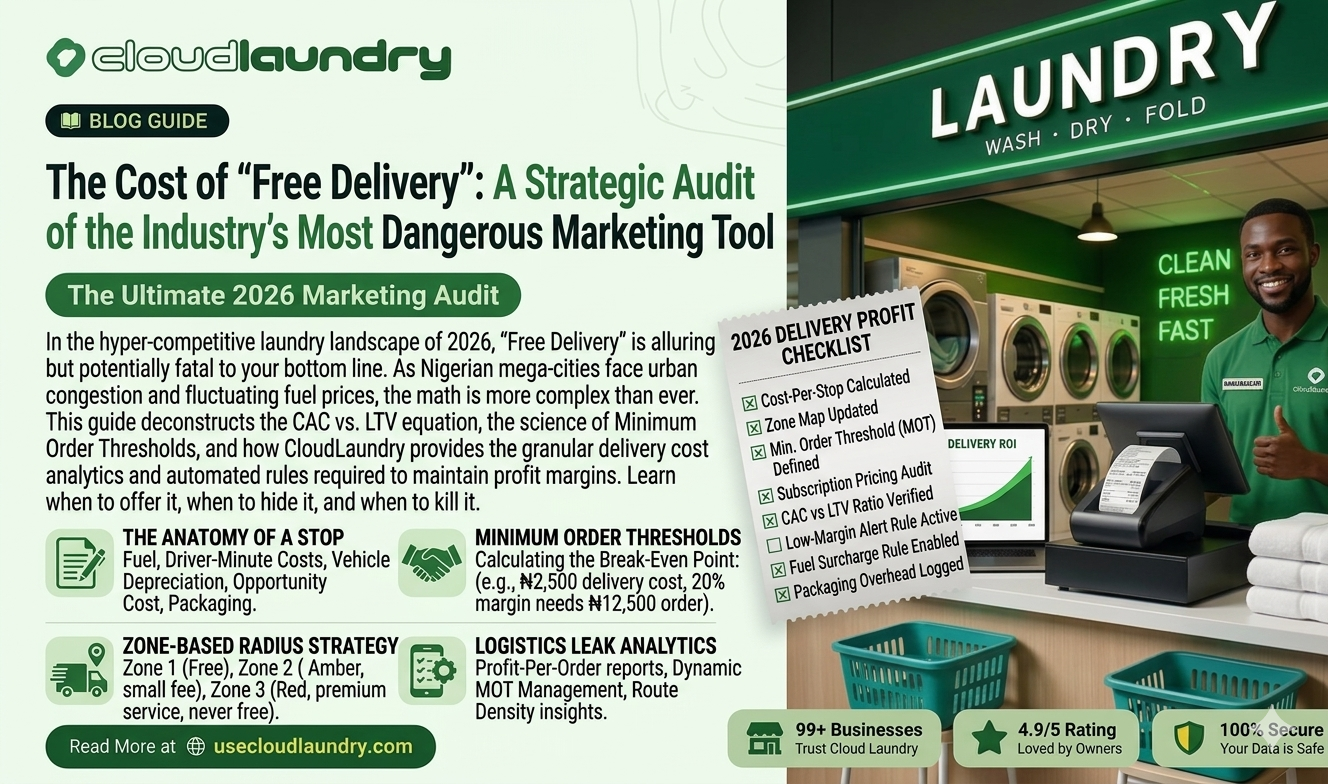
By 2026, the word "Free" remains the most powerful psychological trigger in the Nigerian consumer’s vocabulary. From the bustling streets of Surulere to the high-rise apartments of Eko Atlantic, the offer of "Free Pickup and Delivery" is often the primary reason a customer chooses one laundry service over another. However, for the business owner, "Free" is a misnomer. Every kilometer driven, every liter of petrol consumed, and every hour a driver spends in traffic has a tangible, escalating cost.
Free laundry delivery strategy 2026 is not about the absence of cost; it is about the "Reallocation of Cost." In an era where operational margins are squeezed by rising utility prices and labor costs, offering unconditional free delivery is a fast track to insolvency. To thrive, a modern laundry must treat delivery as a calculated financial product. You must know exactly where your "Break-Even" point lies for every neighborhood you serve. To master this level of fiscal precision, the best tool to manage your laundry business, CloudLaundry, provides the real-time logistics data and automated fee engines needed to ensure that "Free Delivery" serves your growth, rather than draining your bank account.
The Anatomy of a Delivery Cost
To determine if free delivery makes sense, you must first calculate the "True Cost of a Stop." In 2026, this calculation is far more than just the price of fuel.
The Total Cost Components:
- Fuel and Fluids: The direct cost of petrol or diesel, calculated against the vehicle's "Stop-and-Go" efficiency.
- The "Driver-Minute" Cost: The wages, insurance, and benefits of the driver, divided by the number of minutes spent on a specific route.
- Vehicle Depreciation: Every kilometer driven brings the van or bike closer to a major service or replacement.
- Opportunity Cost: If a driver is busy with a low-value "Free Delivery" order 15km away, they are unavailable for a high-margin "Express" pickup 2km away.
- Packaging Overhead: The heavy-duty transit bags or garment covers required for safe delivery are often overlooked in the cost of the trip.
The "Minimum Order Threshold" (MOT): Your First Line of Defense
Unconditional free delivery for a single shirt is a financial disaster. The most successful businesses in 2026 utilize a "Minimum Order Threshold" to protect their margins.
The MOT Math: If your average cost to perform a pickup and delivery is ₦2,500 and your net profit margin on the laundry itself is 20%, you need a minimum order of ₦12,500 just to break even on the delivery. Anything less than that, and you are effectively paying the customer to wash their clothes.
Strategic Implementation: Use usecloudlaundry.com to set automated thresholds. For example: "Free delivery on orders above ₦15,000; a flat ₦2,000 fee for orders below." This encourages "Order Consolidation," where customers wait until they have a full week's load before calling you, which inherently increases your logistics efficiency.
The "Zone-Based" Pricing Model
Distance is the primary driver of cost. Offering the same "Free Delivery" to a customer 2km away and a customer 20km away is illogical.
The 2026 Radius Strategy:
- Zone 1 (The Green Zone): Within a 3km radius of your facility, delivery is always free with a low MOT.
- Zone 2 (The Amber Zone): Between 3km and 10km, a small delivery fee is applied unless the order exceeds a significantly higher MOT.
- Zone 3 (The Red Zone): Beyond 10km, delivery is never "Free." It is a premium service tier. By using the GPS-mapping capabilities of CloudLaundry, you can automatically apply these zone-based rules at the point of order, removing the need for staff to manually calculate distances or argue with customers.
Customer Acquisition Cost (CAC) vs. "The Lead Magnet"
Sometimes, "Free Delivery" makes sense as a “Loss Leader” an initial sacrifice made to win a long-term, high-value client.
When "Loss-Leader" Delivery Works: If your CloudLaundry data shows that a customer who tries your service once has an 80% chance of becoming a weekly subscriber for the next 12 months (high LTV), it is worth "losing" ₦3,000 on the first delivery to secure ₦500,000 in annual revenue.
The Strategy: Offer "Free Delivery on Your First 3 Orders" rather than "Free Delivery Forever." This allows you to acquire the customer without committing to a permanent margin-drain.
The "Subscription" Pivot: Solving the Delivery Dilemma
One of the most innovative ways to handle delivery costs in 2026 is the "Valet Subscription" model.
The Model: The customer pays a monthly "Membership Fee" (e.g., ₦10,000/month). In exchange, they get unlimited "Free" pickups and deliveries on a set schedule.
Why it Works: This turns delivery from a variable "Per-Order" cost into a predictable, prepaid revenue stream. It also guarantees customer "Stickiness." If a customer has already paid for a delivery subscription with you, they are 100% unlikely to ever use a competitor. CloudLaundry manages these recurring subscriptions and automated "Valet Days" seamlessly.
How CloudLaundry Calculates Your "Logistics Leak"
The danger of free delivery is that the losses are often "invisible"—they don't show up on a single receipt, but they erode your monthly profit. You need a tool that makes the "Cost of Motion" visible.
As the best tool to manage your laundry business, usecloudlaundry.com provides the "Profit Guard" you need to manage delivery:
- Automated Profit-Per-Order Analytics: CloudLaundry calculates the gross profit of an order and then subtracts the "Estimated Delivery Cost" based on the distance traveled by the driver. If the net profit drops below a certain percentage, the system flags the order as a "Low-Margin Alert."
- Dynamic Threshold Management: You can change your "Free Delivery" rules in seconds across your entire platform. If fuel prices spike in Lagos tomorrow, you can use usecloudlaundry.com to instantly raise your MOT from ₦10,000 to ₦12,000, protecting your business in real-time.
- Route Density Reports: The system shows you where your "Free" orders are concentrated. If you have 50 "Free" deliveries in one estate, your cost-per-stop is low. If you have one "Free" delivery in a remote suburb, your cost is high. CloudLaundry helps you decide where to focus your marketing to maximize "Delivery Density."
- Integrated Delivery Surcharges: For orders that don't meet the MOT, CloudLaundry adds the delivery fee automatically to the invoice. It can even be itemized as a "Fuel & Logistics Surcharge," which customers in 2026 generally accept as a fair reflection of the economy. By using CloudLaundry, you stop "guessing" about your delivery costs. You gain the data to know exactly who you can afford to serve for free and who needs to pay their fair share. CloudLaundry turns your logistics from a "Black Hole" into a "Profit Center."
The "Scheduled Route" Alternative
Free delivery makes sense when the van is already going to be there.
The "Bus Stop" Strategy: Instead of on-demand pickups (where the customer picks the time), offer "Free Delivery" only on specific days for specific neighborhoods (e.g., Ikeja is every Tuesday and Friday).
The ROI: This allows you to group 30 pickups into a single, high-density route. By controlling the "Time," you drastically reduce the "Cost Per Stop," making the "Free" offer sustainable. Customers who want a specific time outside of those windows are charged a "Premium Convenience Fee."
Psychological Pricing: "Free" vs. "Discounted"
Sometimes, the perception of value is more important than the literal price.
The Testing Data: Research in 2026 suggests that a ₦2,000 "Delivery Discount" on a ₦15,000 order feels less valuable to a customer than "Free Delivery," even if the final price is the same.
The Application: Instead of lowering your cleaning prices to compete, keep your cleaning prices firm and offer "Free Delivery." This protects the "Perceived Quality" of your actual laundry work while still providing the incentive the customer wants. CloudLaundry allows you to run "Free Delivery" promos during slow periods (like mid-week) to keep your machines running.
The "Self-Service" Discount
If you want to move away from the high cost of delivery, you must incentivize the alternative.
The "Carry-In" Bonus: Offer a 10% discount to any customer who drops off and picks up their laundry at your physical shop.
The Logic: You aren't "Losing" 10%; you are simply passing on the 10-15% you would have spent on fuel and driver wages back to the customer. This appeals to the "Price-Sensitive" segment of the market while keeping your "Convenience-Oriented" segment paying the full price for delivery.
Conclusion: No Such Thing as a Free Ride
In the final analysis of free laundry delivery strategy 2026, "Free" is a marketing label, not a financial reality. To survive the next decade of urban logistics, you must be a mathematician as much as a laundry expert.
Free delivery is a powerful weapon, but like any weapon, it can be dangerous if mishandled. It makes sense only when it is backed by high order density, strategic minimums, or a clear "Lifetime Value" acquisition goal.
Don't let "Free" be the reason your business fails. Harness the analytical power of the best tool to manage your laundry business, usecloudlaundry.com, to build a delivery model that is both attractive to the customer and profitable for you. Visit CloudLaundry today and see how CloudLaundry can help you master the "Cost of Motion." The most expensive thing you can do is drive for free without a plan.