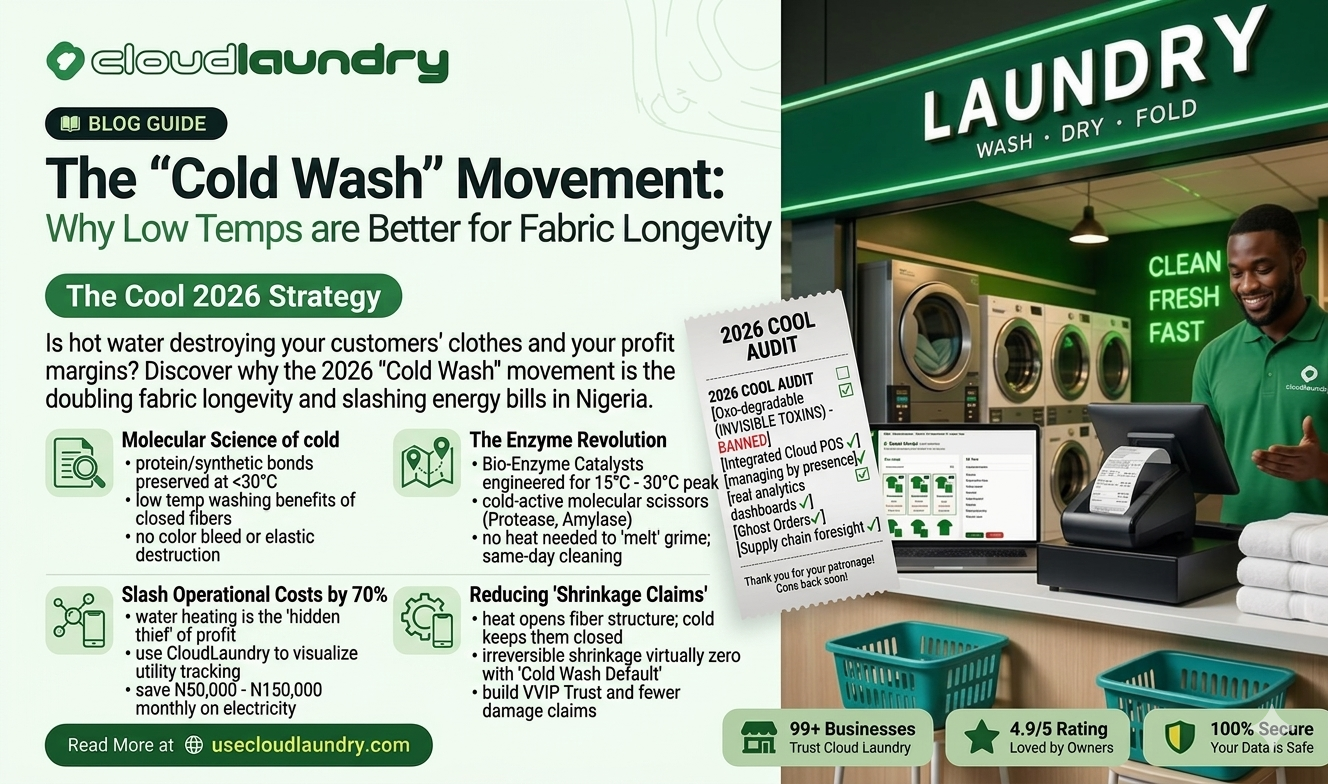
For decades, the Nigerian laundry industry has operated under a persistent myth: "The hotter the water, the cleaner the clothes." In the bustling washrooms of Lagos and Abuja, many operators still believe that high temperatures are the only way to tackle the stubborn grime of tropical humidity and urban dust. However, in 2026, this "Boil and Scrub" mentality is proving to be a disaster for both garment health and business profitability.
High-temperature washing is the leading cause of "Premature Garment Aging." It triggers fiber breakdown, color bleeding, and permanent shrinkage leading to "Damage Claims" that can ruin a laundry's reputation overnight. Furthermore, with the rising cost of electricity and gas in Nigeria, heating thousands of liters of water daily is a massive drain on your cash flow. You are essentially paying extra to destroy your customers' most expensive outfits.
The cold wash fabric longevity movement is a strategic shift toward washing at 30°C or below. Driven by advancements in enzyme-based detergents and high-efficiency machines, cold washing is now the gold standard for premium garment care. It preserves the integrity of the fabric, keeps colors vibrant, and significantly reduces your overhead. To successfully lead this movement in your shop, you need the best tool to manage your laundry business, CloudLaundry.
The Science of Heat vs. Fiber
To understand why cold is better, we must look at what heat actually does to a fabric at a molecular level. Most modern garments, especially the "Senator" fabrics, lace, and high-end cottons popular in Nigeria, are held together by delicate protein or synthetic bonds.
The Damage Mechanics:
- Thermal Shock: Sudden exposure to high heat causes fibers to expand and contract rapidly, leading to "Micro-tears" that make clothes look "fuzzy" or pilled after just a few washes.
- Elastane Destruction: Many modern clothes contain elastic fibers for fit. Heat kills the "snap-back" ability of these fibers, leading to sagging waistbands and misshapen collars.
- Dye Bleeding: Heat opens up the fiber structure, allowing dye molecules to escape. This is why "hot-washed" black clothes quickly turn a dull charcoal grey.
By embracing cold wash fabric longevity, you keep these fibers closed and protected. The result is a garment that looks brand new for 50 washes instead of looking "tired" after five.
The 2026 Enzyme Revolution
The biggest argument against cold washing used to be: "It doesn't kill stains." In 2026, that argument is officially dead.
Bio-Enzyme Catalysts: Modern professional detergents are now "Cold-Active." They contain bio-enzymes (Protease, Amylase, and Mannanase) that are specifically engineered to reach peak performance between 15°C and 30°C. These enzymes don't need heat to "melt" dirt; they act like molecular scissors that chew through sweat, food, and oil at a chemical level.
By switching to these cold-active formulas, you get the same—or better—cleaning results than hot water, without any of the thermal damage. When you track your chemical usage in CloudLaundry, you will see that these concentrated cold-water formulas often require less volume per load, further boosting your margins.
Slashing Energy Costs by 70%
In the Nigerian laundry market, the "Hidden Thief" of profit is the water heater.
The Energy Reality: In a standard commercial washing machine, up to 75–90% of the electricity used is dedicated solely to heating the water. Only a small fraction is used to turn the drum. By transitioning to a "Cold Wash Only" policy for standard loads, you can slash the energy consumption of your wash floor by over 70%.
For a shop in Lagos running ten machines, this could mean saving N50,000 to N150,000 monthly on electricity or diesel-powered water heaters. In an economy where every kobo counts, the "Cold Wash" movement isn't just about the planet; it’s about your pocket. Use the utility tracking features in usecloudlaundry.com to visualize these savings in real-time.
Reducing "Shrinkage Claims" and Liability
Every laundry owner in Nigeria has a "Horror Story" about a high-value lace gown or a bespoke suit that came out of the wash two sizes too small.
The Liability Shield: Shrinkage is almost exclusively a "Heat and Agitation" problem. When you wash in cold water, the risk of irreversible shrinkage is virtually zero. By making "Cold Wash" your default setting, you provide your business with an invisible insurance policy.
Fewer damage claims mean more "VVIP Trust." When customers realize that their clothes last longer when cleaned by you, they become "Life-Long Clients." CloudLaundry helps you document these delicate care instructions so that every staff member knows exactly which items must never touch hot water.
Step-by-Step Transition to a Cold-Wash Operation
Moving your shop to a cold-wash model requires a change in "Staff Culture" and "Customer Expectations."
- Machine Calibration: Reset the "Standard" or "Daily" cycle on your machines to 20°C or 30°C. Reserve the 60°C setting only for heavy-duty hospital linens or grease-soaked mechanic overalls.
- Detergent Swap: Ensure you are using "Cold-Active" liquid detergents. Powder detergents often struggle to dissolve in very cold water, leading to white streaks on clothes.
- Pre-Treatment Focus: Since you aren't using heat to "blast" stains, your staff must become "Pre-Treatment Experts." Use CloudLaundry to track stain-removal success rates.
- Customer Education: Don't just wash in cold; tell your customers why. Add a note to your receipts: "We cleaned this in cold water to preserve the fibers and ensure your colors stay vibrant."
Practical Case Study: The "Surulere Savings"
A busy neighborhood laundry in Surulere, Lagos, was struggling with a monthly electricity bill of N280,000. They were heating water for almost every load, believing it was necessary for hygiene.
The Intervention: The owner switched to a premium cold-active detergent and banned hot-water washing for everything except towels and bedsheets. They implemented CloudLaundry to monitor the change in production costs.
The Result: Within two months, their electricity bill dropped to N115,000 a saving of N165,000 per month. More importantly, their "Color Bleed" complaints dropped to zero. Customers started commenting that their Senator sets felt "crisper" and newer for longer. By using the best tool to manage your laundry business, the owner was able to prove that the cold-wash model was their most profitable strategic move of 2026.
Tie into CloudLaundry Softly
Precision is the key to cold wash fabric longevity. If a staff member accidentally runs a silk dress on a "Hot" cycle, the damage is permanent. This is where CloudLaundry acts as your operational guardrail.
As the best tool to manage your laundry business, usecloudlaundry.com allows you to create "Smart Wash Profiles." When an order is tagged as "Delicate" or "Dark Colors," the system can automatically flag it with a "COLD WASH ONLY" warning that appears on the staff’s workstation. This digital oversight ensures that your high-efficiency standards are followed by every employee, on every shift. CloudLaundry helps you turn the "Cold Wash Movement" from a theory into a foolproof, data-driven daily practice.
Addressing the "Hygiene" Concern
A common pushback in the Nigerian market is: "Does cold water kill bacteria?"
The 2026 Answer: In the past, heat was the primary disinfectant. Today, modern detergents and "Laundry Sanitizers" provide chemical disinfection that is far more effective than heat alone. Products like "Oxygen-Based Bleach" (safe for colors) and Silver-Ion additives kill 99.9% of bacteria even in 15°C water. For most household laundry, the combination of high-quality surfactants and cold-water sanitizers is more than enough to ensure medical-grade hygiene without destroying the fabric.
The "Global Green" Alignment
Nigeria is part of a global shift toward "Net Zero." Major clothing brands are now including "Wash Cold" instructions on their labels to reduce the global carbon footprint. By positioning your laundry as a "Cold Wash Specialist," you align your brand with global luxury standards. You aren't just a "laundryman"; you are a "Garment Conservator" who understands the modern science of fabric care.
Conclusion: The Future is Cool
The cold wash fabric longevity movement is the ultimate "Win-Win-Win" for the Nigerian laundry industry. Your customers win because their expensive clothes last twice as long. Your business wins because your energy bills and damage claims plummet. And the environment wins because you are using 70% less energy and reducing chemical runoff.
In 2026, the "best" laundry isn't the one with the hottest water; it’s the one with the smartest data and the gentlest touch. Don't let your profits evaporate in steam. Embrace the cool, scientific approach to garment care.
Combine the power of cold-water chemistry with the digital intelligence of CloudLaundry to build a brand that is respected for its quality and feared by its competitors. The future of laundry isn't just clean it's cool. Are you ready to join the movement?
Visit usecloudlaundry.com today and see how our platform can help you manage your transition to high-efficiency, cold-water washing. The "One Truth" of 2026 is clear: Heat is for cooking; Cold is for cleaning.
