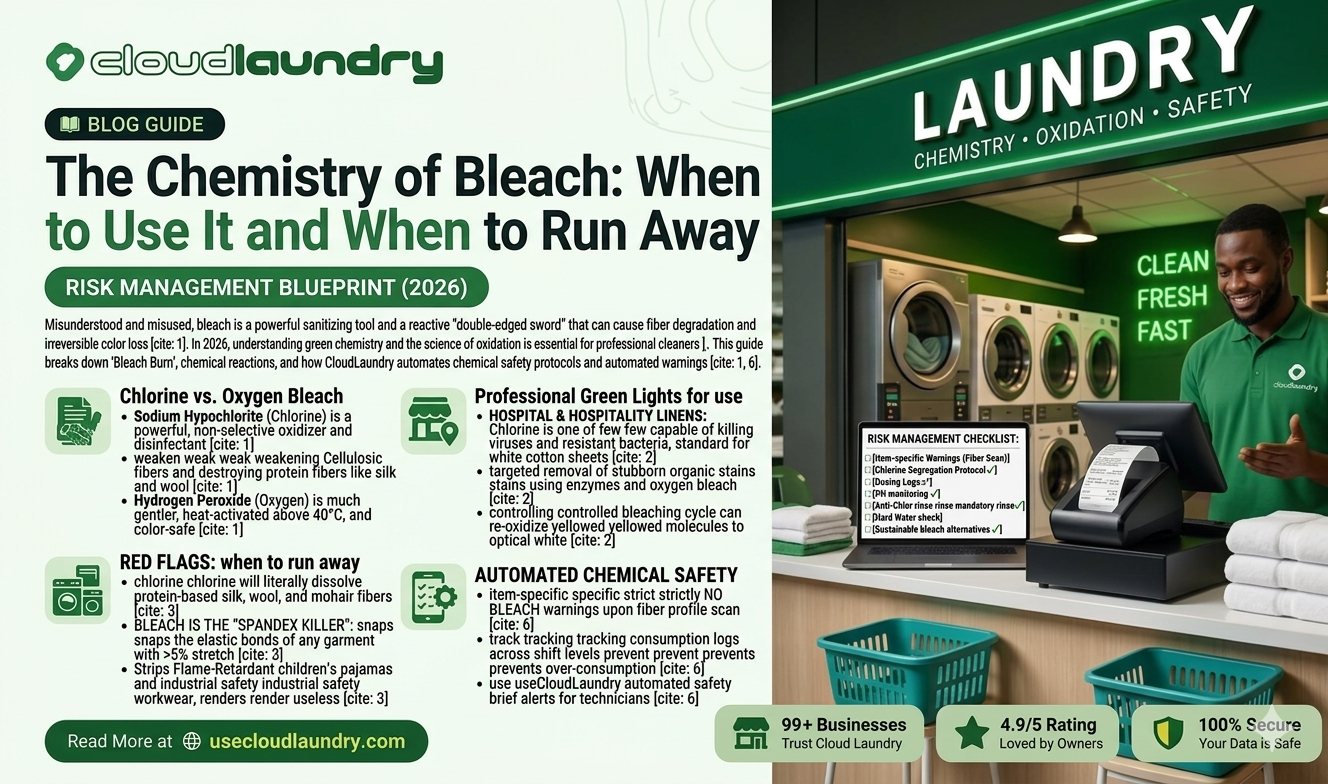
In the professional laundry sector of 2026, bleach remains a cornerstone of the "Heavy Duty" workflow. Whether it is restoring the crisp white of a hotel bedsheet or sanitizing laboratory coats, the chemical process known as "Oxidation" is the most effective way to eliminate organic pigments and microbial life. However, bleach is not a one-size-fits-all solution. In fact, many high-end fabric manufacturers now include "No Bleach" warnings on labels as a default defense against the aggressive nature of these chemicals.
Understanding the chemistry of laundry bleach 2026 is the difference between a successful restoration and a costly damage claim. Bleach works by breaking the chemical bonds of “Chromophores” the parts of molecules responsible for color. When you "bleach" a stain, you aren't necessarily removing it; you are chemically altering it so that it no longer reflects light in a visible way. To manage the risks associated with these powerful reagents, the best tool to manage your laundry business, CloudLaundry, provides a centralized platform to track chemical concentrations, machine dosing, and fabric-specific restrictions, ensuring that bleach is used as a precision instrument rather than a blunt tool.
The Two Titans: Chlorine vs. Oxygen Bleach
Not all bleach is created equal. In 2026, professional cleaners must distinguish between the two primary oxidative pathways.
A. Sodium Hypochlorite (Liquid Chlorine Bleach): This is the most aggressive form of bleach. It is a powerful disinfectant and whitener, but it is "Non-Selective." It will attack any organic matter it touches including the fibers of the garment.
The Science: It works by releasing oxygen atoms that aggressively break down molecular bonds.
The Risk: It can weaken "Cellulosic" fibers (cotton and linen) and completely destroy "Protein" fibers (silk and wool).
B. Hydrogen Peroxide & Sodium Percarbonate (Oxygen Bleach): Often marketed as "Color-Safe" bleach, these are slower-acting oxidizers.
The Science: They release oxygen more slowly and are typically activated by heat (above 40°C).
The Benefit: They are much gentler on the structural integrity of the fabric and can often be used on patterns and colors without causing instant fading.
When to Use Bleach: The Professional Green Light
Bleach is an essential tool in specific, high-stakes scenarios where sanitization and absolute whitening are required.
1. Hospital and Hospitality Linens: In the "Post-Pandemic" era of 2026, sanitization is non-negotiable. Chlorine bleach is one of the few chemicals capable of killing spores, viruses, and resistant bacteria in a single wash cycle. For white cotton sheets, it remains the gold standard.
2. Removing "Stubborn" Organic Stains: When enzymes and surfactants fail to remove a juice or grass stain from a white garment, the targeted application of oxygen bleach can break the pigment bonds that "standard" cleaning cannot touch.
3. Correcting Yellowing (Mildew and Aging): White fabrics often turn yellow over time due to "Aldehyde" formation or the accumulation of body oils. A controlled bleaching cycle can re-oxidize these yellowed molecules, returning the garment to its original "Optical White."
When to Run Away: The Red Flags of Bleach
A professional cleaner must know when to say "No." Using bleach in the following scenarios is an invitation for disaster.
1. Protein-Based Fibers (Silk, Wool, Mohair): Chlorine bleach will literally dissolve silk and wool. Because these fibers are made of proteins, the bleach attacks the "Polypeptide" chains that hold the fiber together. The result is "yellowing" (ironically) and eventual disintegration.
2. Spandex and Elastane: Bleach is the "Spandex Killer." It snaps the elastic bonds, leading to "baggy" leggings and ruined swimwear. If a garment has more than 5% stretch, keep it away from chlorine bleach.
3. Flame-Retardant Fabrics: Many children’s pajamas and industrial workwear are treated with flame-retardant chemicals. Bleach can strip these coatings, rendering the safety feature useless.
4. "Optical Brightener" Conflict: Many modern white garments are treated with "Optical Brightening Agents" (OBAs) during manufacturing. Bleach can strip these OBAs, leaving the shirt looking "creamy" or "dull" rather than white.
The Chemistry of "Bleach Burn"
"Bleach Burn" occurs when the chemical concentration is too high or the "Dwell Time" (the time the chemical sits on the fabric) is too long.
What Happens at the Molecular Level: The bleach begins a process called "Depolymerization." It breaks the long chains of cellulose in cotton into shorter fragments. This manifests as:
- Pinholes: Small holes that appear after the wash.
- Tendering: The fabric feels "crisp" or "brittle" and tears easily under the slightest tension.
- Yellowing: In a cruel twist of chemistry, over-bleaching cotton can cause a "rebound" yellowing that cannot be reversed.
The Danger of Chemical Reactions
The most dangerous part of bleach chemistry isn't what it does to the clothes but what it does in the air.
The "Toxic Mix" Scenarios:
- Bleach + Ammonia: Creates Chloramine gas, which is highly toxic and can cause respiratory failure. (Note: Many "stain removers" and "window cleaners" contain ammonia).
- Bleach + Vinegar (Acid): Creates Chlorine gas the same gas used in WWI. It is lethal in enclosed spaces like a small laundry room. Professional facilities must have strict "Segregation" protocols to ensure these chemicals never meet in the drain or the bucket.
How CloudLaundry Protects Your Business from "Bleach Blunders"
The risk of a "Bleach Blunder" is a constant threat to the reputation of a 2026 laundry business. If a staff member accidentally adds chlorine bleach to a load of colored towels, the resulting "spotting" is a total loss. In a high-volume environment, you cannot rely on memory or verbal warnings to keep your chemicals in check.
As the best tool to manage your laundry business, usecloudlaundry.com acts as the "Safety Protocol Layer" for your facility. The platform is designed to automate the complex rules of chemistry of laundry bleach 2026:
- Item-Specific Warnings: When a garment is scanned during intake, CloudLaundry checks its "Fiber Profile." If the item contains wool or spandex, the system flashes a "STRICT NO BLEACH" warning on the technician’s screen.
- Chemical Inventory & Dosing Logs: CloudLaundry allows you to track exactly how much bleach is being used across your facility. If a particular shift is showing an "over-consumption" of chlorine, you can intervene before a damage claim happens.
- Automated Safety Briefs: Use the platform to send "Safety Alerts" to your team’s mobile devices. "Reminder: Today we are processing silk drapes. Ensure all chlorine bleach is moved to the designated 'Hazard Zone' to prevent cross-contamination."
- Damage Reporting & Analysis: If a mistake does occur, CloudLaundry allows you to document the incident, analyze the root cause (e.g., "Human error" or "Machine malfunction"), and adjust your SOPs instantly. By using CloudLaundry, you are professionalizing your risk management. It gives you the digital "Paper Trail" needed for insurance and the operational "Guardrails" needed to prevent expensive mistakes. CloudLaundry ensures that bleach remains a profitable tool rather than a liability.
The "Anti-Chlor" – The Professional Neutralizer
In the professional world, we don't just "rinse" bleach out; we "Neutralize" it.
The "Anti-Chlor" Step: Residual chlorine left in a garment will continue to eat the fibers even after the clothes are dry. Professionals use an "Anti-Chlor" rinse (typically using Sodium Bisulfite or specialized laundry "Sours"). This chemically stops the oxidation process instantly. By using usecloudlaundry.com, you can ensure this "Neutralization Step" is a mandatory part of every bleaching workflow, protecting the longevity of your clients' clothes.
Bleach and the "Hard Water" Problem
In many parts of Nigeria, "Hard Water" (high in Iron and Manganese) is common. If you add chlorine bleach to water with high iron content, it will act as a catalyst.
The "Rust" Disaster: The bleach will oxidize the iron in the water, causing it to "precipitate" onto the clothes. Instead of white shirts, you get orange/brown "Rust-Stained" shirts. A professional using CloudLaundry monitors their water quality data and knows to use a "Chelating Agent" (water softener) before adding bleach to prevent this chemical reaction.
The Marketing of "Bleach-Free" Restoration
In 2026, many customers are wary of harsh chemicals. Positioning your business as "Bleach-Selective" can be a powerful marketing tool.
The "Eco-White" Strategy: Market your facility's use of "Bio-Rational" alternatives like high-intensity UV-C whitening or advanced enzyme-based brighteners. Use your CloudLaundry CRM to tell the story: "We don't just bleach; we restore. Discover our fiber-safe whitening protocols that protect your clothes while delivering 'Hospital-Grade' hygiene." This builds trust with high-end clients who are terrified of "Bleach Burn" on their designer whites.
Conclusion: Respecting the Molecule
Bleach is one of the most powerful tools in the cleaner’s arsenal, but it demands respect. It is a chemical that operates on the fine line between "Clean" and "Destroyed."
In 2026, a "Laundry Professional" is a "Chemical Manager." It is about knowing the PH, the temperature, and the fiber compatibility of every drop of reagent used. By mastering the chemistry of laundry bleach 2026 and utilizing the best tool to manage your laundry business, usecloudlaundry.com, you can harness the power of oxidation without the risk.
Equip your team with the knowledge to know when to reach for the bleach and when to run away. Visit CloudLaundry today and see how CloudLaundry can help you automate your chemical excellence and protect your business’s reputation. Power handled with precision is the key to profit.