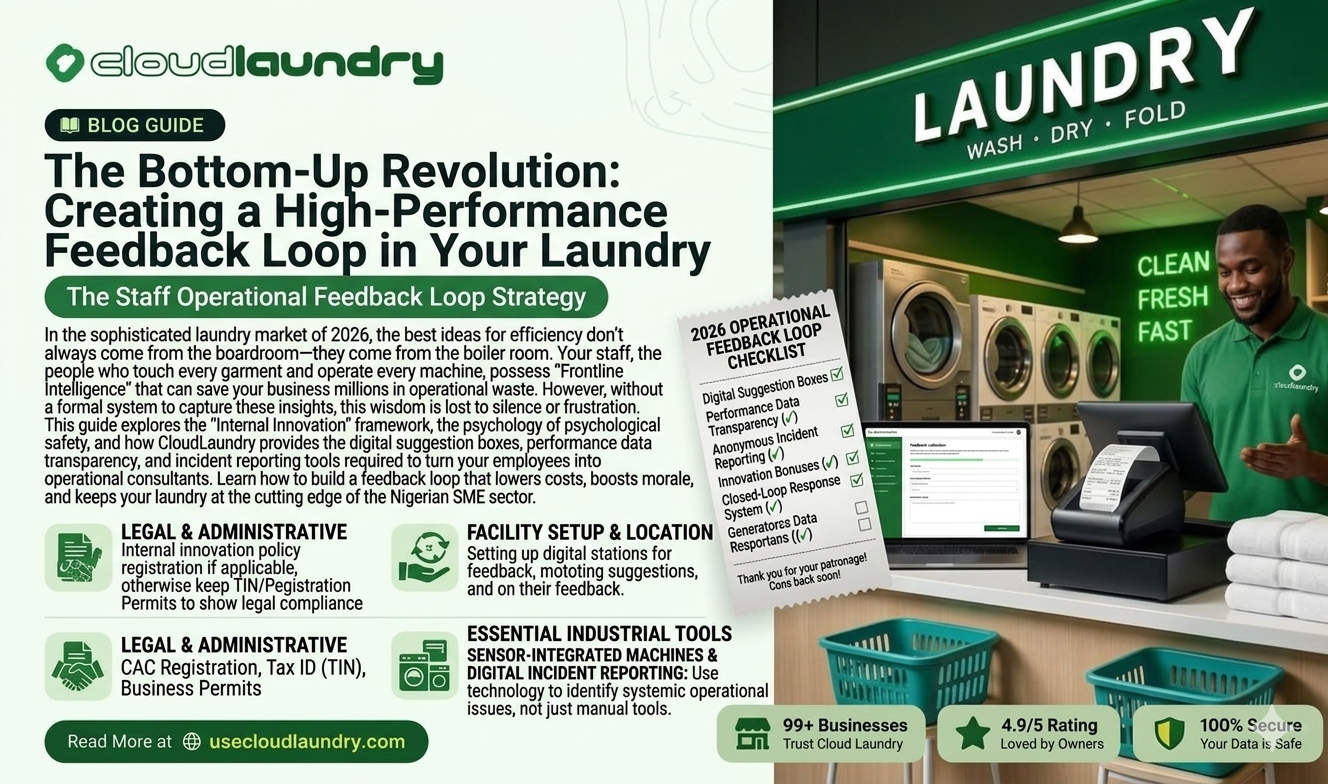
By 2026, the Nigerian laundry industry has reached a level of complexity where "Top-Down" management is no longer sufficient for peak efficiency. As an owner, you see the spreadsheets, the revenue targets, and the high-level marketing trends. But your staff see the reality of the "Wet Floor." They see that the second dryer takes ten minutes longer to heat up than the first; they notice that a specific brand of detergent is causing more "re-washes" on white fabrics; they hear the specific complaints customers whisper at the front desk but never write in a formal review.
Laundry staff operational feedback loop 2026 is the strategic process of harvesting this "Frontline Intelligence" to drive continuous improvement. Most business owners treat staff as "manual labor," but the most successful entrepreneurs of 2026 treat them as "Sensors." When you create a formal feedback loop, you are essentially installing an early-warning system and an innovation incubator within your own walls. To manage this flow of information without becoming overwhelmed, the best tool to manage your laundry business, CloudLaundry, provides the digital infrastructure to log, track, and reward staff suggestions, ensuring that every good idea is moved from the "Backroom" to the "Dashboard."
The Psychology of "Psychological Safety"
The biggest barrier to operational improvement is "The Silence of Fear." In many traditional Nigerian workplaces, staff are afraid to point out a problem because they fear being blamed for it, or they are afraid to suggest a change because they don't want to seem "smarter than the boss."
Building the Foundation of Trust:
Removing the "Blame Filter": You must make it clear that an operational flaw is a "System Problem," not a "Person Problem." If a staff member says, "The intake process is too slow when we have three customers," they are not complaining about their coworkers; they are identifying a bottleneck.
The "No Stupid Ideas" Rule: Every suggestion must be acknowledged. If a staff member feels ignored after speaking up once, they will never speak up again.
Rewarding "The Messenger": Instead of getting angry when a staff member reports a broken machine or a faulty process, thank them. You cannot fix what you do not know is broken.
Identifying the Three Types of Staff Feedback
To build an effective loop, you must categorize the information you are looking for. Not all feedback is about "complaining"; most of it is about "optimization."
Process Improvements: "If we move the folding table closer to the dryer, we save 2 minutes per load." This is about efficiency and labor cost reduction.
Resource Optimization: "This new bleach is too harsh for the linens; we are getting more fabric thinning." This is about protecting your inventory and customer property.
Customer Experience Insights: "Customers are asking if we can offer a 'Shirt-Only' express price." This is about market-driven revenue growth. By training your staff to look for these specific categories, you focus their "Observational Power" on things that directly affect the bottom line.
The "Suggestion-to-Solution" Framework
Feedback is useless if it doesn't lead to action. An "Open Door Policy" is a myth if it doesn't have a "Closed Loop" process.
The Four Steps of the Loop:
Capture: Use a formal channel (Digital or Physical) to record the suggestion.
Evaluate: Review the suggestion with the Floor Manager (as discussed in our previous guide). Is it feasible? What is the ROI (Return on Investment)?
Implement: Test the idea on a small scale. If the staff suggests a new way to sort clothes, try it for one week.
Report Back: This is the most important step. Tell the staff: "We tried your idea, and it saved us 30 minutes a day. Thank you." Even if the idea is rejected, explain why: "We looked into that machine, but the cost is too high right now; we will revisit it in December."
Gamifying Operational Innovation
In 2026, the "Innovation Bonus" is a powerful tool for engagement. Don't just ask for feedback; make it a competition.
The "Bright Idea" Program:
The Monthly Challenge: "This month, we are looking for ways to reduce our electricity bill. The best suggestion gets ₦5,000."
The "Efficiency Leaderboard": Use the data from usecloudlaundry.com to show how a staff member’s suggestion improved the shop’s "Output-per-Hour" metric. When staff see that their brains not just their hands are being rewarded, their loyalty to the brand sky-rockets.
How CloudLaundry Powers the Feedback Loop
Managing staff suggestions on scraps of paper or through random WhatsApp messages leads to "Information Decay." In 2026, the feedback loop must be "Digitized."
As the best tool to manage your laundry business, usecloudlaundry.com provides the "Operational Intelligence Hub":
- Digital Incident Reporting: When a staff member notices a recurring issue (e.g., "The scanner is failing on dark tags"), they can log an "Incident Report" directly in CloudLaundry. This ensures the owner sees the data pattern immediately.
- Staff Performance Transparency: CloudLaundry allows staff to see their own efficiency metrics. When staff have access to the data, they start asking their own questions: "Why am I slower on Wednesdays?" This leads to self-discovered operational improvements.
- Internal Messaging and "Announcements": Use the CloudLaundry dashboard to post "Operational Surveys." Ask the team: "Which station feels the most crowded?" The data is then centralized for your review.
- Audit Logs for "Process Changes": When you implement a staff suggestion, CloudLaundry allows you to track the "Before and After." If the suggestion worked, the "Average Processing Time" in the app will drop. This provides the "Numerical Proof" that the staff member was right. By using CloudLaundry, you turn your shop into a "Learning Organization." You aren't just guessing what works; you are using your staff's eyes and the system's data to prove what works. CloudLaundry turns "Voices" into "Values."
Overcoming the "Status Quo" Bias
Older staff or managers may resist suggestions from younger employees (as discussed in our Digital Literacy guide). This "We've always done it this way" attitude is the enemy of growth.
The "Experimentation" Culture:
The "Pilot Week": When a suggestion is made, don't say "No." Say, "Let's try it for a Pilot Week." This removes the ego from the decision. If the data in CloudLaundry shows the new way is better, the debate is over.
The "Why" Technique: Encourage staff to ask "Why" five times when they see a problem. This helps them get past the "Symptom" and find the "Root Cause" of an operational failure.
The "Customer-Staff" Feedback Bridge
Your front-desk staff and delivery drivers are the "Sensors" for your market. They hear the raw truth about your business every day.
Capturing the "Unspoken" Feedback:
The "Rejected Service" Log: Have staff use usecloudlaundry.com to log when a customer asks for a service you don't offer (e.g., shoe cleaning or carpet steaming).
The "Price Resistance" Tracker: If staff report that ten customers in one week complained about the price of "Bedding Bundles," it’s time to look at your CloudLaundry pricing settings. This isn't just “complaining” it's "Market Research" that your staff is providing for free.
Incorporating Feedback into Training
A feedback loop isn't just about changing the shop; it's about changing the people.
Closing the Skills Gap: When a staff member suggests an improvement, it often reveals a training need. If a presser says, "We need a better way to handle silk," they are identifying a gap in their own confidence. Use this as a trigger to conduct a "Masterclass" (as discussed in our previous guides). In 2026, training should be “Reactive” driven by the needs identified by the staff on the floor.
The "Safety First" Feedback Loop
In an industrial environment, feedback can literally be a matter of life and death.
The HSE (Health, Safety, and Environment) Loop:
The "Near-Miss" Report: Encourage staff to report "Near-Misses"—situations where an accident almost happened. "I almost tripped over the loose cable near the boiler."
Anonymous Safety Hotlines: Sometimes staff are afraid to report a safety violation by a supervisor. Providing a way to alert the owner via CloudLaundry or a private channel ensures the facility remains a "Professional Haven."
Conclusion: The Power of the "Empowered" Team
In the final analysis of laundry staff operational feedback loop 2026, the most valuable asset in your laundry isn't your imported washing machine or your premium detergent—it is the engaged mind of your employee.
A business where staff feel their opinions matter is a business that innovates faster, retains talent longer, and recovers from errors more gracefully. When you give your team a voice, you give your business a brain.
Stop managing your laundry from the top down. Harness the collective intelligence of your team and the analytical power of the best tool to manage your laundry business, usecloudlaundry.com, to build a feedback loop that drives growth. Visit CloudLaundry today and see how CloudLaundry can help you capture, track, and implement the ideas that will define the future of your brand. Your staff has the answers; you just need the system to hear them.
