By 2026, the relationship between a Nigerian consumer and their laundry service has become deeply emotional. Clothes are more than just fabric; they are significant financial investments and symbols of status in a professional and social world. When a customer perceives an error, whether it’s a missing button, a slight discoloration, or a delivery that missed a critical "Aso Ebi" event, they aren't just complaining about a chore. They are experiencing "Wardrobe Anxiety."
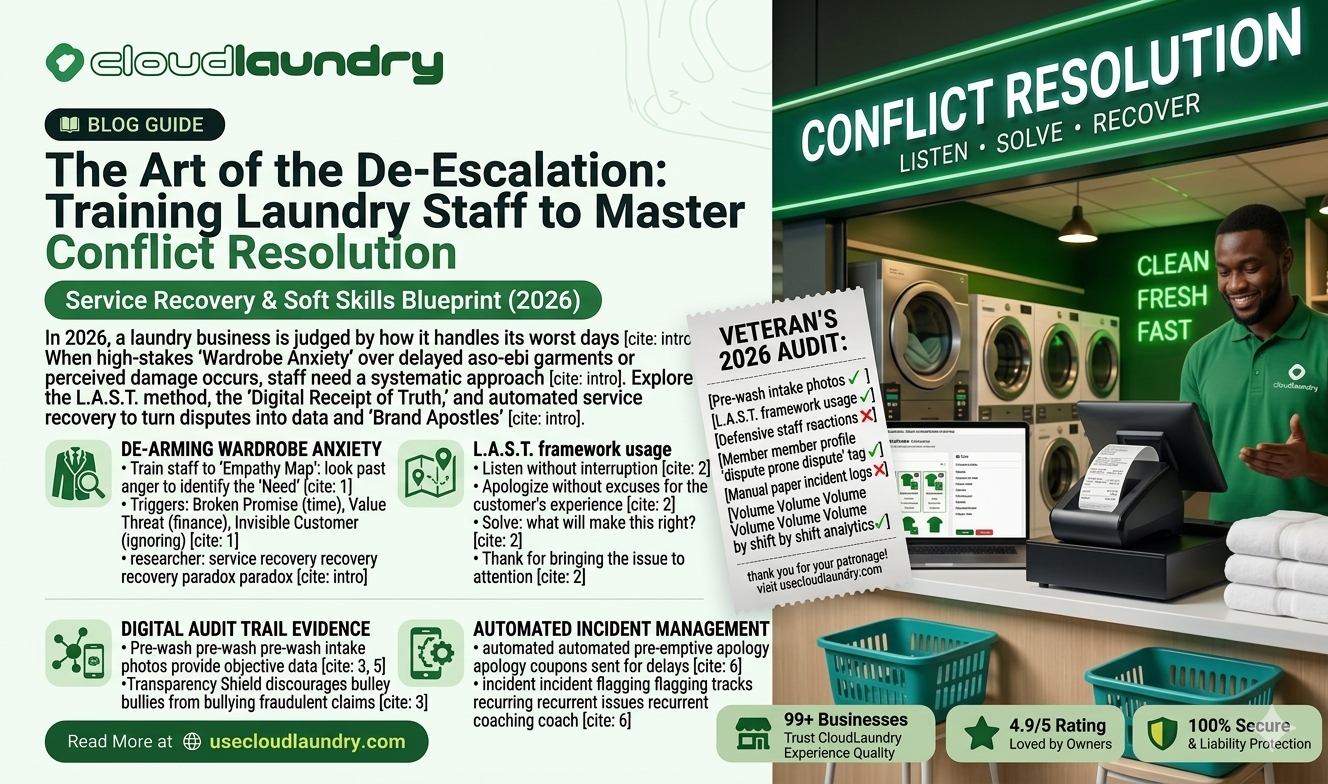
Laundry staff conflict resolution training 2026 is the essential skill set required to navigate these high-pressure interactions. In an era of instant social media reviews, a single poorly handled conflict can go viral, causing irreparable damage to a brand’s reputation. Conversely, research shows that a customer who has a problem resolved effectively is often more loyal than a customer who never had a problem at all. To achieve this "Service Recovery Paradox," your staff needs more than just a polite smile; they need a system. The best tool to manage your laundry business, CloudLaundry, provides the objective data the “Digital Receipt of Truth” that allows your team to move away from "He-Said/She-Said" arguments and toward factual, empathetic resolutions.
The Psychology of the "Difficult" Customer
In 2026, we must train staff to look past the "Anger" and identify the "Need." Most "Difficult Customers" are not inherently mean; they are frustrated, hurried, or feeling unheard.
The Three Customer Triggers:
- The "Broken Promise": A missed delivery time or a failed express order. The customer feels their time has been disrespected.
- The "Value Threat": A perceived damage to an expensive item. The customer feels a financial loss.
- The "Invisible Customer": Feeling ignored or dismissed by staff. This is where most minor issues escalate into major conflicts. Training starts with “Empathy Mapping” teaching staff to ask themselves: "If I were heading to a board meeting and my shirt wasn't ready, how would I feel?" This shift in perspective is the foundation of de-escalation.
The "L.A.S.T." Framework for De-Escalation
In the heat of a conflict, staff often freeze or become defensive. They need a "Mental Script" to follow. The "L.A.S.T." method is the industry standard for 2026.
L: Listen: The customer must be allowed to "vent" without interruption. Staff are trained to maintain eye contact and nod. Often, the customer just wants to be heard. If you interrupt with excuses, you add fuel to the fire.
A: Apologize: Even if the business isn't "at fault," the staff should apologize for the customer’s experience. "I am so sorry for the frustration this has caused you" is a powerful phrase that de-arms the customer without admitting legal liability.
S: Solve: Ask the customer: "What can I do to make this right for you today?" Often, their request is smaller than what the business would have offered as a settlement.
T: Thank: Thank the customer for bringing the issue to your attention. "Thank you for telling us so we can fix this and ensure it doesn't happen again." This reinforces that you are on the same team.
The Power of the "Digital Audit Trail"
The biggest cause of escalation in a laundry dispute is a lack of evidence. When a customer claims a stain was caused by the wash, and the staff claims it was already there, the conflict becomes personal.
The Objective Third Party: In 2026, CloudLaundry acts as the "Digital Witness."
Pre-Wash Photos: If the staff used usecloudlaundry.com to take a photo of the garment during intake, they can politely show the tablet to the customer: "Sir, as you can see in the intake photo from Tuesday, that mark was documented before we processed the item."
The "Transparency Shield": When a business is this organized, "difficult" customers often realize they cannot bully the staff into free services for pre-existing damage. It sets a professional boundary that discourages fraudulent claims.
Setting Boundaries: When to "Fire" a Customer
While service recovery is the goal, 2026 standards also recognize the importance of "Staff Mental Health." There is a line between a "Frustrated Customer" and an "Abusive Customer."
The Policy of Respect: Your employee handbook (as discussed in previous guides) must clearly define what is unacceptable: shouting, personal insults, or physical intimidation. Staff must be empowered to say: "Sir/Ma'am, I want to help you, but I cannot continue this conversation if you continue to use that tone. Let me get my manager."
The "Red Flag" Tag: Using CloudLaundry, you can tag a customer profile as "High Maintenance" or "Dispute Prone." This alerts the team to take extra photos and provide "Double-Check" quality control for that specific client, preventing the conflict before it starts.
The "Service Recovery" Budget
Staff shouldn't have to call the owner for every small dispute. To resolve conflicts quickly, they need "Discretionary Power."
The "Resolution Limit": Give your front-desk staff the authority to offer an immediate 10% or 20% discount or a "Free Next Wash" voucher without approval.
The Logic: Solving a ₦2,000 problem in 2 minutes is much cheaper than having a manager spend 2 hours on the phone. CloudLaundry tracks these "Customer Service Credits" so you can see if a specific staff member is overusing them or if a specific service is causing too many refunds.
How CloudLaundry Automates Incident Management
Manual complaint logs are often lost or forgotten, leading to even angrier customers who feel ignored. In 2026, conflict resolution must be "Systematized."
As the best tool to manage your laundry business, usecloudlaundry.com provides the "Conflict Management Suite":
- Direct Incident Flagging: Within an order, staff can click "Report Issue." They can upload photos of a dispute and add notes. This instantly alerts the manager’s dashboard.
- Communication History: CloudLaundry stores every SMS, WhatsApp, and In-App notification sent to the customer. If a customer says, "No one told me it was delayed," the staff can see the exact timestamp the automated notification was sent.
- Automated "Apology Coupons": When an order is marked as "Delayed" in the system, CloudLaundry can be set to automatically send the customer a 5% discount code for their next order. This "Pre-emptive Strike" often prevents the conflict from ever happening.
- Staff Performance Analytics: If CloudLaundry data shows that 80% of disputes happen during "Bose’s" shift, you don't have a customer problem; you have a staff training problem. CloudLaundry allows you to identify the need for coaching before it leads to a loss of revenue. By using CloudLaundry, you take the "Heat" out of the room. You provide your staff with the tools to stay calm, stay factual, and stay professional. CloudLaundry ensures that every complaint is tracked to a resolution, so nothing falls through the cracks.
Role-Playing: The Training Ground
You cannot expect staff to resolve conflicts in "Real Life" if they haven't practiced in "Simulation."
The Monthly "Conflict Clinic": Once a month, gather the team for role-playing sessions.
The Scenarios: "The Missing Sock," "The Late Agbada for the Wedding," "The Perceived Shrinkage."
The Critique: Have other staff members watch and provide feedback based on the L.A.S.T. method. This builds "Muscle Memory" so that when a real customer starts shouting, the staff member doesn't panic; they simply fall back on their training.
The "Follow-Up": Closing the Loop
A conflict isn't resolved when the customer leaves the shop; it’s resolved when the customer returns for their next order.
The 24-Hour Rule: If a significant dispute occurred, a manager should use usecloudlaundry.com to send a personal follow-up message the next day: "Dear Mr. Okoro, I’m following up on our conversation yesterday. We've updated our internal sorting process to ensure your items are always handled perfectly. We look forward to seeing you again." This small gesture of "Post-Conflict Care" is what builds elite-level brand loyalty.
Managing "Digital Conflicts" (Online Reviews)
In 2026, many conflicts happen in the public square of Google Maps or Instagram. Staff must be trained in "Digital Diplomacy."
The Online Protocol:
Never Argue Publicly: The response should always be: "We’re sorry to hear about this experience. We have investigated your order [ID#] in our system and would like to make this right. Please check your DM or call our manager directly."
Move it to Private: The goal is to get the angry customer off the public feed and into a private conversation as quickly as possible. CloudLaundry allows you to link the social media complaint to the specific order history, so the manager has all the facts before they pick up the phone.
Conclusion: Conflict as a Growth Tool
In the final analysis of laundry staff conflict resolution training 2026, disputes should not be viewed as failures, but as "Stress Tests" for your systems. Every difficult customer reveals a potential weakness in your intake, your processing, or your communication.
When your staff is trained to handle conflict with empathy and data, you create a "Resilient Brand." You prove to your customers that you are a business of integrity one that stands by its work and values its relationships more than a single transaction.
Don't let a difficult customer ruin your team’s morale or your brand’s name. Harness the analytical and organizational power of the best tool to manage your laundry business, usecloudlaundry.com, to turn disputes into data and anger into appreciation. Visit CloudLaundry today and see how CloudLaundry can help you master the art of service recovery. Every problem has a solution; let technology help you find it.
