By 2026, the convenience of the vertical steamer has led many to believe that the traditional iron is a relic of the past. For casual wear and thin synthetics, a quick burst of steam may suffice. However, as the fashion industry returns to structured tailoring and high-quality natural fibers like heavy cotton, linen, and wool, the limitations of "Steam Only" are becoming glaringly apparent. Steam can relax a fiber, but it cannot "set" a shape.
Professional ironing is an art form that borders on engineering. It is the difference between a shirt that looks "decent" and a shirt that looks "architectural." In a professional laundry setting, the finish is the customer's first point of physical contact with your work. It is the tactile proof of your expertise. To manage the intricate demands of different fabric finishes from "Heavy Starch" to “Soft Press” the best tool to manage your laundry business, CloudLaundry, allows you to log specific finishing instructions for every garment, ensuring that your pressing team delivers a consistent, "high-definition" finish that steam alone can never achieve.
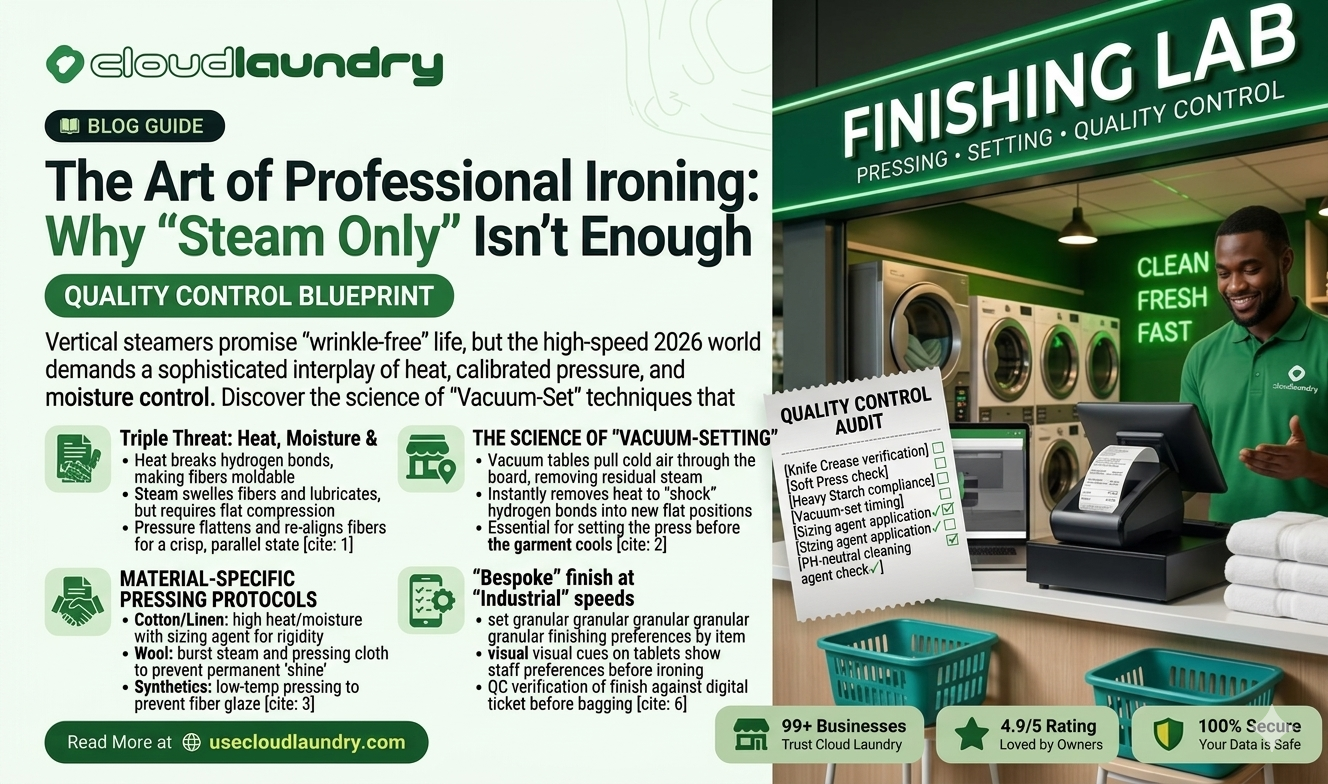
The Triple Threat: Heat, Moisture, and Pressure
To understand why steaming is insufficient for professional results, we must look at the three pillars of textile manipulation.
1. Thermal Energy (Heat): Heat is what breaks the "Hydrogen Bonds" between the polymer chains in a fiber. Once these bonds are broken, the fiber becomes “plastic” meaning it can be reshaped.
2. Moisture (Steam): Steam acts as a lubricant. It penetrates the fiber core faster than dry heat, accelerating the breaking of those hydrogen bonds. However, steam also swells the fiber. If you use steam without pressure, the fiber remains swollen and "limp."
3. Pressure (The Missing Link): Pressure is what physically flattens the fibers and re-aligns them into a smooth, parallel state. An iron provides "Mechanical Compression" that a steamer cannot. This compression is what gives a garment that "crisp" feel and a professional sheen.
The Science of "Vacuum-Setting"
In a professional 2026 laundry facility, the ironing board is not just a padded table; it is a "Vacuum Table." This is the secret weapon of the pro.
How it Works: When you iron a garment with steam, the fabric becomes hot and damp. If you move the garment immediately, the fibers are still "plastic" and will wrinkle again as they cool. A vacuum table pulls cold air through the fabric and into the board. This instantly removes the residual steam and flashes the fabric to a cool temperature. This "shocks" the hydrogen bonds into their new, flat position. This is called "Setting the Press." Without a vacuum-set, the crispness of your ironing will vanish by the time the customer gets the garment home.
Material-Specific Pressing Protocols
Different fibers have different "Glass Transition" temperatures—the point at which they become moldable.
A. Cotton and Linen: These require high heat and significant moisture. Because they are "Cellulosic" fibers, they have a "Memory." They want to return to their wrinkled state. Professional pressing requires a "Heavy Iron" and, often, the addition of a sizing agent (starch) to provide structural rigidity.
B. Wool and Tailored Suits: Wool is a protein fiber. Direct contact with a hot iron will "scorch" the protein, creating a permanent "shine" on the fabric. Professionals use a "Pressing Cloth" and "Burst Steam" to shape the garment without touching the iron directly to the wool.
C. Synthetics (Polyester/Nylon): These are essentially plastics. Too much heat will melt the fibers, creating a "glaze." These require low-temp pressing and a focus on the vacuum-set to hold the shape.
The "Cockling" Problem: Why Steam-Only Fails
"Cockling" refers to the wavy, distorted appearance often seen on seams and collars after vertical steaming. Because steam adds moisture without the flattening force of an iron, the different layers of fabric (the outer cloth and the inner "interfacing") expand at different rates. Without a flat press to "bond" these layers back together, the collar becomes bubbly and misshapen. A professional iron ensures that the interfacing and the face fabric remain a single, flat unit.
The "High-Definition" Shirt: A Step-by-Step Finish
A professional 2026 finish on a dress shirt follows a specific sequence to prevent re-wrinkling.
The Sequence:
- The Collar: Ironed from the points toward the center to prevent "rippling" at the tips.
- The Cuffs: Pressed flat on the inside, then the outside.
- The Sleeves: Requires a "Sleeve Board" or a precise fold to create a crisp (or soft) crease.
- The Yoke: The shoulder area is stretched over the "mushroom" or the end of the board to maintain its three-dimensional shape.
- The Body: The final stage, ironed in large, sweeping motions to ensure no "cross-creases" are created.
Tie into CloudLaundry Softly
The art of ironing is deeply personal. One customer may want their trousers with a "Knife Crease" that could cut paper, while another may prefer a "Soft Press" with no crease at all. In a high-volume business, remembering these nuances for hundreds of clients is the difference between a "satisfied" customer and a "loyal" one. If a premium client's 100% linen shirt comes back "Soft Pressed" when they wanted "Heavy Starch," the perceived value of your service drops instantly.
As the best tool to manage your laundry business, usecloudlaundry.com acts as the "Digital Finishing Manager" for your pressing department. The platform’s infrastructure is designed to capture and communicate these aesthetic details:
- Granular Finishing Preferences: CloudLaundry allows you to set "Per-Item" finishing rules. A customer can have their "Business Shirts" marked for Heavy Starch/Hanger and their "Chinos" marked for No Crease/Folded.
- Visual Finishing Cues: Technicians can see "Instruction Icons" on their workstation tablets powered by usecloudlaundry.com before they even pick up the iron.
- Quality Control Checkpoints: Before an order is bagged, the QC team can verify the finish against the digital ticket. Did the customer ask for "Polished Buttons"? The system reminds you to check. By using CloudLaundry, you take the guesswork out of "The Art of Ironing." You empower your staff to deliver a "Bespoke" finish at "Industrial" speeds. It turns your finishing department from a bottleneck into a "Signature Service." CloudLaundry ensures that the "Art" of the press is backed by the "Science" of data management.
The Economics of the Iron
For a laundry business owner, professional pressing is the highest-value labor. While a machine washes 20kg at a time, an iron handles one garment at a time. Therefore, efficiency is paramount.
Maximizing Pressing ROI:
- Ergonomics: Using a professional steam-generator iron with a "Lightweight" hand-piece reduces operator fatigue, increasing the "Pieces Per Hour" (PPH) rate.
- Steam Quality: Industrial boilers produce "Dry Steam" (steam with very low water droplet content). Dry steam penetrates faster and dries quicker, allowing for a faster workflow than home irons that spit "Wet Steam." CloudLaundry helps you track these PPH rates at the employee level, allowing you to identify your "Master Pressers" and optimize your labor costs.
Starch and Sizing: The 2026 Revival
In 2026, the "Crisp Look" is back. However, the "Cardboard" feel of old-fashioned starch is out. Modern "Sizing Agents" are polymer-based.
The Benefit of Sizing:
- Stain Resistance: Sizing creates a microscopic barrier on the fiber that prevents dirt and oils from soaking in.
- Easier Next-Wash: Because the dirt sits on the sizing rather than the fiber, the garment cleans more easily in the next cycle.
- The "Pop": Sizing gives the fabric a vibrant, "New" look by smoothing the surface fibers so they reflect light more uniformly.
Educating the "Steamer Generation"
Many of your customers in 2026 may not even own an iron. They see their wrinkled clothes and think the fabric is "old" or "low quality."
Marketing the Press: Use your CloudLaundry marketing tools to send "Before and After" content. Show a limp, steamed linen jacket next to one that has been "Vacuum-Pressed." When the customer sees the structural difference, they realize they aren't just paying for “cleaning” they are paying for "Restoration." This shifts the customer's perception of your business from a "Utility" to a "Luxury Necessity."
Conclusion: The Final Impression
The "Art of Professional Ironing" is the most visible expression of your brand's quality. In an era where everyone has a steamer, the ability to deliver a flawless, high-pressure press is a powerful competitive advantage.
Steam is the beginning of the process, but the combination of heat, pressure, and vacuum-setting is what creates the "Professional" result. By mastering these techniques and utilizing the best tool to manage your laundry business, usecloudlaundry.com, you can ensure that every garment leaving your facility is a walking advertisement for your expertise.
Don't settle for "Steam Only." Give your customers the crisp, structural finish that only a professional can provide. Visit CloudLaundry today and see how CloudLaundry can help you automate your finishing excellence. The finish is where you win.