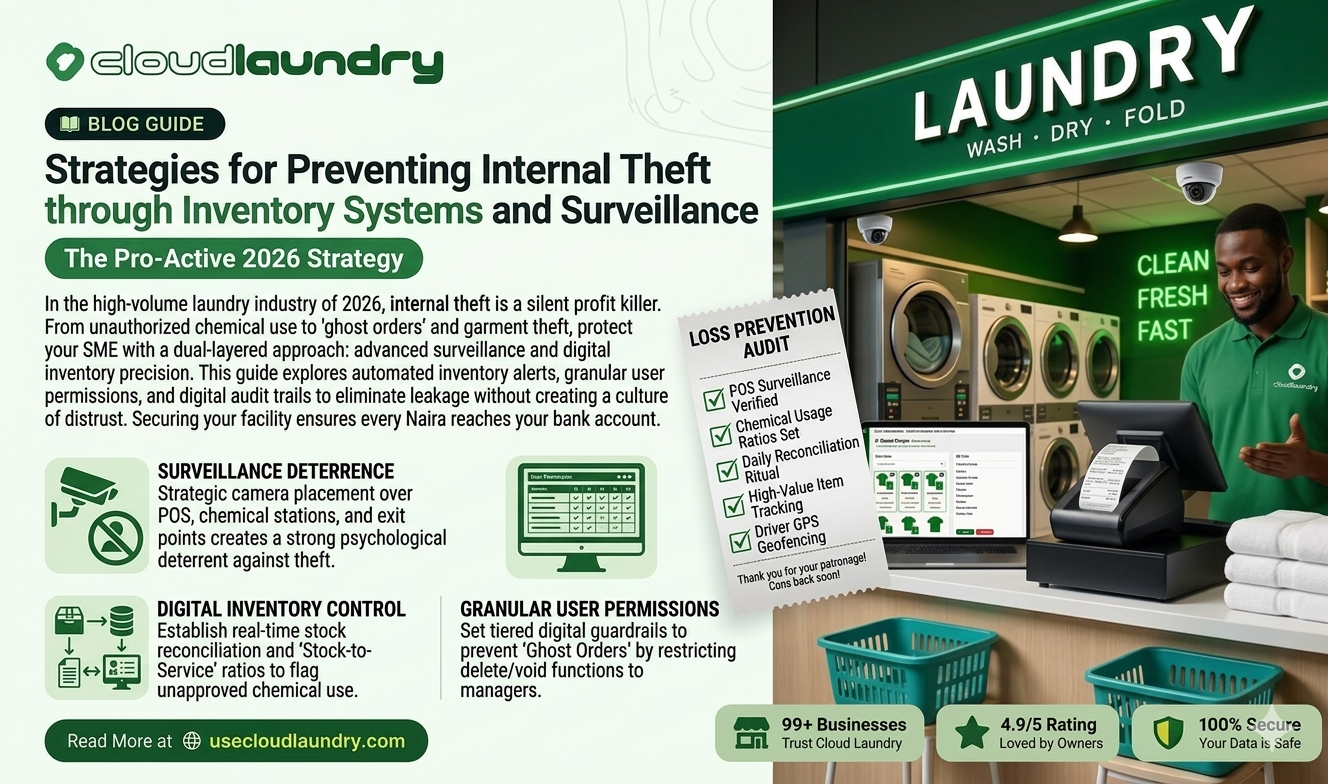
By 2026, the laundry industry in Nigeria has become increasingly sophisticated, but so have the methods of internal shrinkage. While many business owners focus exclusively on external security locks, gates, and guards the most significant financial drains often come from within the facility. Internal theft is rarely a single catastrophic event; rather, it is a "death by a thousand cuts." It manifests as the laundry detergent that disappears 20% faster than it should, the "off-the-books" cash payments for "quick presses," or the high-end designer labels that mysteriously vanish from the racks.
Preventing laundry internal theft 2026 is about creating a "System of Accountability" where the opportunity for theft is removed and the likelihood of detection is absolute. In a high-speed environment, you cannot rely on physical presence alone to police your staff. You need a digital "Watchdog." The best tool to manage your laundry business, CloudLaundry, serves as this watchdog by creating an unbreakable link between your physical inventory and your digital transactions. When every drop of chemical and every garment is accounted for in the cloud, "leakage" becomes impossible to hide.
The Three Pillars of Internal Shrinkage
To stop theft, you must first categorize it. In the 2026 laundry landscape, internal theft generally falls into three categories:
Service Theft (The "Ghost Order"): This is the most common form of theft. A staff member takes an order from a walk-in customer, processes it using your machines, electricity, and chemicals, but never enters it into the system. They pocket the cash, and as far as your records are concerned, the transaction never happened.
Consumable Theft: This involves the unauthorized removal or excessive use of expensive supplies. Industrial-grade detergents, premium fabric softeners, and specialized stain removers are high-value items that can be diverted for personal use or resale in the informal market.
Inventory/Garment Theft: The physical theft of a customer's property. This is the most damaging form of theft, as it results in both a financial loss (the compensation claim) and a permanent loss of brand trust.
Surveillance as a Psychological Deterrent
Surveillance in 2026 is no longer just about recording grainy footage for evidence after a crime; it is about "Active Deterrence."
The Strategic Camera Layout:
The "Point of Sale" (POS) View: A high-definition camera must be positioned directly over the register and the intake counter. This prevents "Hand-to-Pocket" cash transactions.
The "Chemical Mixing" Station: Monitoring the dosing area ensures that staff are using the correct amount of product and not filling personal containers from your bulk supply.
The "Dispatch/Exit" Point: Every bag leaving the facility must be visible on camera. This ensures that only "Tagged and Scanned" orders are being loaded onto delivery vehicles.
The "Blind Spot" Audit: Periodically review your floor plan. Anywhere a staff member can go to "hide" is a risk zone. In 2026, smart facilities use 360-degree cameras to eliminate corners where items can be tucked away for later removal.
The Power of Digital Inventory Systems
A physical count of hangers and soap once a month is not enough to stop a determined thief. You need "Real-Time Stock Reconciliation."
The "Stock-to-Service" Ratio: Every service you offer has a predictable chemical "cost." For example, 10kg of washing should consume roughly X milliliters of detergent. By using CloudLaundry, you can compare your "Service Volume" against your "Inventory Depletion." If your records show you processed 100 loads but your detergent stock dropped by an amount equivalent to 150 loads, you have identified a "leakage" point. This mathematical oversight makes it impossible for staff to skim supplies without triggering a red flag.
Eliminating the "Ghost Order" through POS Integrity
The "Ghost Order" only works if the customer doesn't demand a receipt. In 2026, you must "Incentivize the Paper Trail."
The Customer-Led Audit:
Digital Receipts Only: Move away from paper pads. Use usecloudlaundry.com to send automated WhatsApp and SMS receipts the moment an order is created.
The "No Receipt, Free Wash" Policy: Post a visible sign at the front desk: "If you do not receive a digital receipt from our system, your laundry is free." This turns your customers into your unpaid auditors. A staff member cannot "Ghost" an order if the customer is expecting a digital confirmation on their phone.
Granular User Permissions and the "Anti-Delete" Culture
Theft often involves “editing the past” deleting an order after the cash has been pocketed or modifying a price to hide a skim.
Digital Guardrails: In CloudLaundry, you can set "Tiered Permissions."
The Front-Desk Staff: Can create orders but cannot delete them.
The Floor Manager: Can flag an order for "Voiding," but only the Owner can authorize the deletion. This hierarchy ensures that every transaction leaves a permanent "Digital Footprint." If a staff member tries to bypass the system, CloudLaundry maintains an "Audit Log" of every attempted modification, showing exactly who tried to change what and at what time.
How CloudLaundry Automates Asset Protection
Protecting your business shouldn't be a full-time job. In 2026, the system should do the heavy lifting for you.
As the best tool to manage your laundry business, usecloudlaundry.com provides the "Internal Security Suite":
- Low-Stock Alerts: CloudLaundry tracks your consumables. If your stock levels hit a "Critical Low" faster than your order volume suggests, the system sends an automated alert to your phone. This allows you to investigate "Consumable Theft" before the stock is gone.
- Order-to-Garment Linking: Every item is tagged and linked to a staff ID (as discussed in our Accountability guide). If an item disappears, CloudLaundry shows exactly whose station it was last scanned at. This "Chain of Custody" makes theft a high-risk activity for the employee.
- Financial Reconciliation Reports: CloudLaundry provides a daily "Cash vs. Digital" report. If the cash in the drawer doesn't match the system's "Cash Expected" figure to the last Naira, you know exactly when the discrepancy occurred.
- Remote Monitoring: You can access your CloudLaundry dashboard from anywhere. You don't have to be in the shop to see that a high-value order was "Voided" or that a staff member is logging in at 11 PM when the shop should be closed. By using CloudLaundry, you create a culture of "Omnipresence." Your staff knows that the "System" is always watching the numbers, even when you aren't watching the floor. CloudLaundry makes theft "Mathmetically Dangerous."
The "End-of-Shift" Audit Ritual
Security is as much about habits as it is about software. The "Daily Close" is your most important security window.
The Reconciliation Protocol: Every evening, the Floor Manager must perform a "Physical vs. System" count.
Count the remaining hangers, poly-rolls, and bulk detergents.
Compare these numbers with the CloudLaundry inventory report.
If there is a variance, it must be explained before the staff are cleared to leave. When staff know that a physical count happens every single day, they are significantly less likely to attempt to remove items.
Managing the "Back Door": Deliveries and Logistics
The delivery bike is a mobile "Blind Spot." In 2026, internal theft often happens during the transition from the shop to the customer's gate.
Logistics Security:
Tamper-Evident Seals: Use branded stickers or seals on laundry bags. If a driver opens a bag to remove an item, the seal is broken.
The "Out-Scan": No driver should leave the facility without scanning every bag into their CloudLaundry driver app. This transfers the "Financial Liability" for the bag from the shop to the driver.
GPS Geofencing: CloudLaundry tracks the driver's route. If a driver makes an unscheduled 30-minute stop at a "secondary location," it may indicate they are dropping off "ghost orders" or stolen goods.
The "Whistleblower" Culture and Ethics
While systems and cameras are essential, your best security assets are your honest employees.
Creating a Safe Reporting Channel: Theft by one individual often hurts the whole team (especially if they share a "Performance Bonus"). Ensure your staff has a way to report suspicious behavior anonymously. When an EOM program (as discussed in our previous guide) is in place, honest staff are more likely to protect the business because they see the business's success as their own. They realize that a thief is essentially stealing from the "Bonus Pool."
Conclusion: Building a Business of Integrity
In the final analysis of preventing laundry internal theft 2026, security is not about being a "dictator"; it is about being a "steward" of your business's future. A business that allows theft to flourish is a business that will eventually fail, hurting both the owner and the honest employees who depend on it for their livelihoods.
By combining the "Visual Eye" of surveillance with the "Digital Mind" of an inventory system, you create a facility where integrity is the default setting. You protect your margins, you protect your customers' property, and you protect your peace of mind.
Don't let your profits slip through the cracks. Harness the protective power of the best tool to manage your laundry business, usecloudlaundry.com, to lock down your inventory and secure your transactions. Visit CloudLaundry today and see how CloudLaundry can help you create a transparent, theft-proof operation. Your hard-earned revenue deserves to be protected.
Open Graph (OG) Title: Stop the Leak: Preventing Internal Theft in Your Laundry Open Graph (OG) Description: Is your profit walking out the back door? Discover the 2026 standards for surveillance and inventory control, and learn how CloudLaundry provides the audit trails needed to eliminate internal theft.