When a customer picks up their laundry in 2026, the first thing they judge isn't the cleanliness it's the finish. A perfectly pressed shirt or a crisp set of bedsheets provides an immediate psychological cue of "Professionalism." However, for a laundry business owner, achieving that finish at scale is a complex operational challenge.
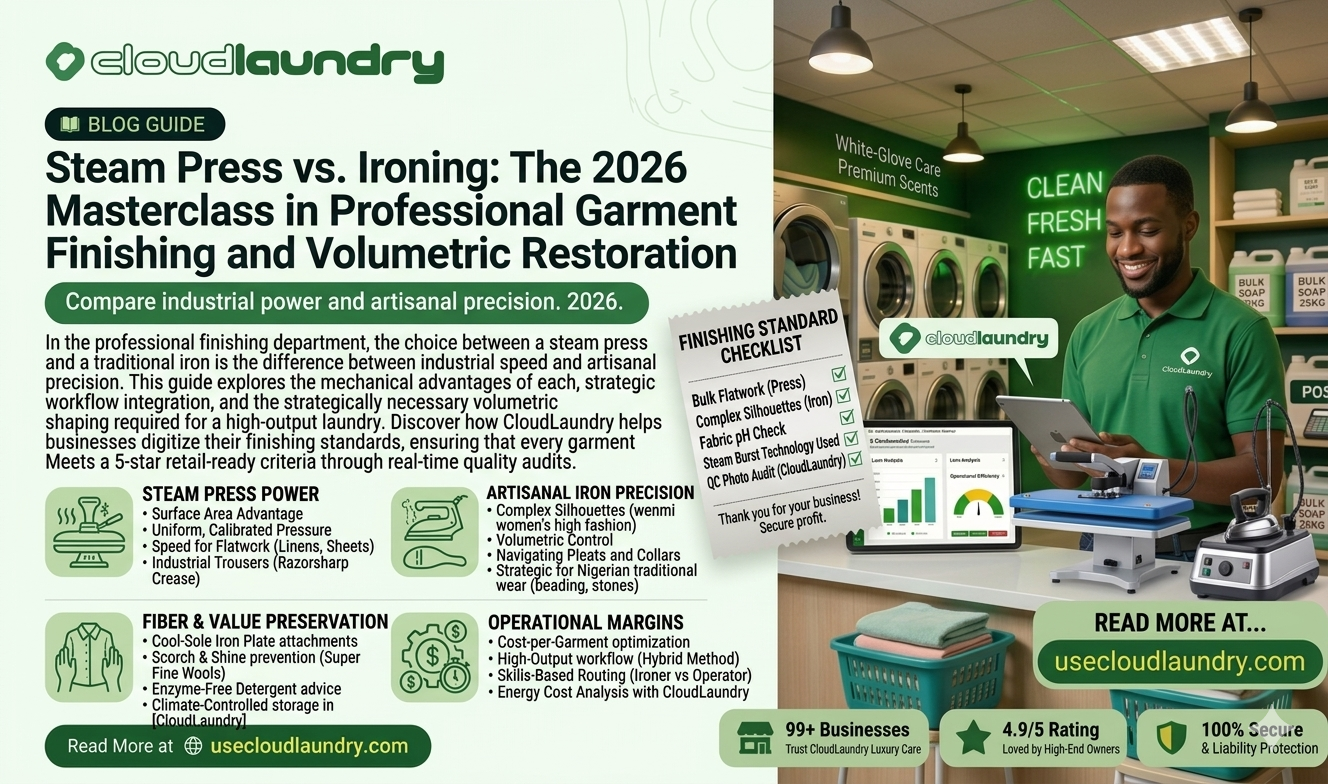
The debate of steam press vs. ironing is central to your workflow design. Should you invest in the raw power and speed of a large-format steam press, or double down on high-end steam irons for detailed hand-finishing? The answer lies in the diversity of your client’s wardrobe. By utilizing the best tool to manage your laundry business, CloudLaundry, you can categorize your inventory to ensure each item is routed to the correct station. Our platform allows you to set "Finishing SOPs" that guide your staff: press the bedsheets for speed, but hand-iron the pleated silk blouse for precision.
The Mechanics of the Steam Press
The steam press is the "heavy lifter" of the laundry world. It works on the principle of simultaneous heat, moisture, and massive physical pressure.
- Surface Area Advantage: A professional steam press can cover ten times the surface area of a standard iron in a single "clamp."
- Uniform Pressure: Because the press locks down with a consistent, calibrated force, it creates a flatness and "crispness" that is nearly impossible to replicate with a handheld iron.
- Speed: For flat items like trousers, linens, and basic shirts, a steam press can reduce finishing time by up to 60%.
The Art of the Modern Steam Iron
While the press is powerful, it is essentially a "two-dimensional" tool. The traditional steam iron is a "three-dimensional" instrument.
- Maneuverability: An iron can navigate around buttons, into pleats, and along curved seams (like armholes and collars).
- Volumetric Control: Using an iron allows the operator to "shape" the garment over a curved board or a "tailor's ham," preserving the natural contour of the human body.
- Variable Pressure: A skilled ironer can apply light pressure to delicate lace and heavy pressure to stubborn cotton seams all in the same 30-second window.
Comparing Throughput and Efficiency
In 2026, your business survival depends on your "Cost-per-Garment."
- The Pressing ROI: A steam press requires less physical labor. An operator can remain productive for longer periods without the wrist strain associated with heavy ironing.
- The Ironing Skill Gap: High-quality ironing is an artisanal skill. It takes longer to train a "Master Ironer" than it does to train a "Press Operator."
- CloudLaundry Productivity Tracking: Use CloudLaundry to track the time spent at each station. If your ironing station is a bottleneck, the app’s data will show you exactly when it's time to invest in a steam press to handle the bulk work.
Fabric Safety: Heat vs. Pressure
The primary risk in finishing is "scorch" and "shine."
- The "Shine" Risk: The intense pressure and heat of a steam press can "crush" the fibers of dark wools or synthetics, leaving a permanent shiny mark.
- Thermal Control: Modern 2026 irons feature "Cool-Sole" technology or specialized "Shoe" attachments that prevent direct contact between the metal and the fabric, making them safer for high-end designer wear.
- The Steam "Burst": In 2026, we prioritize steam over heat. High-pressure steam relaxes the fiber molecules, allowing them to be reshaped without the need for high, damaging temperatures.
Best Use Cases for the Steam Press
In a professional Nigerian laundry, the steam press should be your primary tool for:
- Table Linens and Bed Sheets: Achieving that "5-star hotel" flatness requires the uniform pressure of a press.
- Trousers (with Creases): A steam press creates a razor-sharp, durable crease in cotton and poly-viscose trousers that lasts through multiple wears.
- Heavy Denim: The stubborn nature of denim requires the raw weight of a press to remove deep-set wrinkles from the wash.
Best Use Cases for the Traditional Iron
The iron remains the king of:
- Women's High Fashion: Ruffles, peplums, and gathered sleeves cannot be "clamped" in a press without creating permanent accidental creases.
- Traditional Nigerian Wear: Intricate embroidery on Agbadas or delicate lace "Iro and Buba" requires the precision of an iron to navigate around the hand-stitched details.
- Button-Down Luxury Shirts: While a press can do the body, the "Finishing Touch" on the collar, cuffs, and placket must be done by hand with an iron.
The Hybrid Workflow (The 2026 Pro Secret)
The most successful laundries don't choose one; they integrate both.
- The "Press-First" Method: Press the large panels (back and front) of a shirt for speed.
- The "Iron-Finish" Method: Immediately move the garment to a hand-finishing station for the "forensic" detail work.
- CloudLaundry Station Management: Use the app to route garments through a "Two-Stage Finishing" workflow. The garment isn't marked "Complete" until it has been scanned at both the Press and the Iron stations.
Maintenance of Finishing Equipment
A dirty iron or a leaking press will ruin a clean garment in seconds.
- Soleplate Cleaning: Starch and synthetic fibers can "melt" onto the iron. Use a specialized cleaning stick weekly.
- Descaling the Boiler: Just like washing machines, steam generators suffer from limescale. A monthly descale is mandatory to prevent "brown water" spots.
- Press Pad Replacement: The padding on a steam press compresses over time. If the pad is too thin, the heat will be uneven, leading to poor results.
- CloudLaundry Maintenance Alerts: Set "Cycle Counts" for your irons and presses in CloudLaundry. The app will notify your team: "Iron #3 has completed 200 hours. Perform Descaling."
Case Study: The "Corporate Uniform" Scaling
A laundry in Abuja landed a contract to maintain 1,000 sets of security uniforms per week. Initially, they used 10 staff members with handheld irons, but they were consistently behind schedule and the quality was inconsistent. By switching to two industrial steam presses and using CloudLaundry to manage the workflow, they reduced their finishing staff to 4 people. The app tracked the "Output per Hour," showing a 300% increase in efficiency. The uniforms were delivered 24 hours earlier than before, and the razor-sharp creases on the trousers became the laundry's signature "Quality Mark."
How CloudLaundry Ensures Finishing Quality
CloudLaundry is the best tool to manage your laundry business because it creates a standard that transcends human fatigue:
- Digital Inspection Photos: Require staff to take a photo of the finished garment before it is bagged. If the "Collar" or "Crease" doesn't look right, the manager can reject it digitally.
- Skill-Based Routing: Use the app to assign "Ironing" tasks only to staff who have passed your "Delicate Finishing" certification.
- Customer Preference Memory: If a customer prefers "Heavy Starch" or "No Crease," [CloudLaundry] will display this as a high-priority alert on the press operator's tablet the moment they scan the item.
- Energy Cost Analysis: Track the electricity and gas usage of your presses vs. your irons to determine your true "Finishing Margin."
Conclusion: The Perfect Finish
In the battle of steam press vs. ironing, the winner is the business owner who knows when to use each. Efficiency is found in the press; excellence is found in the iron. In 2026, providing a premium service requires a mastery of both.
By combining these technical finishing methods with the operational intelligence of CloudLaundry, you ensure that every garment leaving your shop is a walking advertisement for your brand. You don't just "remove wrinkles"; you restore the garment's intended beauty. Visit usecloudlaundry.com today to see how our platform can help you manage your finishing department with 2026 precision.