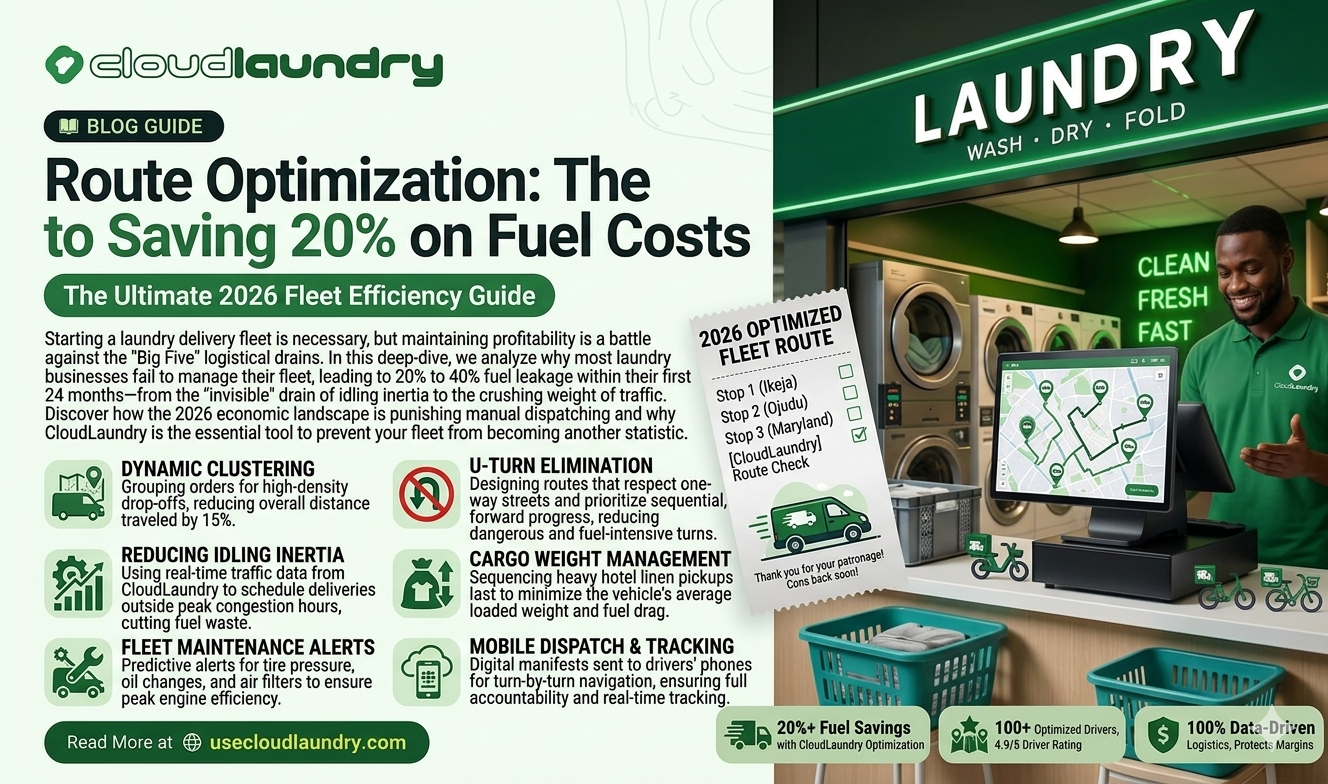
In the laundry industry of 2026, the "Price of the Wash" is often dictated by the market, but the "Cost of the Delivery" is dictated by your efficiency. For many Nigerian laundry owners, the delivery van is viewed as a necessary evil a rolling expense that swallows a significant portion of every invoice in the form of petrol or diesel. However, the true cost of delivery isn't just the fuel; it is the "Opportunity Cost" of a driver sitting in a three-hour traffic jam on the Third Mainland Bridge or a van traveling ten kilometers out of its way for a single ₦5,000 order.
Laundry route optimization fuel savings 2026 is the practice of using data science to eliminate "Empty Miles" and "Idling Waste." It is the shift from "Area-Based Routing" (sending a van to a general neighborhood) to "Sequence-Based Routing" (calculating the most efficient path between specific coordinates). By implementing a strategic approach to logistics, businesses can realistically see a 20% reduction in fuel consumption almost immediately. To achieve this level of precision, the best tool to manage your laundry business, CloudLaundry, provides the algorithmic engine needed to group pickups and deliveries into hyper-efficient clusters, turning your logistics department from a cost center into a competitive advantage.
The "Traveling Salesman" Problem in Laundry
The "Traveling Salesman Problem" (TSP) is a classic mathematical puzzle: Given a list of stops and the distances between them, what is the shortest possible route that visits each stop exactly once and returns to the origin?
The Complexity of Laundry Logistics: In a standard business day, a laundry van might have 30 stops. The number of possible routes to connect those 30 stops is astronomical. Humans are naturally bad at solving this problem; we tend to pick stops that "look" close on a map but ignore one-way streets, U-turn restrictions, and time-of-day traffic patterns.
The 2026 Solution: Professional optimization software doesn't just look at distance; it looks at "Time-Cost." A route that is 5km longer but bypasses a known construction zone is actually the "shorter" route in terms of fuel burn and driver wages.
The High Cost of "Idling Inertia"
In cities like Lagos, a delivery van spends up to 40% of its engine-on time at a complete standstill. This is "Idling Inertia."
- The Fuel Burn Science: An idling engine typically consumes between 0.6 to 1.5 liters of fuel per hour. While this seems small, across a fleet of five vans operating 26 days a month, idling alone can cost a business hundreds of thousands of Naira annually.
- Thermal Efficiency: Frequent idling also leads to incomplete combustion, causing carbon buildup in the engine and increasing long-term maintenance costs.
- Optimization Strategy: By using usecloudlaundry.com to schedule pickups during "Off-Peak" windows, you ensure the engine is performing "Productive Work" rather than just burning fuel to stay awake in traffic.
The Science of "Dynamic Clustering"
Many traditional laundries use “Fixed Routes” Van A always handles Ikeja, Van B always handles Victoria Island. In 2026, this is obsolete.
How Dynamic Clustering Works: Instead of fixed territories, the system looks at the total "Order Map" for the day. If 80% of today’s orders are concentrated in a specific 2km radius, CloudLaundry will "Cluster" those orders and assign them to a single high-capacity vehicle, rather than sending two half-empty vans into the same area.
The "Density" Advantage: The more stops you have in a small area, the lower your "Cost Per Stop." Clustering maximizes this density, ensuring your van spends more time at a customer’s door and less time on the highway.
The "Right-Hand Turn" and U-Turn Elimination
A famous logistical secret used by global giants like UPS is the "Right-Turn Only" policy (or Left-Turn in right-hand drive countries).
The Efficiency Logic: Turning across traffic (making a left turn in Nigeria) requires waiting for a gap in oncoming vehicles. This leads to increased idling and a higher risk of accidents.
Fuel Impact: Constant braking and accelerating while waiting to turn across traffic is a major fuel drain. Optimized routes are designed to follow the natural "Flow" of the road, prioritizing continuous movement.
Safety: 60% of commercial vehicle accidents happen during turns across traffic. Reducing these turns lowers your insurance risk and keeps your fleet on the road.
Weight Distribution and Fuel Drag
It is a simple law of physics: The heavier the van, the more fuel it takes to move.
The "Dirty-to-Clean" Weight Shift: Laundry is unique because the weight of the cargo changes. A van full of wet, dirty hotel linens is significantly heavier than a van full of folded, dry shirts.
The Optimization Angle: Routes should be designed so that the heaviest pickups occur at the end of the route, closest to the facility. Driving a fully loaded, heavy van across the city for three hours is a fuel disaster. CloudLaundry helps sequence stops so the vehicle's "Average Loaded Weight" is minimized throughout the journey.
How CloudLaundry Automates the 20% Saving
In 2026, a laundry manager shouldn't be spending hours staring at Google Maps trying to figure out where to send the drivers. That is a task for an algorithm. Manual routing is prone to favoritism, "scenic routes," and human error.
As the best tool to manage your laundry business, usecloudlaundry.com acts as your "Logistics Commander," removing the guesswork from delivery:
- AI-Driven Route Generation: When orders are ready, CloudLaundry automatically calculates the most efficient sequence of stops. It accounts for "Time Windows" (e.g., this customer is only home after 5 PM) and current traffic conditions.
- Real-Time Driver Tracking: You can see exactly where your vans are on a live map within usecloudlaundry.com. If a driver goes off-route for personal errands—a common cause of fuel leakage the system alerts you instantly.
- Digital Manifests: Drivers receive their optimized route directly on their mobile devices. There are no paper lists to get lost. As they mark an order as "Delivered," the system instantly updates the customer and reroutes the driver to the next most efficient stop.
- Fuel Consumption Analytics: CloudLaundry allows you to log fuel purchases and mileage. It then correlates this data with the "Optimized Miles" vs. "Actual Miles Driven," giving you a clear picture of driver efficiency and fleet health. By using CloudLaundry, you are essentially putting a professional logistics expert in the passenger seat of every van. You ensure that every liter of fuel purchased is converted into revenue. CloudLaundry provides the digital oversight needed to stop the 20% "Fuel Leak" that most businesses simply accept as "the cost of doing business."
Maintenance as a Fuel Strategy
An unmaintained van can consume 10-15% more fuel than a healthy one. Route optimization is only half the battle; the vehicle must be physically capable of efficiency.
The Mechanical Factors:
Tire Pressure: Under-inflated tires increase "Rolling Resistance." Checking tire pressure weekly can save 3% on fuel.
Air Filters: In the dusty environments of many Nigerian cities, air filters clog quickly. A clogged filter forces the engine to work harder, sucking in more fuel to compensate for the lack of oxygen.CloudLaundry allows you to set "Maintenance Alerts" based on mileage, ensuring your vans are always in peak fuel-saving condition.
The "Pick-Up and Drop-Off" (PUDO) Point Strategy
In 2026, the most efficient route is the one you don't have to drive.
The Hybrid Logistics Model: Instead of 100 individual home deliveries, partner with local supermarkets or gyms to act as "PUDO Points." You deliver 20 orders to a single location.
Logistical ROI: This increases your "Drop-Off Density" exponentially. You save fuel, and the customer gets the convenience of picking up their laundry during their regular errands. CloudLaundry manages these "Point-to-Point" logistics, ensuring the right bags end up at the right lockers or counters.
Driver Training and "Eco-Driving"
The person behind the wheel is the final factor in fuel efficiency. “Aggressive Driving” rapid acceleration and hard braking can lower fuel mileage by 33% at highway speeds.
The "Smooth-Flow" Method: Train your drivers to "read" the traffic. Instead of racing to a red light, they should coast. CloudLaundry can help monitor "Time per Route," allowing you to incentivize drivers who complete their routes on time without high fuel consumption, creating a culture of efficiency rather than just speed.
Conclusion: Precision in Motion
In the economy of 2026, profit is found in the "Small Percentages." A 20% saving on fuel might be the difference between being able to hire a new staff member or having to cut back on service hours. Logistics is no longer a "side task" of the laundry business; it is the heartbeat of your customer service.
Mastering laundry route optimization fuel savings 2026 is about respecting your resources. Every kilometer saved is a reduction in your carbon footprint, a decrease in vehicle wear and tear, and a direct boost to your bank balance.
Stop letting your profits evaporate in traffic. Harness the power of the best tool to manage your laundry business, usecloudlaundry.com, to take control of your fleet. Visit CloudLaundry today and see how CloudLaundry can help you navigate the path to a leaner, more profitable business. The road to success is the one you’ve optimized.