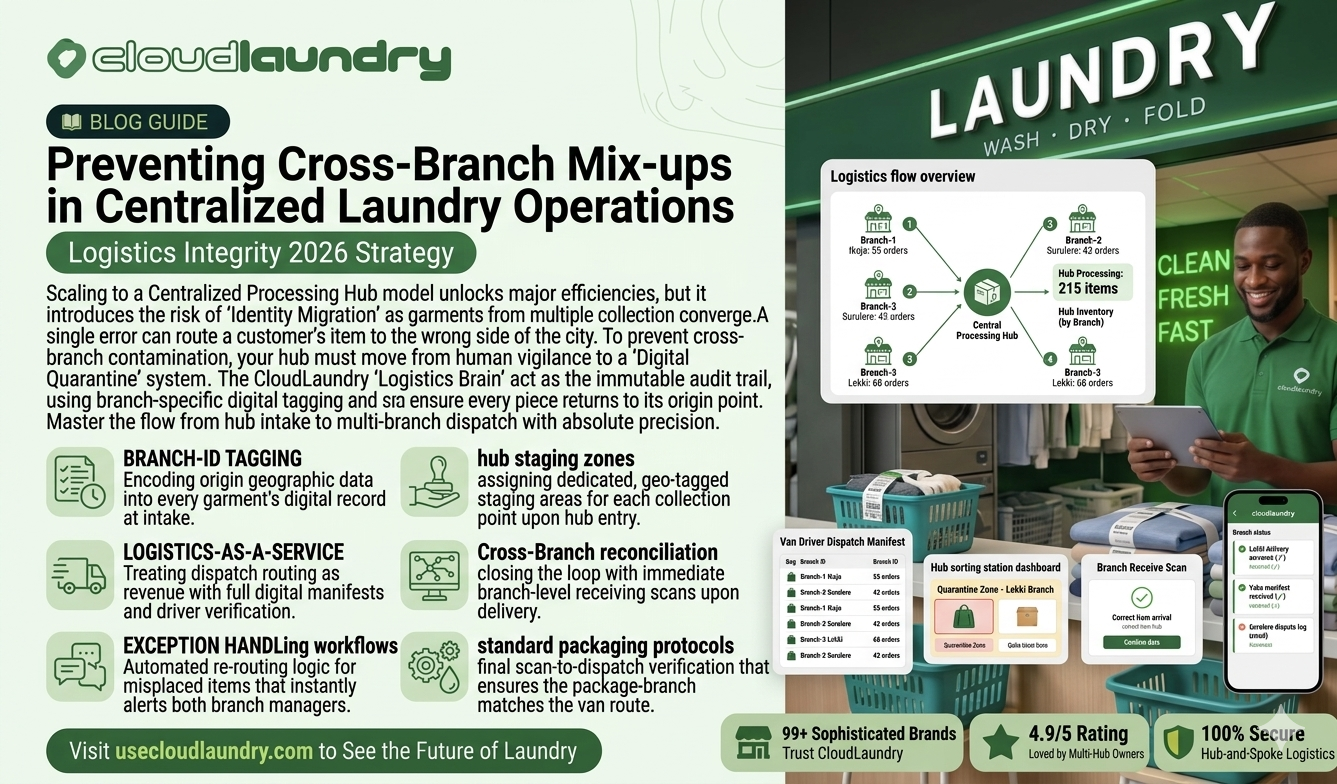
The move to a "Centralized Processing Hub" is the natural evolution for any laundry entrepreneur aiming to scale in 2026. By separating your "Collection Points" (the retail front-ends) from your "Processing Hub" (the industrial facility), you reduce your real estate costs and maximize the utilization of your expensive machinery. But this efficiency comes with a logistical cost: the risk of cross-branch contamination. In a manual system, it is far too easy for a batch of laundry from Branch A to get mixed up with a batch from Branch B during the sorting process. Once that happens, you are forced to engage in a costly, time-consuming "rescue mission" to locate the missing items, often involving expensive courier runs across town to correct your mistake.
Laundry cross-branch mix-up prevention 2026 is not about human vigilance; it is about "Digital Quarantine." You must create a system where items are geographically tagged from the moment they are accepted at the counter. The best tool to manage your laundry business, CloudLaundry, acts as the logistical brain of your hub-and-spoke model. By ensuring that every garment carries a "Branch-ID" in its digital record, usecloudlaundry.com prevents a single item from ever being misrouted. This guide will show you how to engineer a production line that is inherently incapable of branch-level errors.
The "Branch-ID" Tagging Standard
The root cause of cross-branch mix-ups is the failure to link a garment to its origin point. In a centralized model, the tag on the garment must contain more than just an order number; it must contain a "Branch-Origin Code."
The Tagging Protocol:
Geographic Encoding: Every tag printed at a collection point must be automatically encoded with a Branch-ID via CloudLaundry. When your hub receives a bag, the barcode scan instantly displays: "Order #101, Origin: Ikeja Branch."
Visual Color-Coding: While digital tags are the primary source of truth, many high-volume hubs use physical color-coded ribbons or clips for each branch. usecloudlaundry.com can alert staff to use specific colors based on the branch origin, providing a secondary layer of visual verification for the production team.
Non-Tamper Labels: Use heat-transfer labels that are applied at the collection point. These labels should not be removed until the items return to the specific originating branch.
The "Quarantine Sorting" Phase
When your delivery van arrives at the hub, you must treat every incoming batch as a "Foreign Entity." Never allow bags from different branches to sit in the same staging area.
The Sorting Workflow:
Dedicated Staging Zones: Your hub should have clearly marked staging zones for each branch. CloudLaundry prints a "Manifest Summary" for each driver, which dictates exactly where the bags should be placed upon arrival.
The "Check-In" Scan: A designated "Hub Intake" team must scan every bag upon entry. The system confirms if the bag count matches the driver’s manifest. If a bag labeled "Surulere Branch" appears in the "Yaba Branch" intake queue, usecloudlaundry.com triggers an immediate "Route Error" alert.
Separation at Source: Items from different branches should only be combined for washing if your system supports "Batch-Identity Preservation." However, for high-risk items, keep the bags separated until the final sorting phase.
Digital Manifests as the Source of Truth
In a hub-and-spoke model, the van driver is the custodian of your integrity. You need a system that ensures the driver knows what they are carrying, and the hub knows what they should be receiving.
The Manifest Strategy:
Automated Dispatch Manifests: Before a driver leaves the hub, CloudLaundry generates a digital manifest of every item destined for a specific branch.
Driver Validation: The driver must use their usecloudlaundry.com mobile app to "Digitally Sign" for the specific bags in their van. This prevents the driver from grabbing the wrong load by mistake.
Closed-Loop Reconciliation: Upon delivery, the branch staff must "Receive" the items in the app. If the branch manager clicks "Receive" and finds an item that belongs to a different branch, the error is caught immediately, not days later when the customer comes to collect.
Preventing "Cross-Pollination" During Ironing
The ironing station is the most dangerous location for mix-ups. This is where items from multiple branches are often processed side-by-side to maximize efficiency.
The Ironing Floor Workflow:
Branch-Segregated Queues: Use the CloudLaundry production dashboard to group items by Branch-ID at the ironing station. Even if you are ironing 200 shirts, keep the shirts from Branch A on one side of the table and Branch B on the other.
Visual Partitioning: Use physical dividers or colored baskets at the ironing station to store finished items.
Scan-Before-Fold: The packaging team must be trained to scan every finished item into the "Outbound Bag" for the specific branch ID shown on the digital tag. If the tag says "Ikeja" and the basket says "Yaba," usecloudlaundry.com will not allow the order to be closed.
The "Exception-Handling" Workflow
What happens if you find an item from Branch A inside a bag from Branch B? This is the moment where most companies fail by trying to "hide" the mistake.
The Transparent Recovery:
The "Misplaced Item" Alert: CloudLaundry has a specific workflow for misplaced items. The staff member scans the misplaced item, and the system prompts: "This item belongs to Ikeja. Move to Ikeja Dispatch?"
Automatic Re-routing: The system automatically removes the item from the Yaba manifest and adds it to the Ikeja manifest, and updates the branch managers on both sides.
The "Oops" Audit: By logging every misrouting, you can identify if a specific staff member is consistently causing these errors, allowing for targeted training.
Standardizing the Packaging Labeling
The final packaging is your last chance to catch an error. The customer’s receipt and the package label must perfectly match the branch origin.
Packaging Integrity:
Automated Labeling: CloudLaundry prints a final package label that features the Branch Name, Order Number, and Customer Name in bold, easy-to-read text.
Scan-to-Dispatch: The final dispatch scan must confirm that the Package Branch matches the Dispatch Van Route. If they don't match, the system locks the dispatch process. This is your final fail-safe.
Training for Hub-Scale Logistics
A central hub requires a different mindset than a retail shop. Your staff at the hub don't know the customers they only know the system.
Building the Logistics Mindset:
The "System-Over-Memory" Rule: Train your staff to never "guess" which branch a bag belongs to. If a tag is unreadable, it must be sent to the "Manager Verification Station," not guessed.
Professional Communication: Use the CloudLaundry notification system to inform branch managers about deliveries. "Branch A, your shipment is en-route with 50 items." This keeps the branch teams ready to receive and audit the shipment.
The "Audit Culture": Reward staff for finding cross-branch errors. A staff member who finds a misrouted item at the hub has saved you a significant amount of money and customer trust.
Scaling the Hub-and-Spoke Capacity
As your volume grows, your hub will need to handle more branches. The beauty of a digital system is that scaling from 5 branches to 15 branches does not change your process.
Infinite Scalability:
Dynamic Routing: CloudLaundry allows you to add or remove branches from the dispatch queue in seconds.
Load Balancing: You can monitor the throughput of every branch from the hub. If the "Yaba" collection point is seeing a spike in demand, you can adjust your van routes in the system to prioritize that collection.
The "Plug-and-Play" Hub: A tech-enabled hub is essentially "geographically agnostic." It doesn't matter where the branch is; as long as it is on the usecloudlaundry.com network, the rules of dispatch and verification remain constant.
The Value of the "Audit Trail"
In the event of a dispute, your "Digital Audit Trail" is your best defense. If a customer at Branch A claims their items were sent to Branch B, you have a complete digital history of that item’s journey.
Forensic Logistics:
The History Log: CloudLaundry stores a permanent history for every garment: Scanned at Ikeja Branch (Intake) -> Scanned at Hub (Intake) -> Scanned at Ironing -> Scanned at Dispatch (Ikeja) -> Delivered to Ikeja.
Evidence-Based Resolution: This history allows you to resolve any conflict in minutes. You don't have to call staff and ask "who might have messed up." You simply check the logs. This transparency is the backbone of trust in a centralized hub model.
Conclusion: The Hub as a Precision Instrument
In the final analysis of laundry cross-branch mix-up prevention 2026, your hub is not just a room full of washers; it is a logistics instrument. The "Hub-and-Spoke" model is the most efficient way to scale a laundry business, but it requires a level of precision that only digital systems can provide.
Cross-branch mix-ups are not a byproduct of scale; they are a byproduct of outdated processes. By enforcing digital tagging, automated manifest verification, and scan-gated dispatch, you eliminate the risk of items migrating to the wrong branch. You create a system where scale does not mean more errors; it means more efficiency.
Don't let the complexity of your growth threaten your service quality. Harness the verification logic, the route-tracking, and the manifest-management power of the best tool to manage your laundry business, CloudLaundry, to master your hub-and-spoke operations. Visit CloudLaundry today and see how CloudLaundry can help you scale with absolute integrity. Your hub is ready; ensure your logistics are sound.