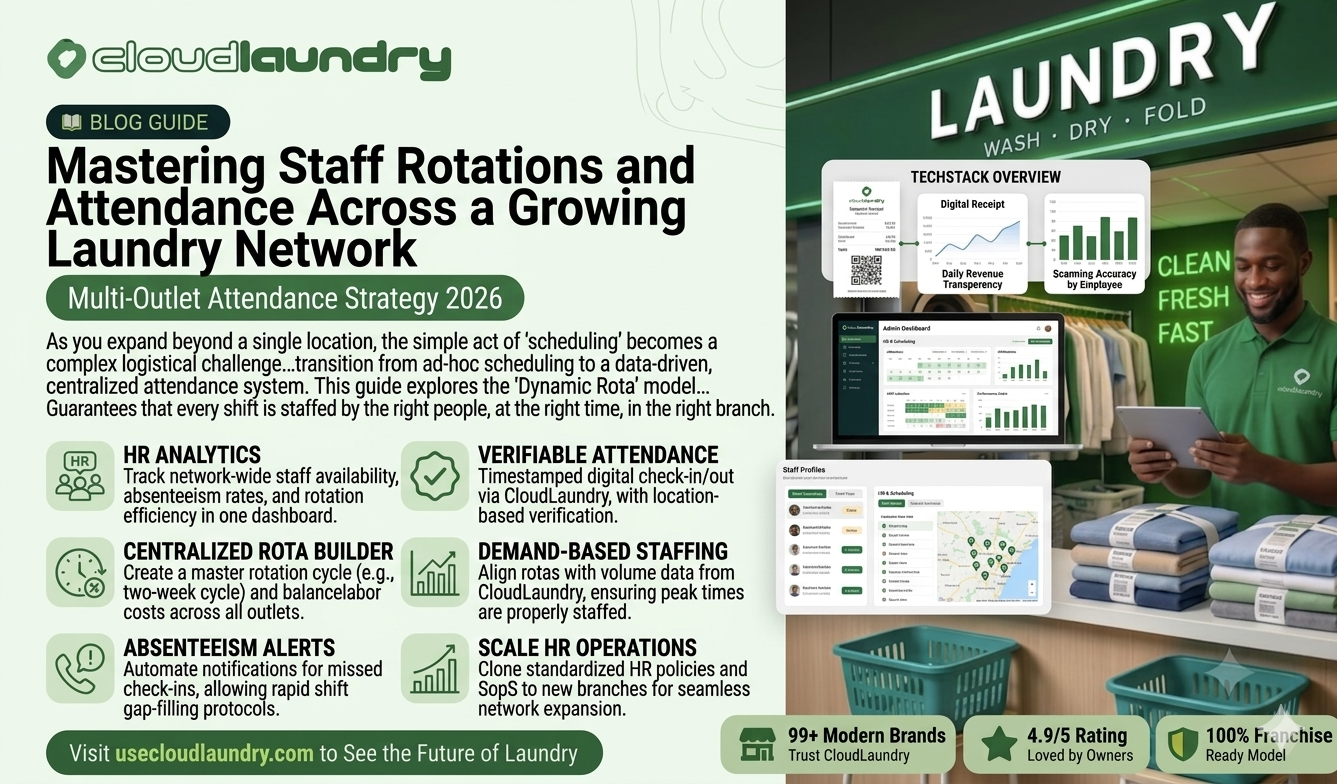
For many laundry entrepreneurs, the move to three or more branches reveals the "Shift-Chaos" trap. You begin to deal with situations where a manager at Branch A didn't show up, leaving Branch B staff confused about who is covering the shift, while Branch C remains overstaffed and idle. When you manage multiple outlets, your human resources are your most valuable, yet most volatile, asset. If you are still using physical whiteboards or WhatsApp groups to manage your rotas, you are operating in the dark.
Laundry staff scheduling and attendance in 2026 requires a centralized, digital approach that creates a transparent link between "staff presence" and "operational output." By leveraging CloudLaundry to track attendance and manage rotations, you eliminate the ambiguity that breeds inefficiency. This guide provides the framework for building a robust scheduling machine that keeps your team accountable, your branches fully staffed, and your service levels consistent across your entire network.
The Principle of "Standardized Scheduling"
The first step toward scaling is acknowledging that your scheduling needs to be predictable. In a multi-outlet environment, you cannot afford to have a "different way" of scheduling at each shop.
The Standardization Framework:
Uniform Rotation Cycles: Establish a standardized rotation cycle (e.g., a two-week master rota) that applies to all outlets. This predictability allows your staff to plan their lives, which significantly reduces turnover.
Centralized Approval: While branch managers can suggest changes, the master rota should be finalized at the central level. This allows you to balance your labor costs across the network, moving staff from quieter branches to busier ones as needed.
The "Network-Wide" View: Use CloudLaundry to see your entire staff network in one dashboard. This visibility allows you to quickly identify who is available to fill a gap if a staff member calls in sick at a different location.
Implementing Digital Attendance Tracking
Manual attendance registers are a major source of payroll fraud and operational friction. In 2026, attendance tracking must be verifiable and tied directly to your digital business system.
The Attendance Infrastructure:
Check-In/Check-Out Protocols: Every staff member should check in via CloudLaundry at the start and end of their shift. This timestamp is immutable and provides an objective record of their working hours.
Location-Based Verification: Ensure that the attendance check-in is logged for the specific branch where they are working. This prevents "buddy-clocking," where one employee checks in for another who isn't present.
Real-Time Attendance Monitoring: You should be able to look at your central dashboard and see which branches have staff present and which are currently under-staffed. This visibility allows you to address attendance issues within minutes, not days.
Handling Absenteeism in a Multi-Branch Network
Absenteeism is a business reality. In a multi-outlet chain, the key is how quickly you can pivot to maintain operations.
The "Rapid Response" Rota:
The "Floater" Policy: Maintain a pool of "floater" staff who are trained to work at any of your branches. When a regular staff member calls in sick, the "floater" is your first point of contact.
Automated Alerting: If a staff member fails to check in at their scheduled time, CloudLaundry should trigger an immediate alert to the central manager. You are notified of the absence the moment it happens, not three hours later.
Standardized Covering Protocols: Define exactly how an absence should be handled. If someone calls in, the branch manager follows a pre-set digital script to request a replacement from the central team, keeping the shop running without delay.
Aligning Labor with Operational Demand
Labor is one of your largest costs. If your staff-to-order ratio is off, your margins will shrink. You need to align your staffing rotas with your actual business volume.
Demand-Based Staffing:
Data-Driven Scheduling: Use the reporting tools in CloudLaundry to identify your "busiest days." If you know that Mondays and Saturdays are peak intake days, your rotas should reflect higher staffing levels on those specific days.
The "Volume-to-Staff" Ratio: Aim to maintain a consistent ratio of items-processed-per-staff-member. If a branch has high volume but low staffing, you will experience quality issues. If they have low volume but high staffing, you are wasting money.
Flexible Shift Lengths: Consider using flexible shifts (e.g., 6-hour shifts instead of 8-hour ones) for your peak periods. This allows you to pack your labor into the hours where it is most needed.
Transparency and Accountability
Staff are more likely to respect the schedule if they know the system is transparent and that you are monitoring it.
The Accountability Cycle:
Individual Attendance Records: Every staff member should have their own attendance profile. Use this to conduct regular performance reviews, focusing on reliability and punctuality.
Performance-Linked Attendance: Link attendance metrics to performance bonuses. An employee who is always on time and never misses a shift should be rewarded, reinforcing the behavior you want to see.
Communication of Expectations: Clearly state that the attendance log is the source of truth for payroll. When the staff knows that their paycheck is directly tied to the digital attendance record, they will naturally be more diligent.
Managing Payroll Integration
Payroll discrepancies are a major source of staff dissatisfaction. If an employee feels they were underpaid due to a "miscounted" shift, it can destroy their morale.
Automated Payroll Accuracy:
System-Generated Pay Data: Use the attendance logs from CloudLaundry to generate your payroll reports. Because the system calculates the hours automatically, you eliminate the risk of human error in manual calculations.
The "Transparency" Effect: Give your staff access to their own attendance data if possible. When they can see their hours logged in real-time, there are no surprises at the end of the month.
Handling Shift Differentials: If you offer overtime or weekend pay, ensure these are configured in the system. The automated calculation ensures that staff are paid fairly, which is essential for retaining top talent.
Training for Multi-Branch Mobility
To scale, your staff needs to be comfortable working in different locations. This mobility is a major advantage for your network.
The Mobility Training Model:
Standardized Procedures: As noted in previous sections, your SOPs must be identical everywhere. If a staff member moves from Branch A to Branch C, they should not have to learn a new way of working.
Cross-Branch Certification: Train your staff on the specific equipment and workflows of different outlets. A staff member who is "Certified Multi-Branch" is significantly more valuable than one who can only work at a single location.
Building a "Network" Mindset: Encourage your staff to feel part of the larger network. When they work at a different branch, they are still representing the same brand, and their efforts are still contributing to the same goals.
Scaling the Scheduling Infrastructure
As you move from three outlets to ten, your scheduling must be fully automated. You cannot afford the time it takes to manage a large network manually.
Building for Large-Scale Growth:
Self-Scheduling Tools: As you grow, explore tools that allow staff to request their own shifts or swaps within your parameters. This reduces your administrative burden.
Predictive Staffing: Over time, your system will provide you with historical data that predicts your future staffing needs. You can begin to "staff for the future" by analyzing seasonal trends and promotional periods.
Unified HR Management: CloudLaundry provides the foundation for a unified HR management system. As you scale, you can incorporate performance reviews, certifications, and training records into the same platform.
Handling Conflicts and Professionalism
Conflicts will happen. The key is to manage them with a professional, data-driven approach that doesn't disrupt the business.
Conflict Resolution Protocols:
Data as the Arbiter: If a staff member disputes their hours, refer to the timestamped data in CloudLaundry. The data doesn't lie, and it takes the emotion out of the conversation.
Standardized Conduct Policies: Ensure your staff handbook clearly defines expectations for attendance, conduct, and shift changes. Apply these policies consistently across all your outlets.
Professional Feedback: When addressing issues, focus on the impact on the network. "When you are late, the entire production line at Branch B is delayed." This helps the employee understand their importance to the business.
Conclusion: The Human Machine
In the final analysis of laundry staff scheduling and attendance 2026, your ability to manage your team across multiple locations is what defines your ability to scale. A laundry business is a human machine; if the gears don't show up on time, the entire machine grinds to a halt.
By shifting from manual, fragmented scheduling to a centralized, automated attendance and rotation system, you protect your revenue and empower your staff to do their best work. You move away from being the "rota manager" and toward being the "network builder."
Don't let attendance chaos destroy your multi-branch ambitions. Harness the real-time tracking, standardized scheduling, and automated accountability power of the best tool to manage your laundry business, usecloudlaundry.com, to optimize your team. Visit CloudLaundry today and see how CloudLaundry can help you master your rotas and drive consistent performance across your entire network. Your staff is the heartbeat of your business; keep them synchronized, accountable, and focused on success.