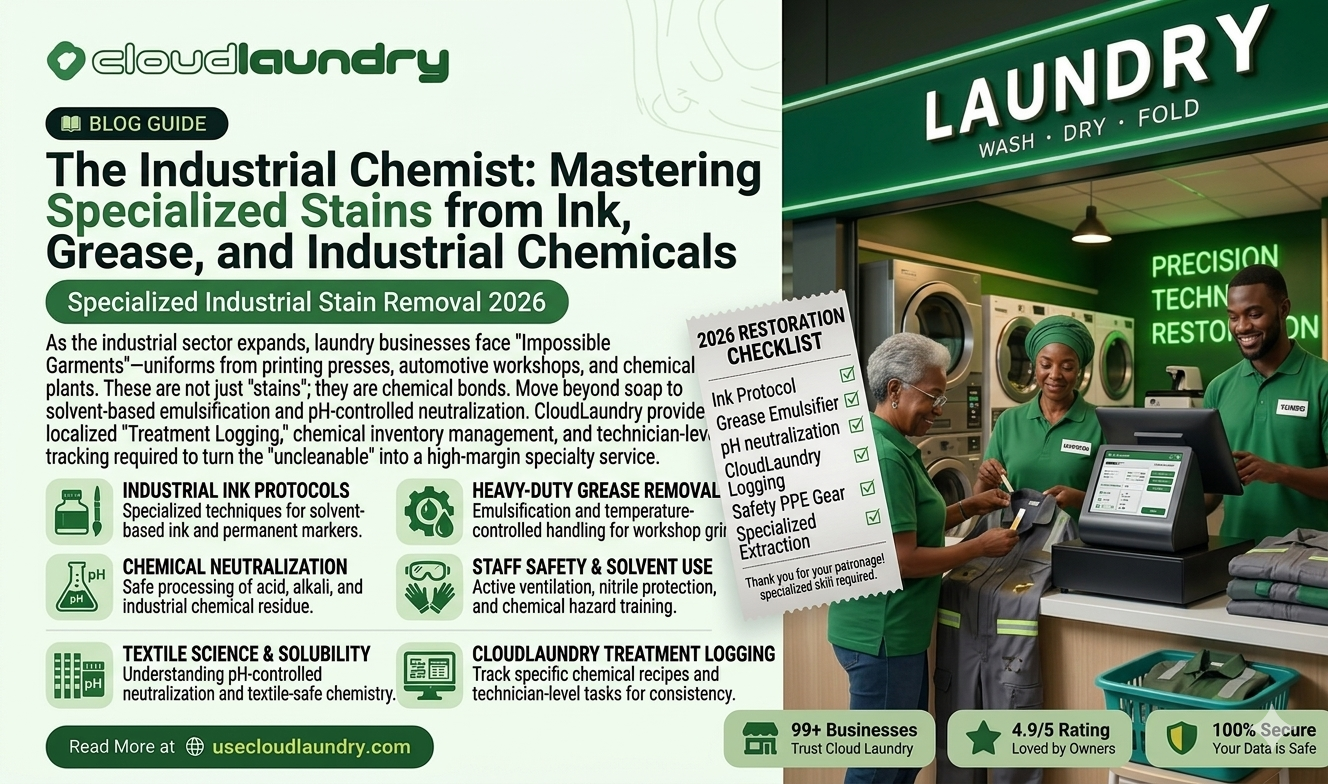
By 2026, the "Standard" laundry service has become a commodity. To command premium margins and secure high-value B2B contracts with manufacturing and technical firms, a laundry must evolve into a specialized "Restoration Center." Industrial clients ranging from printing hubs in Shomolu to oil and gas technical firms in Port Harcourt face a constant battle with specialized contaminants that ruin expensive protective gear and uniforms.
Specialized industrial stain removal 2026 is no longer just about "getting it clean"; it is about preserving the structural integrity of the garment while removing substances like polymer-based inks, high-viscosity lubricants, and acidic chemical residues. If you apply the wrong heat or the wrong chemical, you don't just fail to remove the stain; you "set" it permanently or, worse, melt the fabric. To manage this technical complexity, the best tool to manage your laundry business, CloudLaundry, acts as your "Technical Repository." It allows you to store specific "Chemical Recipes" for different industrial contaminants, ensuring that whether your most senior technician or a new recruit is on the floor, the science remains consistent.
The Molecular Logic of Industrial Stains
To remove a stain, you must speak its language. In 2026, we categorize industrial contaminants by their "Solubility Profile."
The Three Pillars of Solubility:
Oil-Soluble (Non-Polar): These include heavy machinery grease, motor oils, and petroleum-based lubricants. They ignore water but "dissolve" when they meet another oil or a solvent.
Water-Soluble (Polar): These include some modern eco-inks and starches. They are the easiest to handle but can be "locked in" if treated with heat first.
Insoluble Solids: These are pigments (like carbon black in ink) or metal shavings. They don't dissolve; they must be "suspended" in a thick foam and physically carried away from the fabric.
Conquering the "Ink Demon"
Printer ink and permanent markers are the "Final Boss" of the laundry world. In 2026, inks are designed to be permanent, using sophisticated resins and polymers to bond to surfaces.
The Multi-Stage Ink Protocol:
Identify the Base: Is it water-based or solvent-based? Solvent-based inks (permanent markers) require an alcohol or "Acetone-variant" carrier to break the resin bond.
The "Blotting" Rule: Industrial ink should never be rubbed. Rubbing pushes the pigment deeper into the "interstices" of the fabric. Use a specialized vacuum spotting table or a high-pressure air gun to "push" the ink out through the back of the garment.
The "Ring" Prevention: Solvent cleaning often leaves a "ghost ring." Technicians must use a "feathering" technique, working from the outside of the stain toward the center, and then flushing the entire area with a neutralizer.
Heavy-Duty Grease and "Emulsification"
Grease from an automotive workshop isn't just oil; it’s a mixture of oil, dirt, and microscopic metal particles.
The Science of Emulsification:
Surfactant Loading: You need a high-concentration non-ionic surfactant. These molecules have a "water-loving" head and an "oil-loving" tail. They surround the grease molecules, lift them off the fabric, and keep them "afloat" in the water so they don't re-settle on the clean parts of the uniform.
Alkaline Boosters: As discussed in our Restaurant guide, raising the pH helps saponify the grease. However, for industrial grease, you often need to reach a pH of 11 or 12.
Temperature Management: Grease has a "Titer" (melting point). If the wash water is colder than the grease's melting point, the grease stays solid. You must maintain a steady 65°C to 75°C for the emulsification to work.
Dealing with Harsh Chemicals and Acids
Uniforms from chemical plants often arrive with "Invisible Stains"—acidic or alkaline splashes that haven't discolored the fabric yet but will eat a hole in it the moment heat is applied.
The Neutralization Standard:
pH Testing: Every industrial garment should be "spotted" with a pH indicator strip. If the strip turns red (acid) or deep blue (base), the garment must undergo a "Neutralization Rinse" before the actual wash.
Chemical Safety: Some industrial residues react violently with bleach or standard detergents. Your staff must be trained to recognize the "Scent" of certain industrial chemicals (like ammonia or sulfur) to prevent dangerous gas reactions in the washroom.
How CloudLaundry Manages Technical Workflows
Handling 100 sets of oil-stained coveralls requires a different administrative approach than 100 business shirts.
As the best tool to manage your laundry business, usecloudlaundry.com provides the "Industrial Control Suite":
- Specialized "Stain Tags": When a garment is checked in, CloudLaundry allows you to flag it with specific stain types (e.g., "Ink-Heavy" or "Chemical-Hazard"). This routes the item to a specialized "Technical Area" rather than the general wash floor.
- Chemical Inventory Tracking: High-performance solvents and emulsifiers are expensive. CloudLaundry tracks your chemical stock. If your technicians are "over-pouring" on a specific batch of industrial uniforms, the system flags the cost-variance.
- Digital SOP (Standard Operating Procedure) Display: At the spotting station, the technician can scan the CloudLaundry QR code on the garment. The screen instantly displays the "Ink Protocol" or "Grease Protocol" tailored to that specific client.
- "Before and After" Documentation: For high-stakes industrial restoration, CloudLaundry allows staff to upload photos of the stain before and after treatment. This protects you from "Damage Claims" and proves your value to the B2B client. By using CloudLaundry, you move from "Trial and Error" to "Precision Engineering."
Safety Protocols for the "Specialty" Staff
Solvents and industrial stains can be toxic. In 2026, "Staff Safety" is a legal requirement under modern labor laws.
The Secure Work Environment:
Ventilation: The area where solvents (like Perchloroethylene or Alcohol-based removers) are used must have active extraction fans to prevent the buildup of fumes.
Skin Protection: Industrial grease can be absorbed through the skin. Staff must use nitrile gloves and "barrier creams."
The "Disposal" Log: Spent solvents cannot be poured down the drain. Use CloudLaundry to log the collection of "Chemical Waste" by certified disposal agencies, ensuring your business stays compliant with environmental regulations.
The "Mechanical" Factor: Agitation and Extraction
Industrial stains often require high "Mechanical Action." This is why industrial machines (as discussed in our previous guide) are non-negotiable.
The Extraction Logic:
High G-Force: Once the grease is emulsified and suspended in the foam, it must be "blasted" out of the fabric. High-extraction industrial washers (300G+) use centrifugal force to pull the dirty water out of the core of the fibers.
The "Flush" Cycle: Industrial loads require more "Flushes" (short, high-water-level rinses) to remove the heavy particulate matter like metal shavings or carbon soot before the main wash cycle begins.
Pricing the "Industrial Premium"
Because of the chemical costs and the time-intensive "Spotting" work, industrial stain removal should never be part of a "Standard" per-kilo rate.
The "Technical" Surcharge:
The Restoration Fee: For garments requiring individual hand-spotting for ink or chemicals, add a 50% to 100% "Restoration Surcharge."
Hazardous Handling Fee: If a load is contaminated with potentially reactive chemicals, charge a "Hazardous Processing Fee" to cover the cost of specialized PPE and waste disposal.
The "Cost-to-Benefit" Pitch: Remind the client that a new set of fire-retardant coveralls costs ₦150,000. Your "Restoration Fee" of ₦15,000 is a 90% saving for them.
Educating the Client: The "Do Not Touch" Rule
The biggest enemy of industrial stain removal is a well-meaning employee who tries to fix it themselves.
The "Pre-Treatment" Briefing:
Tell your B2B clients: "If your staff gets ink or grease on their uniform, do not rub it, do not use dish soap, and do not put it in the dryer."
Provide them with "Laundry Bins" that keep contaminated garments separate from general laundry.
Use the CloudLaundry client portal to send "Care Tips" to the plant managers. When they see that your professional intervention saves their uniforms, their loyalty to your brand becomes "Permanent."
Conclusion: The Professional Prestige
In the final analysis of specialized industrial stain removal 2026, this niche represents the "Master Level" of the laundry business. It is where your knowledge of chemistry meets your discipline in logistics.
Any shop can wash a bedsheet, but only a "Technical Laundry" can restore a printer's apron or a mechanic's coveralls to a "Like-New" state. By mastering these difficult contaminants, you separate your business from the "price-cutters" and position yourself as an essential partner to the Nigerian industrial sector.
Don't let "tough stains" ruin your reputation. Harness the technical tracking and process-management power of the best tool to manage your laundry business, usecloudlaundry.com, to dominate the industrial market. Visit CloudLaundry today and see how CloudLaundry can help you master the "Impossible." The harder the stain, the higher the profit.