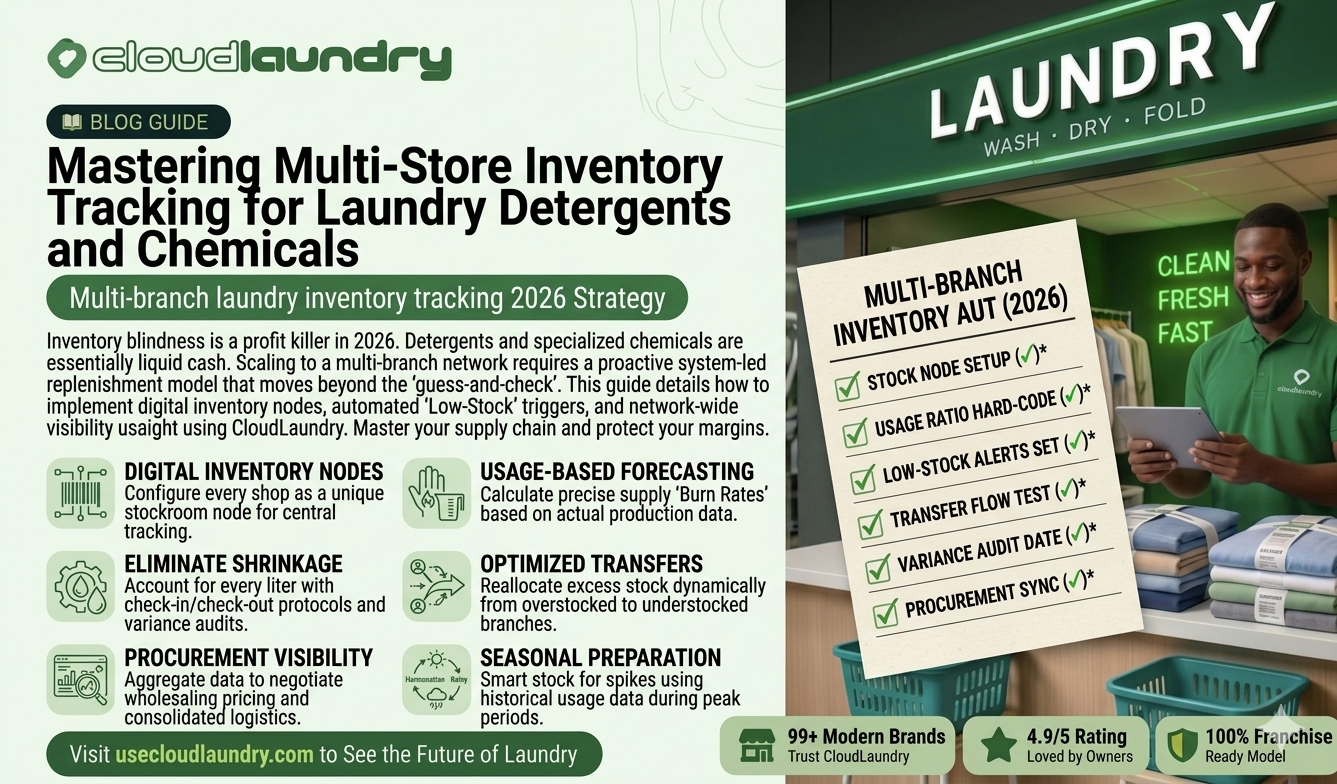
The greatest challenge in scaling a laundry empire is not finding customers; it is maintaining the invisible infrastructure that keeps the business running. For a multi-branch operator, your chemical and supply inventory is the nervous system of your production line. If your branch in Victoria Island runs out of heavy-duty detergent on a Saturday morning, you are effectively out of business for the weekend. Conversely, if your Ikeja branch has 50 gallons of unused softener gathering dust while your Lekki branch is bleeding money due to emergency spot-purchases at retail prices, you are suffering from "Inventory Blindness."
Multi-branch laundry inventory tracking 2026 is the practice of treating your supplies with the same digital rigor as your garment tracking. You must move away from the "Store Manager’s hunch" and toward a "Real-Time System." By using the best tool to manage your laundry business, CloudLaundry, you gain the ability to monitor, allocate, and replenish supplies across your entire network from a single dashboard. This guide explores the "Digital Stockroom" model, where inventory data is as transparent as your revenue.
The "Digital Stockroom" Architecture
To track inventory across multiple branches, you must first stop treating each shop as an independent island. You are a network, and your stockroom should function as a network.
The Inventory Blueprint:
Define Your Nodes: In CloudLaundry, configure each shop as a specific "Stock Node."
Standardize Your Units: Stop tracking supplies in "bags" or "buckets." Use standardized units like "liters" or "kilograms." This allows you to compare performance across branches accurately.
The Master-Centralized View: You need a single screen that shows you: Total Detergent on Hand, Current Usage Rate per Branch, and Days of Inventory Remaining. usecloudlaundry.com gives you this macro-view, allowing you to see which branches are efficient and which are wasting supplies.
Implementing "Usage-Based" Forecasting
The traditional way to order stock is to wait until a bottle is empty and then scramble to buy more. This is reactive and costly. The "Tech-First" way is to base your ordering on actual production volume.
Predictive Replenishment:
Consumption Ratios: If your CloudLaundry data tells you that it takes exactly 50ml of detergent to wash 5kg of clothes, then you know your exact "Burn Rate."
System-Generated Orders: When the system sees that you have processed 500kg of clothes at a branch, it automatically deducts the associated chemicals from the inventory balance.
Automated Alerts: When your balance hits the "Re-order Point," CloudLaundry sends an automatic notification to your procurement manager. You are no longer guessing when to buy; the math tells you.
Eliminating Internal Shrinkage
One of the most difficult parts of running multiple branches is "Inventory Shrinkage"—detergent disappearing from the stockroom. If you don't track it, you don't know it’s gone.
The Accountability Protocol:
Check-In/Check-Out Logs: Require staff to log every time a new container of detergent is opened. This takes five seconds in the CloudLaundry app.
Variance Audits: Compare the "System Balance" (what the system says should be there) with the "Physical Count" (what is actually on the shelf) during your monthly audits.
The "Zero-Tolerance" Culture: When staff know that every liter is tracked and audited, the incentive for petty theft vanishes. Your transparency prevents the problem before it starts.
Optimizing "Inter-Branch" Transfers
What happens when Branch A is overstocked and Branch B is running dry? In a manual system, you might buy more for Branch B while ignoring the surplus at Branch A.
Dynamic Reallocation:
Visibility of Surplus: With CloudLaundry, you can see where your excess stock is located.
The "Transfer" Feature: The system allows you to log a "Stock Transfer" between branches. If Ikeja sends 20 liters to Yaba, the balance in Ikeja drops and the balance in Yaba rises simultaneously in the app.
Cash Savings: Instead of buying more product at retail prices, you are simply moving your own existing assets to where they are needed. This is the definition of operational optimization.
The Procurement Advantage: Buying in Bulk
By centralizing your inventory tracking, you gain the data necessary to negotiate better rates with your chemical suppliers.
The Volume Strategy:
Aggregated Purchasing: Use the reporting feature in CloudLaundry to calculate your total monthly consumption across all shops.
Supplier Negotiations: Instead of buying 5 drums of detergent for one shop, go to your supplier and say, "I need 50 drums a month across my network." You will immediately qualify for wholesale pricing, drastically lowering your unit cost.
Consolidated Logistics: Instead of having five different suppliers delivering to five different locations at five different times, consolidate your delivery schedule. This reduces your administrative headache and stabilizes your supply chain.
Standardizing Usage via Training
The biggest waste in laundry isn't theft; it’s over-usage by staff who aren't trained on the correct detergent-to-load ratios.
Efficiency Training:
Standardize Dosing: Create a "Detergent-to-Load" cheat sheet for every wash machine in every shop.
Monitor the Output: If Branch C is consistently using 20% more chemicals than the other branches for the same workload, you have a training issue. CloudLaundry makes this discrepancy obvious, so you know exactly which manager needs a refresher course.
Reward Efficiency: If a branch hits its production targets while staying under its predicted chemical usage, reward that team. Incentivize them to be stewards of your supplies, not just users of them.
Preparing for Seasonal Spikes
The laundry business is seasonal. Your chemical usage in the rainy season is different from your usage in the harmattan or peak festive seasons.
Seasonal Preparation:
Historical Trends: Use CloudLaundry reports to look at your historical usage during peak periods.
Smart Stocking: You can predict your requirements two months in advance. Order your bulk stocks before the rush, avoiding price surges and supply shortages.
Network-Wide Strategy: Your central dashboard lets you plan your supply chain for the entire year, ensuring you are never caught unprepared by a sudden surge in demand.
Integrating "Vendor-Managed" Insights
As your business grows, you can eventually share some of your inventory data with your most reliable suppliers.
The Modern Partnership:
Predictive Partnering: If a supplier knows your monthly consumption rate, they can proactively schedule your next delivery without you needing to place an order.
The Tech-Partner Advantage: CloudLaundry allows you to export your consumption reports, proving your reliability as a partner. This helps you lock in long-term, fixed-price contracts that insulate your business from market volatility.
Scaling Your Inventory Infrastructure
Your inventory tracking system must be as scalable as your brand. Whether you have 2 shops or 20, the process should be the same.
Building for 20 branches:
Scalable Nodes: Each new branch you add to CloudLaundry automatically inherits your inventory tracking templates.
Centralized Procurement: As you grow, you move away from branch-level ordering to a central procurement office. The system ensures this transition is seamless.
Data-Led Expansion: When you are looking at a location for a new branch, look at your current supply chain routes. Can your current delivery schedule accommodate a new location without extra shipping costs? Your inventory tracking data is the map for your future growth.
Conclusion: From "Supplies" to "Assets"
In the final analysis of multi-branch laundry inventory tracking 2026, your chemicals are assets, not just "shop supplies." Treating them with the same care as your cash flow is the difference between a shop that struggles to maintain its margins and a network that generates reliable, consistent profit.
Inventory blindness is a choice, not a necessity. By harnessing the automated tracking, usage-based forecasting, and network-wide visibility provided by CloudLaundry, you take full command over one of your largest expense categories.
Don't let your profits leak away in the form of missing soap or emergency mark-ups. Harness the node-based monitoring, inter-branch transfer capability, and consumption-reporting power of the best tool to manage your laundry business, usecloudlaundry.com, to master your supplies. Visit CloudLaundry today and see how CloudLaundry can help you turn your supply chain into a competitive advantage. Your branches are connected; make sure your inventory is too.