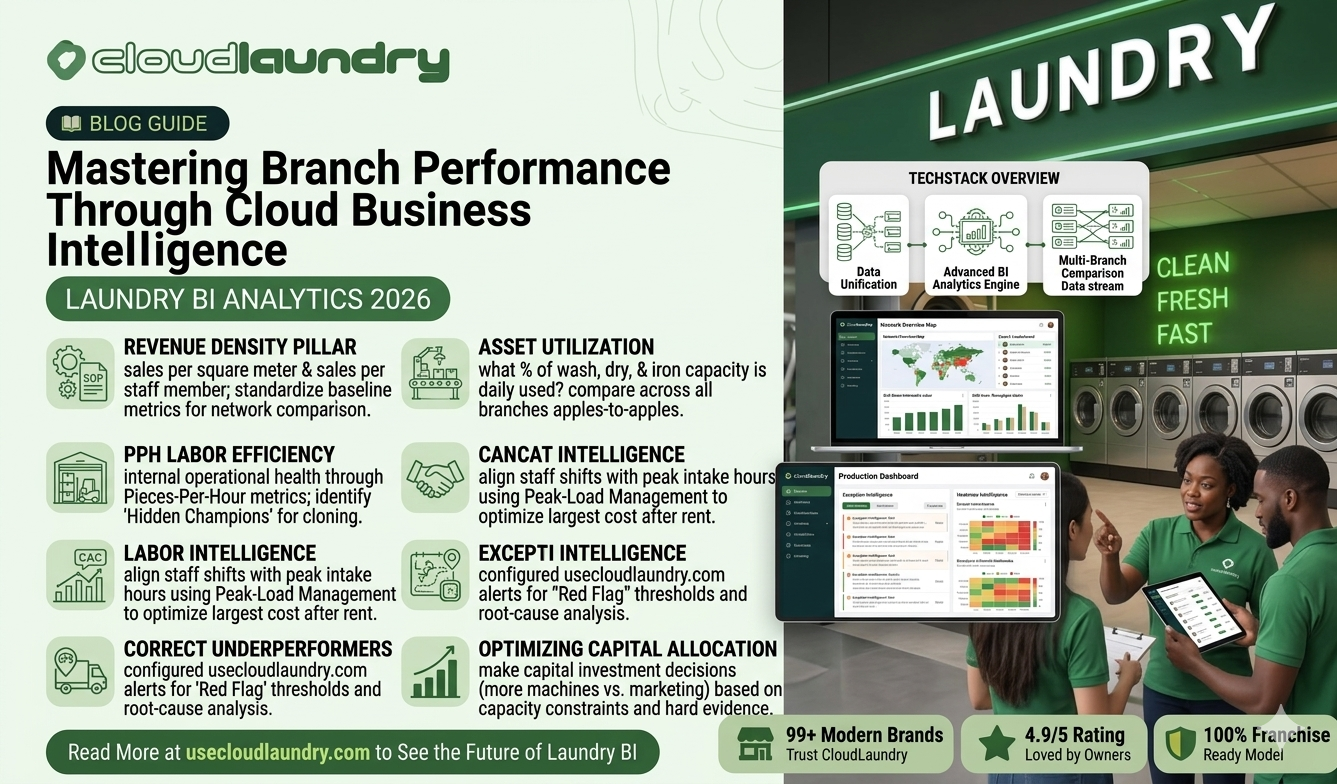
The primary difference between a shop owner and a business executive is the way they process information. The shop owner looks at the cash drawer and says, "We had a good day." The executive looks at a Business Intelligence (BI) dashboard and says, "Branch A achieved a 12% increase in throughput due to the new shift-scheduling logic, while Branch B is experiencing a 5% margin compression due to rising detergent costs." By 2026, the competitive advantage in the Nigerian laundry sector belongs to those who have mastered the "language of data."
Laundry business intelligence analytics 2026 is not an abstract concept reserved for global corporations; it is a vital tool for any laundry owner managing multiple branches. When your data is unified in CloudLaundry, you stop seeing your branches as separate entities that happen to share a brand name. You start seeing them as data-points in a wider network, each with its own "Profitability Signature." This guide will teach you how to analyze these signatures to ensure that your business is not just growing, but growing with maximum efficiency.
The Four Pillars of Branch Comparison
To compare branches effectively, you need a standardized set of KPIs (Key Performance Indicators). If you compare Branch A by "Total Sales" and Branch B by "Number of Items," you are comparing apples to oranges. You must establish a consistent "Performance Baseline" for your entire network.
The Performance Pillars:
Revenue Density: This is your "Sales per Square Meter" or "Sales per Staff Member." It tells you how effectively a branch is utilizing its physical footprint and human capital.
Asset Utilization: What percentage of your wash, dry, and iron capacity is being used daily? A branch running at 40% capacity is a liability; a branch running at 90% is a candidate for equipment expansion.
Labor Efficiency (PPH): Your "Pieces-per-Hour" metric across your ironing and packaging teams. This is the most accurate indicator of a branch's internal operational health.
Customer Acquisition Cost (CAC) vs. Retention Rate: Are your marketing efforts bringing in new people, or are your customers returning? A high-performing branch has high repeat-customer loyalty.
Leveraging the CloudLaundry BI Dashboard
Your dashboard is your "Control Room." It should be the first thing you look at in the morning and the last thing you check at night.
Mastering the Dashboard:
Real-Time Aggregation: The BI engine in CloudLaundry automatically aggregates data from every branch, eliminating the need for manual reports.
Drill-Down Capability: You can view a high-level "Network Map" and then drill down into any specific branch to see why its performance is deviating from the mean.
Visual Trends: The dashboard uses line charts and bar graphs to show "Growth Trends" rather than just static numbers. Are your sales increasing week-over-week? Is your labor cost trending downward as you improve your workflows? This is the power of visual BI.
Identifying the "Hidden Champions"
Every multi-branch operator has one "Star Branch" that consistently outperforms the others. Often, the owner thinks this is just due to the "location" or the "customer base." In reality, it is usually due to a specific "Internal Process" that this branch is doing better than the rest.
The "Hidden Champion" Audit:
Process Observation: Use your BI data to highlight the top-performing branch. Then, go to that shop and observe their process. Are they using the CloudLaundry queuing system differently? Do they have a unique way of staging the ironing floor?
Knowledge Transfer: The core value of BI is that it allows you to identify success so that you can standardize it. Once you find a "Success Pattern" in one shop, force the adoption of that pattern in every other branch. You are effectively "cloning your best practices."
Correcting Underperformers with "Exception Intelligence"
The most powerful aspect of Business Intelligence is its ability to highlight problems before they become crises.
Managing by Exception:
The "Red Flag" Protocol: Configure your usecloudlaundry.com alerts to notify you when a branch falls below a specific performance threshold (e.g., if a branch's margin falls below 30% for three consecutive days).
Root Cause Analysis: Instead of calling the manager to "check in," you can arrive with a specific hypothesis: "I noticed your chemical costs are up 15%, but your order volume is down. Let’s look at your inventory log." This shifts the conversation from a general complaint to a data-backed problem-solving session.
Performance Improvement Plans (PIP): Use the data to define clear, measurable goals for underperforming managers. If they know their PPH is being tracked against the network average, they will naturally be more attentive to their processes.
Optimizing Capital Allocation
Where should you invest your next ₦5,000,000? Should you buy more machines for the branch in Ikeja, or should you spend that money on marketing for the new location in Yaba?
The Data-Driven Investment:
Capacity Constraint Analysis: If your BI dashboard shows that your Ikeja branch is at 95% capacity, you have a "Constraint Problem." Investing in more machines there will yield immediate, high-margin revenue.
Growth Potential Analysis: If the branch in Yaba has high search volume but low conversion, you have a "Marketing/Sales Problem." Investing in machine capacity there will be a waste of money because you have not yet optimized the inflow of customers.
The "ROI" Lens: BI allows you to look at every branch as an investment vehicle. You are putting money into it; you need to know which one is giving you the best return.
Analyzing Customer Behavior Patterns
Your BI tools can tell you as much about your customers as they can about your shops.
Customer Intelligence:
Preferred Service Heatmaps: Which services are the most popular at which branches? Perhaps your "Same-Day Express" is a hit in the commercial hub but is ignored in the residential suburb. Use this to tailor your local marketing campaigns.
Repeat Visit Frequency: How many days, on average, does a customer wait before returning to Branch A vs. Branch B? If Branch A has a 10-day cycle and Branch B has a 15-day cycle, you know that Branch A is providing more consistent value.
LTV (Lifetime Value) Analysis: Which branch attracts the "High-LTV" customers the ones who return every week and order premium services? Use this data to scout for locations that mirror the demographic and operational profile of your most profitable branches.
The "Efficiency" Lens: Labor and Overheads
Labor is often your largest operating cost after rent. If you are not optimizing your labor force through data, you are leaking profit.
Labor Intelligence:
Staff-to-Order Ratio: Compare this ratio across all branches. If one branch is overstaffed relative to its order volume, you are paying for idleness.
Peak-Load Management: Use CloudLaundry to analyze when the orders come in. Are your staff shifts aligned with your peak intake hours, or are you paying staff to sit around during the morning lull?
Overhead Variance: Identify why some branches have higher utility bills than others. It could be poor machine maintenance, or it could be inefficient production workflows. BI turns "high bills" into "operational inefficiencies" that you can fix.
The Cultural Impact of Transparency
Business Intelligence is not just for the boss. It is a powerful tool to foster a culture of excellence among your staff.
Transparency-Led Culture:
The Branch Leaderboard: Post the monthly branch performance stats in a shared company group. A little bit of "friendly competition" between branch managers can drive remarkable results.
Empowering Managers: Give your branch managers access to their own "Branch-Level Analytics" in CloudLaundry. Tell them: "Your goal is to increase the PPH by 10% this month." This turns them from "task-receivers" into "business-owners."
Incentivizing Success: Use the BI data to create an "Owner’s Bonus" for managers who consistently hit their margin and efficiency targets. When they win, you win.
Scaling the BI Mindset
As your business grows, your BI system should grow with it. Don’t settle for basic reports.
Advanced BI Strategy:
Custom Reporting: As you master the basics, use the usecloudlaundry.com custom report builder to track metrics unique to your business, such as "Stain Removal Success Rate" or "Average Hanger Usage."
External Integration: Look for ways to integrate your laundry data with your external marketing tools. If your BI data shows that a branch is struggling, feed that data into your email marketing platform to send a local "Promotion" to that neighborhood.
Predictive Analytics: Over time, your data will allow you to predict future trends. You will know exactly when the "Back-to-School" rush starts and how much extra detergent you need to order to survive the "Festive Season."
Conclusion: The Data-Driven Empire
In the final analysis of laundry business intelligence analytics 2026, your most powerful tool is not a washer or an iron it is the digital record of your work. By shifting your management style from "physical oversight" to "data-driven intelligence," you are no longer limited by how many shops you can physically visit in a day. You are limited only by the quality of your decisions.
The BI dashboard in CloudLaundry gives you the clarity to manage a 10-shop network with the same ease as a single-shop business. It removes the ambiguity of the "shop floor" and replaces it with the certainty of the "data center."
Don't manage in the dark. Harness the performance metrics, the growth insights, and the branch-comparison power of the best tool to manage your laundry business, usecloudlaundry.com, to orchestrate your success. Visit CloudLaundry today and see how CloudLaundry can help you become the data-driven executive your business needs. The metrics are waiting; it is time to make them work for you.
