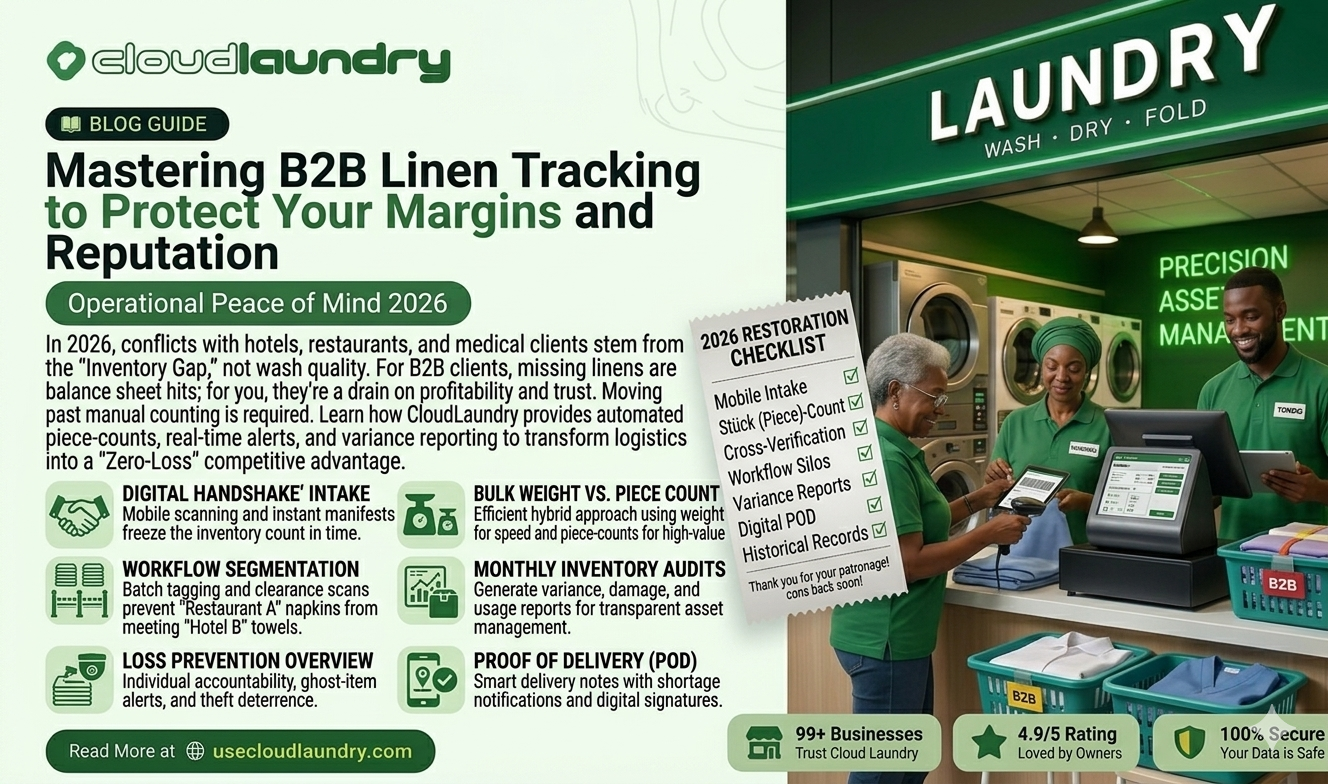
By 2026, the Nigerian commercial laundry landscape has reached a level of maturity where B2B clients ranging from boutique hotels in Ikoyi to corporate catering firms in Abuja expect more than just clean fabrics. They expect "Asset Management." A single high-quality Egyptian cotton tablecloth can cost upwards of ₦25,000. If a restaurant sends 100 such cloths to a laundry and only receives 98 back, that ₦50,000 loss instantly wipes out the profit margin for the entire month’s contract.
Tracking B2B laundry inventory 2026 is the frontline of your business’s relationship with its most valuable clients. In the past, "losing things" was seen as an unfortunate but inevitable byproduct of high-volume laundry. In 2026, that excuse no longer holds water. Clients are now using digital inventory systems of their own, and if your counts don't match theirs, the "Trust Gap" widens until the contract is lost. To eliminate this friction, you need a "Single Source of Truth." The best tool to manage your laundry business, CloudLaundry, acts as this central nervous system. By digitizing every point of contact from the client’s doorstep to the folding station usecloudlaundry.com ensures that every item that enters your facility is accounted for, tracked, and returned.
Why B2B Inventory is Different from Retail
In retail laundry, a lost sock is a nuisance. In B2B, a lost batch of napkins is a "Systemic Failure."
The Complexity of Scale:
The "Bulk" Illusion: When you are processing 500 identical white towels for a gym (see our Gym guide), it is easy for five towels to "slip" into another client’s bag. Without item-level or batch-level tracking, you won't know they are missing until the client complains.
The "Replacement Cycle": Many B2B clients operate on a "Par Level" (the minimum amount of linen needed to run their business). If you lose 10% of their stock, they cannot flip their hotel rooms or set their restaurant tables.
The Responsibility Shift: In 2026, the burden of proof has shifted to the laundry. If you cannot prove that the client only sent 90 items instead of 100, you are legally and financially responsible for the missing 10.
The "Digital Handshake" : Security at the Source
The most critical moment in the inventory lifecycle is the "Point of Collection." Most losses don't actually happen in the washer; they happen because of "Inaccurate Intake."
The Modern Collection Protocol:
Mobile Intake Scanning: Your driver should never just "grab and go." Using the CloudLaundry driver app, every bag must be scanned and, where possible, piece-counted in front of the client’s representative.
The Instant Receipt: The moment the driver clicks "Confirm" on usecloudlaundry.com, the client receives a WhatsApp or email notification with the exact weight and item count. This is the "Digital Handshake" that freezes the inventory count in time.
The "Variance Alert": If the client’s manifest says 50 tablecloths but your driver only counts 48, CloudLaundry flags this discrepancy before the van even leaves the premises. This prevents the "He-Said/She-Said" disputes that plague traditional laundry businesses.
The Physics of Reconciliation: Weight vs. Piece Count
In 2026, the most efficient laundries use a dual-layer tracking system: Weight for speed and Piece Count for precision.
The Hybrid Approach:
Bulk Weight: Weighing the entire bag at pickup and delivery provides a "Macro-Check." If a bag of dry towels weighs 20kg going in and 18kg going out, you know immediately that something is missing.
Piece Count: For high-value items like tablecloths, chef jackets, or specialized medical scrubs, a piece count is non-negotiable.
Cross-Verification: CloudLaundry allows you to link these two metrics. If the piece count is correct but the weight is significantly off, it might indicate that the linens haven't been dried properly another quality check that protects your reputation.
Workflow Segmentation: Preventing "Cross-Pollination"
A major cause of inventory loss is "Client Mixing." When the factory floor gets busy, a stack of napkins from "Restaurant A" often ends up being packaged with the linens of "Restaurant B."
The CloudLaundry Solution: As the best tool to manage your laundry business, usecloudlaundry.com enforces "Workflow Silos":
Batch Tagging: Every client order is assigned a unique, scannable batch ID.
Machine Assignment: CloudLaundry can designate specific washers or dryers for specific B2B batches, ensuring that "Serenity Spa’s" towels never meet "The Grill’s" tablecloths.
The "Clearance" Scan: Before a technician can mark a batch as "Complete," they must scan every item (or the batch tag) at the folding station to verify that the "Outbound" count matches the "Inbound" count recorded during intake.
The "Soiled-to-Clean" Variance Report
In every laundry cycle, there is a natural "shrinkage" due to items being discarded because of permanent stains (see our Industrial Stains guide) or physical damage.
Managing the "Retirement" of Linens:
Damage Logging: If a technician finds a torn tablecloth, they should not just throw it away. In CloudLaundry, they log it as "Damaged/Unrepairable."
Transparency: This item is then listed on the client’s "Inventory Health Report." The client sees that the item isn't "lost"; it is simply no longer fit for use. This level of honesty is a major "Trust Multiplier" for B2B clients in 2026.
The "Re-wash" Loop: If an item is pulled for a second wash due to a stubborn grease stain (see our Restaurant guide), CloudLaundry keeps it in the "Active" inventory so it isn't accidentally marked as missing.
Technology as a Theft Deterrent
Let's be candid: inventory loss isn't always accidental. In a large-scale laundry operation, "Internal Leakage" can be a problem.
Digital Oversight:
Individual Accountability: Because every scan in CloudLaundry is tied to a specific employee ID, you know exactly who handled the inventory at every stage.
The "Ghost Item" Alert: If a bag was checked in by a driver but never scanned at the "Sorting" station, usecloudlaundry.com sends an automated alert to the manager. This real-time visibility makes it very difficult for items to "walk out the door" unnoticed.
Asset Tracking: For high-end "Linen Rental" models (as discussed in our Franchise and B2B guides), CloudLaundry tracks the total life-cycle of your assets, telling you where every single piece of your investment is located at any given moment.
How CloudLaundry Optimizes the B2B Delivery Note
In 2026, the "Delivery Note" is more than a piece of paper; it is a legal document that confirms the fulfillment of a contract.
As the best tool to manage your laundry business, usecloudlaundry.com generates "Smart Delivery Notes":
Itemized Accuracy: Instead of a vague "1 Bag of Laundry," the note lists "48 Large Tablecloths, 2 Small Tablecloths, 200 Napkins."
Shortage Notification: If you are returning 48 out of 50 items because 2 are in a "Specialist Stain Treatment" loop, the delivery note explains this clearly.
Digital Signature Capture: The client’s staff signs the driver’s phone, and the "Proof of Delivery" (POD) is instantly uploaded to the CloudLaundry cloud. This closes the loop and ends your liability for those items.
The "Monthly Inventory Audit": A Strategic Value-Add
Want to make your laundry service "Un-fireable"? Provide your B2B clients with data they can't get anywhere else.
The "Asset Health" Report: Once a month, use CloudLaundry to generate an inventory summary for your client.
"Last month, you sent 1,200 items."
"We identified 12 items with permanent damage."
"Your average 'Turnover Rate' is 2.4 days."
"Your total inventory variance is 0.01%." When a client sees this level of detail, they realize you are not just washing their clothes; you are protecting their investment. No "cheap" competitor (see our Reliability guide) can compete with this level of professional reporting.
Educating the Client on "External Loss"
Sometimes, the laundry gets blamed for losses that happen at the client’s site. Staff members at a hotel might take towels home, or napkins might be accidentally thrown in the trash during a busy restaurant shift.
The "Data Defense": Because you have the CloudLaundry records of what was actually picked up, you can defend your business. If a hotel claims they are "missing 50 sheets" but your CloudLaundry intake logs show they only sent 300, you can prove the loss happened on their side. This saves you from paying for replacements that weren't your fault.
Conclusion: Precision is the New Standard
In the final analysis of tracking B2B laundry inventory 2026, "Zero Loss" is the only acceptable goal. In a competitive market, your ability to account for every single piece of a client's linen is what separates a "Professional Laundry Plant" from a "Local Washman."
Inventory tracking is the foundation upon which B2B trust is built. It protects your profits, simplifies your logistics, and provides your clients with the "Peace of Mind" they are willing to pay a premium for.
Don't let your profits disappear in a pile of missing tablecloths. Harness the inventory, logistics, and accountability power of the best tool to manage your laundry business, usecloudlaundry.com, to secure your B2B contracts and protect your brand. Visit CloudLaundry today and see how CloudLaundry can help you master the "Art of the Count." Every item matters; make sure your system knows where they are.
