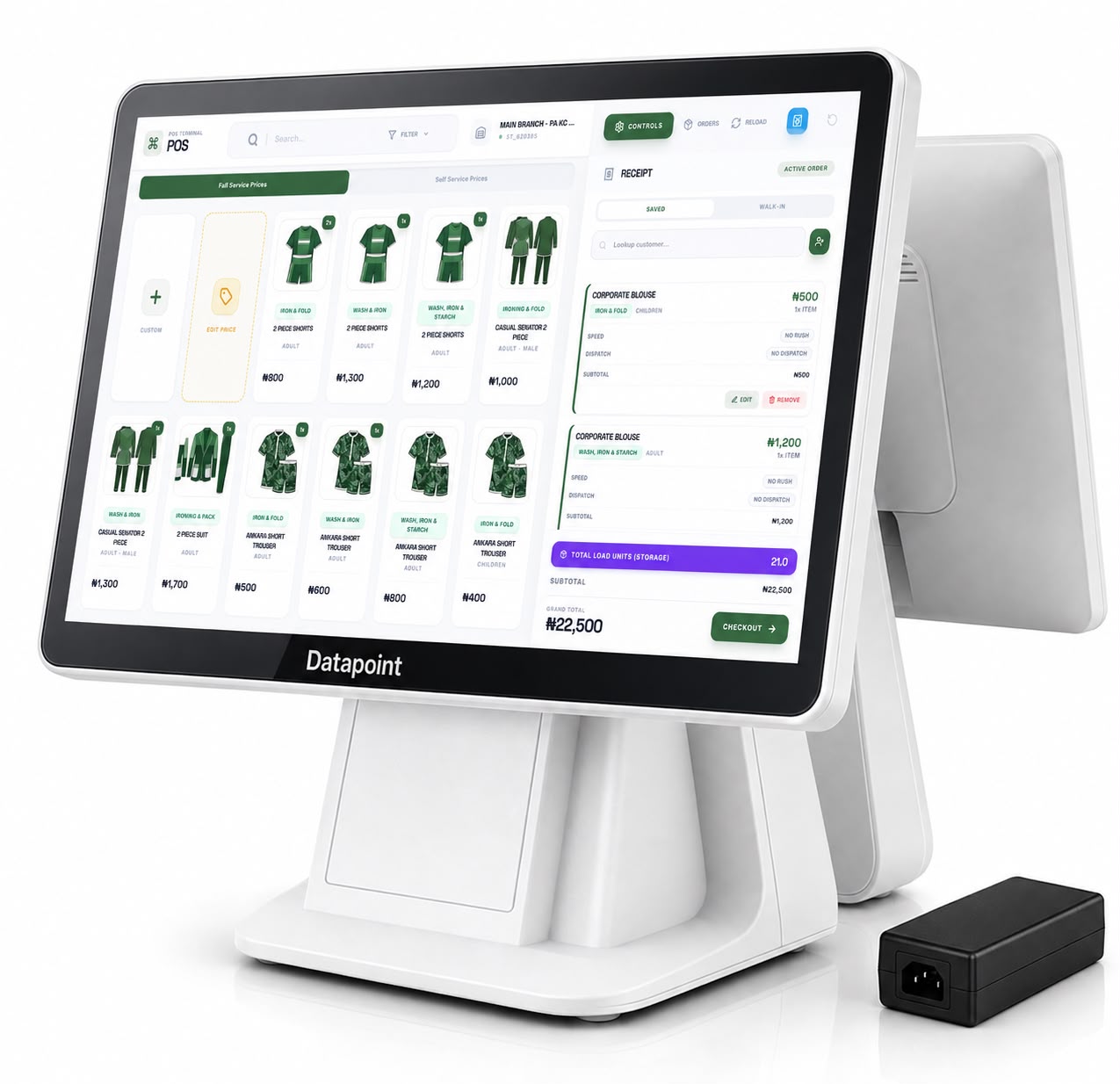
In the bustling laundry markets of Lagos, Abuja, and Port Harcourt, two types of businesses exist side-by-side. The first relies on a weathered notebook, a ballpoint pen, and the owner’s memory. The second utilizes a sleek tablet, QR-coded tags, and real-time cloud analytics. The debate of manual vs. pos laundry management is at the heart of how these two businesses perform.
While the manual shop struggles to remember which blue shirt belongs to which Mr. Adebayo, the digital shop is already sending an automated WhatsApp notification to the customer. In 2026, manual management is a ceiling; it limits how many customers you can serve and how much you can grow. By utilizing the best tool to manage your laundry business, CloudLaundry, you shatter that ceiling. Our platform turns the chaotic variables of a laundry shop into a streamlined, predictable, and highly profitable machine.
Inventory Tracking: The Battle of the Tags
In a manual system, inventory is managed by "Trust and Luck."
- The Manual Risk: Paper tags are held on by safety pins. They fall off in the wash, the ink bleeds, or they simply get mixed up on the sorting table. When a tag is lost, the garment becomes an "orphan," leading to customer disputes and expensive replacements.
- The POS Solution: CloudLaundry uses heat-resistant, uniquely numbered QR tags. Once an item is scanned, its "Digital Twin" is created in the system. It is physically impossible for the system to "forget" who an item belongs to.
- The Verdict: POS management reduces garment loss by 99% compared to manual methods.
Financial Integrity: Stopping the Leakage
Revenue leakage is the silent killer of manual laundry businesses.
- The Manual Leak: Without a digital record, there is no way to verify that every wash performed resulted in cash in the drawer. Staff can easily perform "favors" for friends or pocket the cash from walk-in customers without writing it in the ledger.
- The POS Shield: Every transaction in a POS system creates a permanent, unchangeable audit trail. You can reconcile your machine cycles against your recorded orders. If the machines ran 10 times but only 8 orders were logged, the POS flags the discrepancy immediately.
- The Verdict: POS management typically increases realized revenue by 15-25% by simply eliminating "off-the-book" transactions.
Customer Experience and Communication
In 2026, the customer expects to be kept in the loop.
- The Manual Friction: If a customer wants to know if their clothes are ready, they have to call the shop. The staff then have to stop what they are doing, hunt through a pile of clothes, find the ledger, and give an answer. This wastes time for everyone.
- The POS Automation: [CloudLaundry] sends a message the moment the "Ready" button is pressed. The customer feels respected, and the shop feels professional. Digital receipts are sent instantly to the customer's phone, meaning they never have to worry about losing a physical paper slip.
- The Verdict: POS systems turn a "transaction" into a "relationship" through consistent, automated touchpoints.
🔹 Section 4: Speed of Intake and Processing
Time is money in a high-volume laundry.
- The Manual Bottleneck: Writing out a detailed receipt by hand, counting items, describing colors, and noting stains can take 5 to 10 minutes per customer. During morning rush hours, this creates long queues and frustrated clients.
- The POS Turbo-charge: With a touchscreen interface like [CloudLaundry], intake takes less than 60 seconds. You tap the icons for "Shirt," "Suit," or "Duvet," take a quick photo for documentation, and the receipt is generated.
- The Verdict: A POS-managed shop can process three times as many customers at the front desk as a manual shop.
Data and Business Intelligence
You cannot manage what you do not measure.
- The Manual Blind Spot: Ask a manual shop owner, "What is your most profitable month?" or "Who are your top 10 customers?" and they will have to spend days digging through old notebooks to find the answer.
- The POS Insight: With one click on the [CloudLaundry] dashboard, you see a graph of your sales, your most popular services, and your customer retention rates. You can see which days are slow and offer "Happy Hour" discounts to fill the machines.
- The Verdict: POS management provides the "Eyes" needed to make strategic business decisions.
Staff Accountability and Management
Managing a team is difficult when you aren't physically in the shop.
- The Manual Fog: In a manual shop, the owner has no way of knowing who ironed a specific shirt or how long a staff member spent on a specific task. Mistakes are difficult to trace back to the source.
- The POS Transparency: Every staff member has a login. The POS tracks who took the order, who washed it, and who ironed it. If a customer complains about a burnt collar, you know exactly who was at the ironing station for that order.
- The Verdict: POS systems create a culture of responsibility that manual ledgers can never match.
Scalability: The "Multi-Branch" Challenge
Growth is the ultimate test of your management system.
- The Manual Wall: If you have three shops and use manual ledgers, you have to spend your entire day driving between them to check the books and collect cash. You are a "Courier," not a "CEO."
- The POS Cloud: With CloudLaundry, you can manage 10 branches from your living room. You see the total revenue, machine health, and customer satisfaction levels of every location in real-time on your phone.
- The Verdict: POS is the "Operating System" for growth; manual is a recipe for exhaustion.
Professionalism and Pricing Power
Your management system dictates what you can charge.
- The Manual Perception: A shop with handwritten notes and safety pins is perceived as a "low-cost" provider. It is difficult to charge premium prices for a chaotic service.
- The POS Premium: When a customer receives a QR-coded tag and a professional digital receipt, they perceive high value. They are willing to pay more for the security and efficiency that a digital system provides.
- The Verdict: Moving to a POS allows you to raise your prices because your perceived "Professionalism" has increased.
Case Study: The "Lekki Shift"
A small laundry in Lekki, Lagos, operated manually for two years. They were constantly replacing lost garments (costing roughly N30,000 a month) and their staff was "forgetting" to record about 10% of the walk-in sales. The owner switched to CloudLaundry. In the first 60 days:
- Lost Items: Dropped to zero.
- Recorded Revenue: Jumped by 20% overnight because every kobo was now tracked.
- Customer Growth: They used the "Auto-SMS" feature to remind customers to pick up their clothes, which cleared out their storage rack faster and improved cash flow. The owner now says, "I used to own a job; now I own a business."
Why CloudLaundry Wins the Comparison
CloudLaundry is the best tool to manage your laundry business because it was built to solve the specific failures of manual management in the Nigerian context:
- Hybrid Sync: Works even when the internet is down, so you never have to go back to paper.
- Power Tracking: Log your fuel and generator costs to see your true profit after the "NEPA bill."
- Simple Interface: Designed for staff of all education levels—if they can use a smartphone, they can use CloudLaundry.
- End-to-End Transparency: From the first "Hello" at intake to the "Thank you" at delivery, every step is digitized.
Conclusion: The Choice is Clear
The comparison of manual vs. pos laundry management is a choice between the past and the future. Manual management is a heavy anchor that keeps your business small and stressed. POS management is the engine that drives you toward expansion and professional excellence.
By adopting CloudLaundry, you are not just buying software; you are upgrading your entire business philosophy. You are choosing to be a modern entrepreneur who values data, respects the customer, and protects their profit. Visit usecloudlaundry.com today and leave the paper ledger behind for good.