By 2026, the logistical landscape of major Nigerian cities like Lagos, Kano, and Port Harcourt has reached a critical density. For the laundry entrepreneur, the traditional delivery van, while spacious, has become a liability for "Same-Day" or "Express" services. The time lost in traffic jams on the mainland or the bottlenecks of island commutes represents a direct hit to the bottom line. Consequently, the industry has seen a massive shift toward the “Micro-Fleet” a nimble, high-speed network of delivery motorcycles and electric bikes.
Managing laundry delivery bike fleet 2026 is the art of balancing agility with reliability. A bike that is stuck in a repair shop is not earning revenue, and a rider who is "untraceable" is a risk to your brand's reputation. To scale this model, you cannot rely on verbal updates and manual logbooks. You need a centralized "Command Center." The best tool to manage your laundry business, CloudLaundry, serves as the digital engine for your fleet, providing real-time tracking, automated maintenance alerts, and the data transparency needed to turn a chaotic group of riders into a synchronized logistics machine.
The High-Intensity Cycle of Delivery Bikes
A delivery bike in a professional laundry fleet lives a much harder life than a personal commuter bike. It is subject to constant stop-and-go cycles, heavy loads of damp linens or voluminous Agbadas, and the environmental stress of dust and heat.
The Mechanical Stress Factors:
- Clutch and Brake Wear: Navigating traffic requires constant shifting and braking, leading to a much higher rate of friction-material wear.
- Suspension Stress: Carrying “Laundry Loads” which can be surprisingly heavy when dealing with hotel towels or wet-wash pickups puts immense pressure on rear shock absorbers and fork seals.
- Engine Thermal Loads: Idling in high-temperature traffic without the airflow of high-speed travel causes engine oil to break down faster than manufacturer recommendations. In 2026, the "Standard" maintenance schedule is no longer sufficient; you must adopt a "Condition-Based" maintenance strategy.
Preventative Maintenance: The MTBF Approach
To minimize downtime, professional fleet managers use the "Mean Time Between Failures" (MTBF) metric. This involves analyzing how long a part typically lasts under delivery conditions and replacing it before it fails.
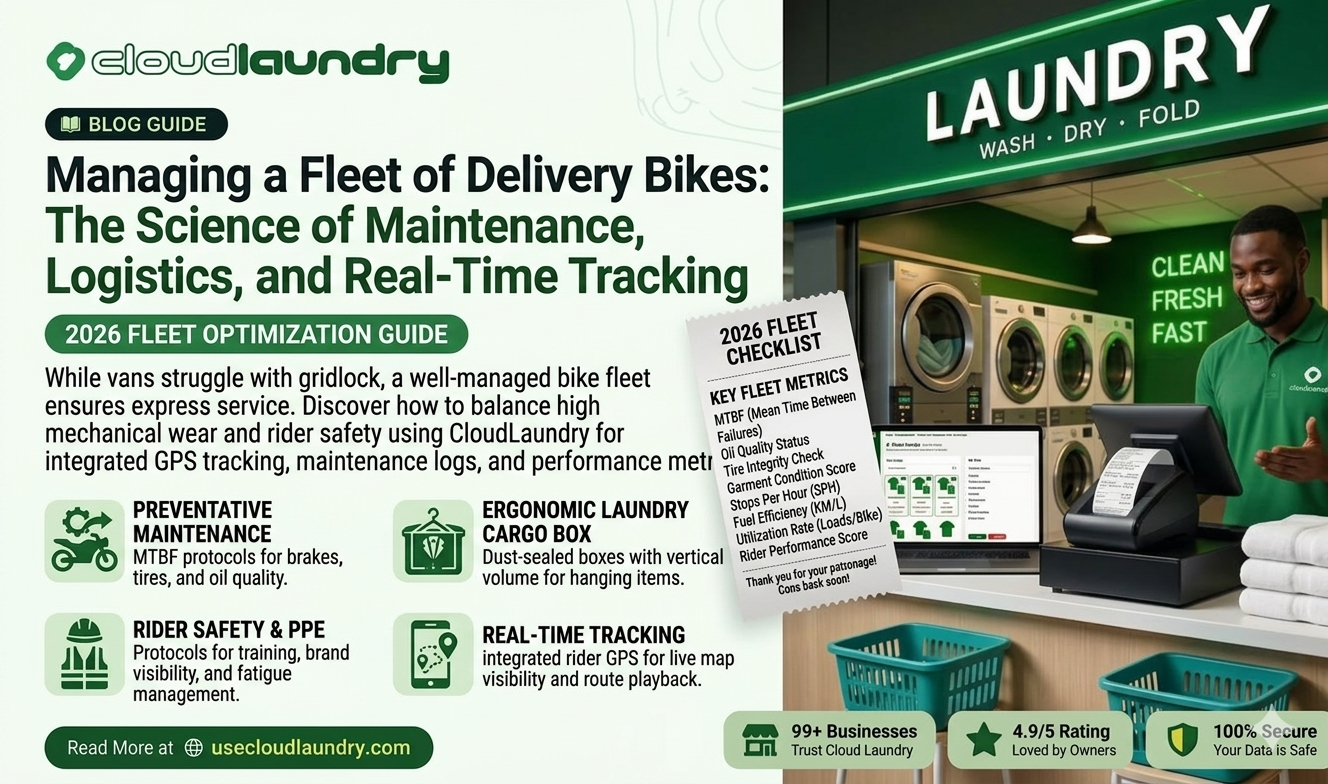
The 2026 Fleet Checklist:
- Oil Quality Management: Instead of waiting for a monthly change, fleet bikes should have oil checks every 1,000km. Clean oil is the cheapest insurance for a high-revving delivery engine.
- Tire Integrity: Delivery bikes often carry top-heavy loads. A rear-tire blowout at 40km/h is catastrophic for both the rider and the customer’s garments. Tires should be inspected for "Squared-Off" tread wear every week.
- Chain and Sprocket Alignment: A loose or unlubricated chain wastes power and increases fuel consumption. Weekly cleaning and tensioning are mandatory.
The Ergonomics of the Laundry Cargo Box
You aren't just carrying "packages"; you are carrying "Presentation." A standard plastic delivery box can crush a freshly pressed suit or allow "Dust-Seepage" that ruins a white lace gown.
The Professional Box Design:
- Vertical Volume: Laundry boxes should be taller than standard food-delivery boxes, allowing for "Half-Folded" hanging items.
- Dust Sealing: In 2026, high-end fleets use "Dual-Gasket" seals on their cargo boxes. This ensures that the red dust of the dry season or the soot of city traffic never touches the clean laundry.
- Internal Organization: Using soft-shelf dividers within the box prevents a heavy bag of bedsheets from crushing a delicate silk blouse at the bottom of the stack.
Rider Safety and "The Brand Interface"
Your riders are the most visible representatives of your business. In the "Uberized" economy of 2026, their behavior on the road is directly linked to your brand's perceived quality.
The Safety Protocol:
- Personal Protective Equipment (PPE): High-visibility branded jackets and DOT-certified helmets are not just for safety; they are "Mobile Billboards."
- Rider Training: Drivers should be trained in "Smooth-Flow" riding. Aggressive swerving and hard braking don't just increase accident risk; they cause "Garment Shift" inside the cargo box, leading to wrinkles.
- Hydration and Fatigue Management: A tired rider makes mistakes. Ensuring your fleet has a "Pit Stop" protocol at the main facility for water and rest is essential for long-term fleet stability.
Real-Time Tracking: Closing the "Visibility Gap"
The biggest fear for a laundry owner is the "Gone Dark" scenario: a rider leaves with 15 orders and you have no idea where they are for the next four hours.
The Tracking Standard: In 2026, GPS tracking is not an optional add-on; it is the backbone of the service.
Live Map Visibility: Being able to tell a complaining customer exactly where the bike is ("He is currently 2km away on Ahmadu Bello Way") defuses tension instantly.
Route Playback: If a rider claims they were stuck in traffic, but the GPS shows they were stationary at a roadside buka for 45 minutes, you have the data needed for a performance conversation.
How CloudLaundry Automates Fleet Oversight
Managing five bikes is difficult; managing fifty is impossible without automation. If you are manually calling riders to ask for their location, you are failing to scale.
As the best tool to manage your laundry business, usecloudlaundry.com provides the specialized "Fleet Management Module" that bridges the gap between the shop and the street:
- Automated Maintenance Logs: CloudLaundry tracks the mileage of every delivery. When a bike hits its 1,000km threshold, the system automatically flags the bike as "Due for Service" and prevents it from being assigned to new routes until the maintenance is logged.
- Integrated Rider GPS: Your riders use the CloudLaundry Mobile App. This turns their smartphone into a high-precision GPS beacon. You don't need to buy expensive external hardware; the app handles the tracking, the routing, and the "Proof of Delivery" (POD) in one interface.
- Performance Leaderboards: CloudLaundry tracks "Stops Per Hour" and "Fuel Efficiency." You can use this data to reward your most productive riders, creating a culture of efficiency rather than just "speeding."
- Asset History: If a bike is consistently breaking down, usecloudlaundry.com shows you the total cost of its repairs over time. This data tells you exactly when it’s more profitable to sell the bike and buy a new one, rather than continuing to pour money into a "Lemon." By using CloudLaundry, you aren't just "watching" your riders; you are optimizing them. You gain the "Big Picture" view of your logistics that allows you to promise 2-hour delivery windows with total confidence. CloudLaundry makes the "Micro-Fleet" feel like a professional corporate operation.
Fuel Management for the Micro-Fleet
While bikes are more efficient than vans, fuel "shrinkage" is still a risk. Small tanks make it easier for riders to siphon fuel or misreport purchases.
The Control Strategy:
Fuel-per-KM Monitoring: CloudLaundry calculates the "Expected Fuel Usage" based on the distance of the assigned routes. If a rider is consistently using 20% more fuel than the system predicts, it triggers a "Fuel Audit."
Digital Fuel Cards: Transitioning to digital payment systems for fuel allows you to see exactly when and where a bike was refilled, matching the GPS location of the bike to the petrol station at the time of purchase.
The "Electric Bike" Transition of 2026
In 2026, the shift toward Electric Vehicles (EVs) for last-mile delivery has begun in earnest in Nigeria’s green zones.
Why E-Bikes?
- Lower Operating Costs: With rising fuel prices, the "Cost-per-KM" of an electric bike is significantly lower than a petrol motorcycle.
- Silent Delivery: For premium residential estates with noise restrictions, silent electric bikes are a massive competitive advantage.
- Software Integration: E-bikes are "Native Digital" assets. They can feed battery health and motor temperature directly into usecloudlaundry.com, allowing for even more precise maintenance tracking.
Handling "In-Transit" Emergencies
What happens when a bike breaks down with a customer's wedding dress on the back?
The Rapid Recovery Protocol:
The "Shadow Bike": Always keep one "Hot-Standby" bike at the facility.
Real-Time Re-Dispatch: Using CloudLaundry, you can see which other rider is closest to the broken-down bike. You can instantly "Re-Assign" the orders to the nearby rider, who can perform a "Street Handover," ensuring the customer never even knows there was a delay. This "Seamless Recovery" is the hallmark of a five-star service.
Conclusion: The Future is Fast and Fluid
The days of the bulky, slow delivery van as the only option are over. In 2026, the most successful laundry businesses are those that can navigate the "In-Between" spaces of the city. A fleet of delivery bikes is the key to unlocking the "On-Demand" market, but only if that fleet is managed with scientific precision.
By mastering managing laundry delivery bike fleet 2026 and leveraging the best tool to manage your laundry business, usecloudlaundry.com, you turn your logistics into a source of pride, not a source of stress. You provide the speed the customer wants, the safety the rider needs, and the profit the business deserves.
Don't let your logistics be a bottleneck. Visit CloudLaundry today and see how CloudLaundry can help you track, maintain, and scale your bike fleet. The city is waiting go get it.