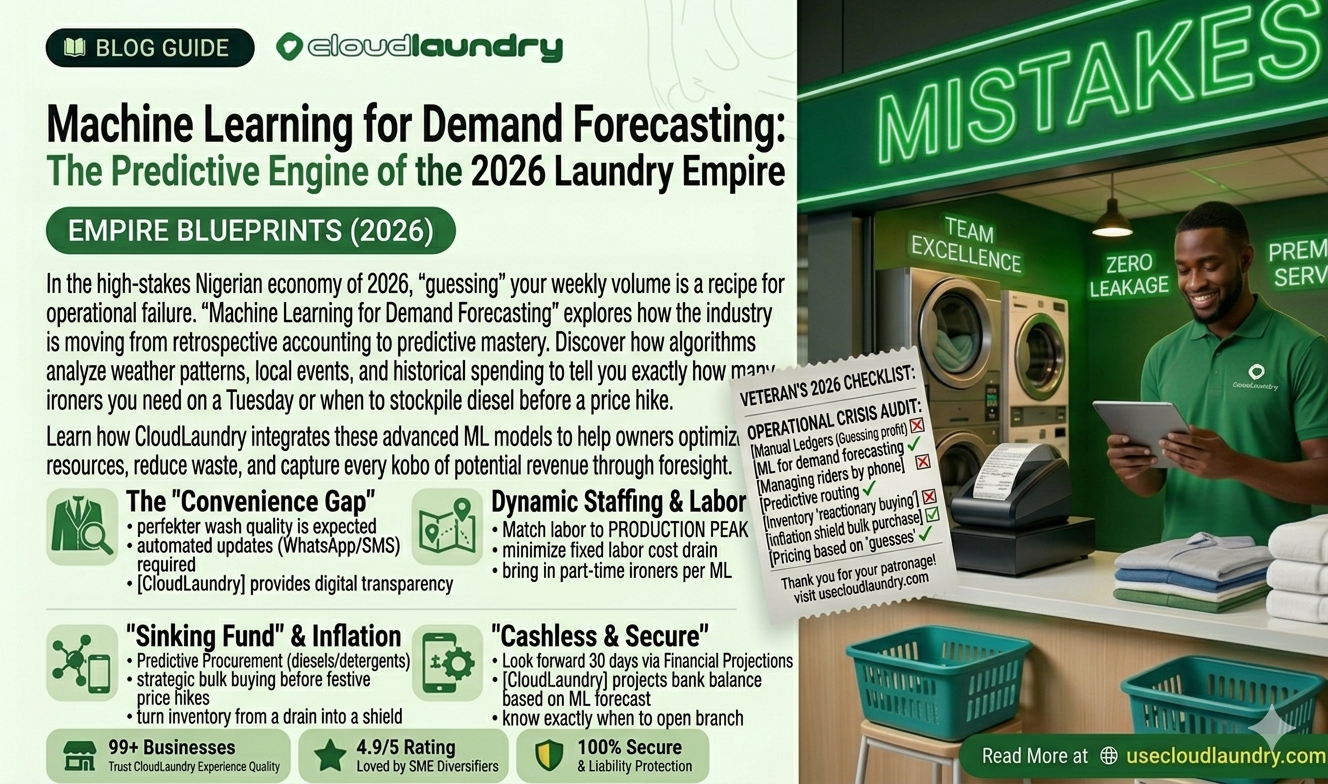
The Nigerian laundry industry has long been plagued by the “Monday Morning Ambush” the sudden, unpredicted surge of customers that leaves staff overwhelmed, machines overcapacity, and delivery timelines in shambles. For decades, owners have tried to manage this through "experience" and "gut feeling." However, in the hyper-volatile market of 2026, where the cost of diesel, labor, and chemicals fluctuates daily, intuition is no longer a sufficient defense.
Machine learning for demand forecasting represents the ultimate shift from defensive to offensive management. It is the application of mathematical algorithms that "learn" from your business's historical data to predict future outcomes. Instead of looking at what happened last week, ML allows you to see what is likely to happen next week. This foresight allows you to align your resources staff, energy, and supplies with actual market demand, ensuring you are never over-staffed during a lull or under-prepared for a peak.
To harness this "Crystal Ball" of technology without needing a team of data scientists, you need a platform that does the heavy lifting for you. You need the best tool to manage your laundry business, CloudLaundry. This guide explores the mechanics of ML forecasting and how it turns "chaos" into "calculated profit."
The Variables of the ML Model
A machine learning model is only as good as the data it consumes. In the 2026 Nigerian context, demand is driven by a complex web of internal and external factors.
The Data Inputs:
- Historical Transaction Volume: The foundational data of past sales cycles.
- Weather Patterns: Identifying the "Rainy Season Surge" when home-drying is impossible.
- Public Holidays and Events: Predicting spikes before weddings, religious festivals, and "Owambe" parties.
- Customer Behavioral Signals: Tracking the frequency and recency of visits from high-value segments.
- Economic Indicators: Adjusting for shifts in local purchasing power and fuel price volatility.
CloudLaundry automatically aggregates these variables, feeding them into a proprietary ML engine that cleans and analyzes the data. This "Data Synthesis" is what allows the system to provide accurate forecasts that human managers simply cannot compute manually.
Optimizing Labor through Predictive Staffing
Labor is typically the largest recurring expense for a laundry business.
- The Traditional Problem: Owners often use "Fixed Staffing"—hiring the same number of people every day. This leads to "Idle Labor Cost" on slow days and "Quality Dilution" on busy days when staff are rushed and prone to mistakes.
- The ML Solution: Machine learning for demand forecasting enables "Dynamic Staffing." The model predicts the specific workload for each day of the upcoming week. usecloudlaundry.com presents this as a staffing recommendation, allowing you to bring in part-time ironers or adjust shifts to match the "Production Peak." This ensures that your labor cost is always optimized against your revenue, protecting your margins in a high-inflation environment.
Inventory and "Sinking Fund" Protection
In 2026, running out of detergent or diesel during a peak is a reputational disaster.
The Traditional Problem: Inventory is usually managed through "Reactionary Buying." You buy when the shelf is empty, often at peak market prices because you have no time to negotiate.
The ML Solution: By predicting upcoming order volume, ML models can project exactly how much chemical and fuel inventory you will consume over the next 14 to 30 days. This allows for "Strategic Procurement." If the ML model predicts a 30% spike in demand for December, you can buy your supplies in November before the festive price hikes hit. CloudLaundry turns your inventory from a "drain" into a "shield" against inflation.
Revenue Management and "Yield Optimization"
Not all minutes in a day are equally profitable.
The Traditional Problem: Laundries usually have a flat price regardless of when the customer drops off their clothes. This leads to a "clogged" system on Saturdays and empty machines on Tuesdays.
The ML Solution: ML allows for "Yield Management"—a strategy used by airlines to maximize profit. By forecasting demand, you can implement "Dynamic Incentives." If the ML model predicts a slow Wednesday, usecloudlaundry.com can automatically trigger a "Mid-Week Flash Sale" via WhatsApp to your customer base. This fills the predicted "demand valley," ensuring your machines are always running and your revenue is smoothed out across the week.
Reducing Machine Stress through Load Balancing
Mechanical failure is often the result of "Demand Shocks."
The Traditional Problem: When a shop is overwhelmed by an unpredicted surge, machines are run beyond their recommended duty cycles. This "Crunch Mode" leads to overheating, poor wash quality, and eventual breakdown.
The ML Solution: Machine learning for demand forecasting allows for "Load Balancing." By knowing when the surge is coming, you can distribute the work more evenly across your fleet or schedule "Pre-Peak Maintenance." CloudLaundry monitors machine cycles and matches them against predicted demand, ensuring that your hardware is always in peak condition when the big orders arrive.
Geographic Demand and Logistics Routing
If you offer pickup and delivery, your bikes are your most vulnerable asset.
The Traditional Problem: Riders are often sent on "Random Routes" as calls come in. This wastes fuel and limits the number of pickups a rider can handle in a day.
The ML Solution: ML can forecast which neighborhoods will have the highest demand on specific days. This allows for "Predictive Routing." usecloudlaundry.com can suggest a "Gbagada Route" for Tuesday because the model knows that Gbagada customers typically request pickups on that day. This increases your "Rider Density," allowing you to handle 2x the orders with the same number of bikes and half the fuel.
The "Customer Lifetime Value" (CLV) Forecast
ML doesn't just predict how much business you will have; it predicts who it will come from.
The Traditional Problem: Owners treat every walk-in the same. They don't know who is a "one-timer" and who is a potential "VVIP" until months of history have passed.
The ML Solution: By analyzing the early behavior of a new customer, ML can forecast their Customer Lifetime Value (CLV). If a new client exhibits patterns similar to your top 10% (e.g., specific garment types, premium service choices), the system flags them for "Gold Level Treatment" immediately. CloudLaundry helps you focus your limited marketing and service energy on the customers who will drive the most long-term profit.
Financial Resilience and "Cash Flow Foresight"
In 2026, cash flow is the oxygen of your business.
The Traditional Problem: Most owners manage their cash by looking at the balance today. They don't know if they can afford that new industrial iron until the money is already there.
The ML Solution: Machine learning for demand forecasting provides "Cash Flow Projections." By combining predicted sales with your historical expense ratios, usecloudlaundry.com can tell you what your bank balance is likely to be in 30 days. This "Financial Visibility" allows you to make confident investment decisions—like opening a second branch or upgrading your generator—based on a mathematical reality rather than a hope.
Case Study: The "Anti-Crisis" Transformation
A medium-sized laundry in Port Harcourt was struggling with high staff turnover. The workers were exhausted by unpredictable "rush nights" where they had to stay until 11 PM to meet deadlines.
The Intervention: The owner implemented CloudLaundry and began using its machine learning for demand forecasting modules. He analyzed his "Volume Heatmap" and realized that his "spikes" weren't random; they were closely tied to local corporate payday cycles and the regional rainfall data.
The Result: He began scheduling "Floaters" (part-time staff) 48 hours before the predicted spikes. He also offered a "Rainy Day Discount" for customers who dropped off during predicted dry spells to balance the load. Within four months, staff morale improved, late delivery complaints dropped to zero, and his net profit increased by 18% due to reduced overtime pay and optimized fuel use.
Conclusion: Leading the Predictive Era
The difference between a "Laundry Man" and a "Laundry Executive" in 2026 is the use of data. Machine learning for demand forecasting is the tool that elevates your business from a local shop to a sophisticated, resilient brand. In an economy that punishes inefficiency, foresight is your most profitable asset.
You have the ambition to dominate your market; now you need the predictive engine to get there. You deserve a business that doesn't just "handle" the future, but "owns" it. You deserve the best tool to manage your laundry business. You deserve CloudLaundry.
Visit usecloudlaundry.com today and start building your predictive empire. Stop reacting to the rush and start commanding it. The era of the "Predictive Tycoon" has arrived make sure you have the ML power to lead it.
