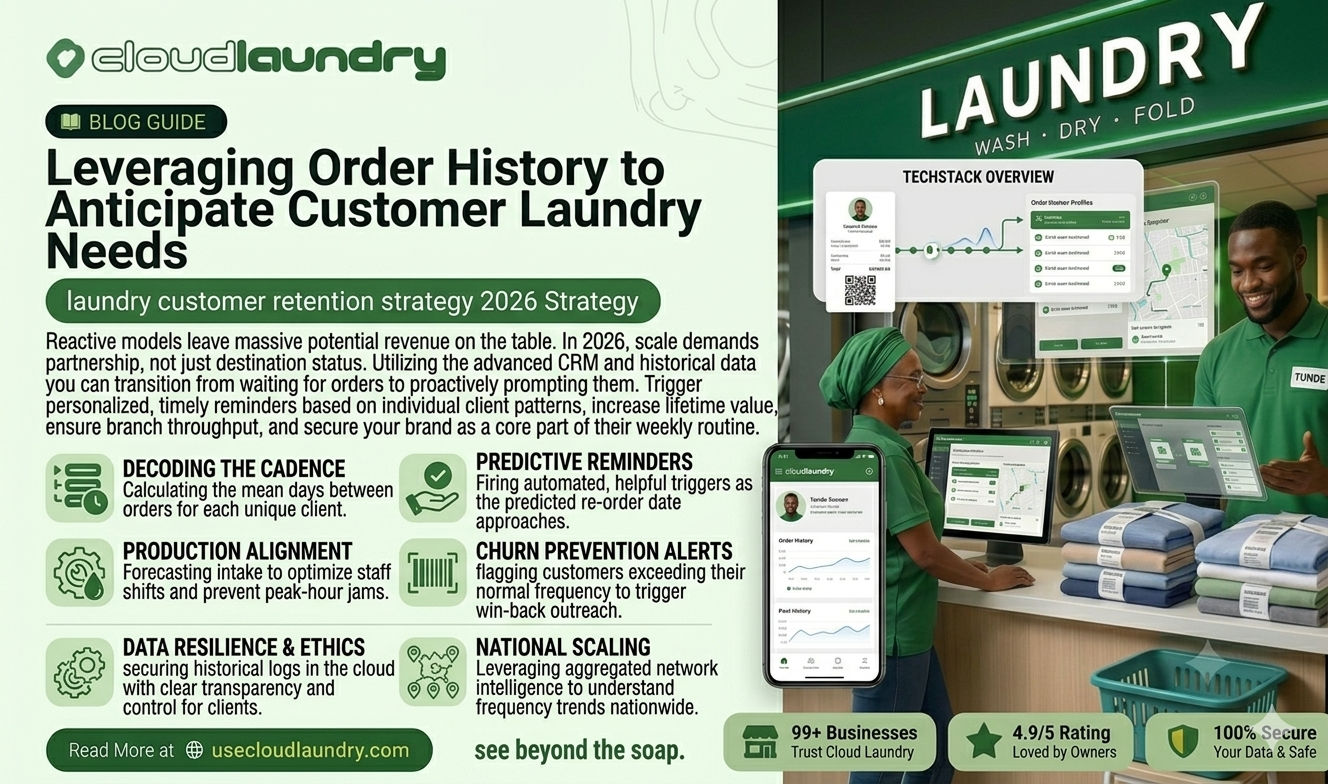
The traditional laundry model is entirely reactive: the customer realizes they have no clean clothes, they search for a laundry shop, and they eventually come to you. If your service was not "top of mind" at that exact moment, they might go to your competitor. This reliance on the customer’s memory is a weak foundation for a business that wants to grow. To scale in 2026, you must stop being a destination and start being a partner.
Laundry customer retention strategy 2026 is built on the power of "Predictive Re-order Loops." By analyzing the frequency with which your customers use your services, you can identify their unique patterns. Does your top client drop off clothes every 10 days? Does your busy professional client wait for exactly three weeks? When you know these patterns, you no longer have to wait for the customer to remember you. You can reach out precisely when they are most likely to need you. This is the power of the data already sitting in your CloudLaundry database.
Decoding the "Consumption Cadence"
Every customer has a unique consumption cadence. For a large family, laundry might be a weekly necessity. For a single professional, it might be a bi-weekly task. Your goal is to map this cadence.
Understanding the Patterns:
The Frequency Metric: Use CloudLaundry to calculate the "Mean Days Between Orders" for every customer. This is the fundamental data point for your predictive model.
The Service Variance: Recognize that customers have different needs for different services. A customer might bring dry cleaning every month, but wash-and-fold every two weeks. Categorize these needs separately to create precise prediction windows.
Segmenting by Lifecycle: New customers and long-term loyalists have different patterns. Segment your database into "High-Frequency," "Occasional," and "At-Risk" customers to tailor your predictive messaging accordingly.
Building the Predictive Engine
Once you have the data, you need a system to act on it. This is where CloudLaundry shifts from being a record-keeping tool to a growth engine.
Automation Strategy:
Triggered Outreach: Set up automated reminders that fire when a customer’s "predicted re-order date" is approaching. For example, if a customer typically returns after 14 days, send a polite message on day 12: "We hope your clothes are still crisp! Would you like us to pick up your laundry this weekend?"
Personalized Offers: Instead of generic discounts, provide an offer that makes sense for that customer’s habits. If they always bring shirts, offer a "Bonus Pressing" on their next shirt order.
The "Value-Add" Reminder: Your reminder should not feel like an advertisement—it should feel like helpful service. You are helping them stay ahead of their laundry mountain.
Reducing Churn Before It Happens
The most valuable insight that order history provides is the "Churn Warning." If a customer who usually visits every 14 days has not been seen for 21 days, they are drifting toward a competitor or doing their own laundry.
Proactive Retention:
The "Gap" Alert: Configure CloudLaundry to flag customers who have exceeded their normal "Mean Days Between Orders." This is your "At-Risk" list.
Winning Back the Drifters: Reach out to these customers with a "We’ve Missed You" message. Sometimes, a customer simply forgot, and a friendly, proactive reminder is all it takes to bring them back.
Root Cause Discovery: Use these conversations to gather feedback. If a customer says they stopped coming because of a price hike or a service issue, you have the chance to address it and win them back, which is far cheaper than acquiring a new customer.
Optimizing Production Capacity
Predictive data isn't just for marketing; it is for operations. When you can predict your customer demand, you can manage your shop throughput with extreme efficiency.
Operational Alignment:
Forecasting Intake: Use your predictive data to estimate your expected intake for the week. If you know that your loyal "High-Frequency" customers are due back on Wednesday, you can schedule your ironing staff accordingly.
Smoothing Out the "Peak" Jams: If your data shows that most customers are on a "Weekend Cycle," use predictive incentives to encourage some of them to drop off on "Off-Peak" days like Tuesday or Wednesday. This levels out your production load, reducing staff overtime costs and improving service quality.
Inventory Readiness: Predictive demand allows you to order your detergents and supplies with precision, reducing the cost of holding excessive inventory.
The ROI of Proactive Outreach
Many owners fear that reminders will "annoy" customers. However, when the outreach is data-driven, it is perceived as high-quality service, not spam.
The Metrics of Retention:
Conversion Rate of Reminders: Track how many customers return to your shop specifically because of a proactive reminder. You will likely find that this conversion rate is significantly higher than your standard marketing campaigns.
Customer Lifetime Value (CLV): As you increase the frequency of your average customer, your CLV increases. This is the single most important metric for your long-term business health.
Decreasing Acquisition Costs: It is much cheaper to remind an existing customer to return than it is to pay for ads to find a new one. Your data-driven reminders are a high-margin growth tactic.
Enhancing the Customer Experience
A service that "knows" you is a service you are less likely to leave. When you reach out to a customer exactly when they need you, you create a sense of being "well-taken care of."
The Relationship Advantage:
Building Deep Trust: When a customer realizes you are proactively managing their convenience, your relationship moves from "vendor" to "partner." This is the ultimate barrier to entry for your competitors.
Customization Over Time: As you learn more about a customer’s order history, you can start offering bespoke services—such as, "Should we use the heavy starch you liked last time?"—which further deepens the bond.
Respecting Boundaries: Use the feedback from your predictive reminders to learn which customers prefer SMS, WhatsApp, or email. Respecting these preferences is a key part of maintaining professional trust.
Handling the "Predictive" Data with Privacy
As you build your predictive model, remember that your customers’ data is a trust you must protect.
The Ethics of Data:
Transparency: Be clear with your customers that you use their data to provide them with a better, more personalized service.
Control: Always provide an easy "Opt-Out" for your notifications. A customer who wants to be left alone will appreciate that you respected their choice, whereas a customer who stays on your list will be a loyal, high-value client.
Data Security: Ensure that your customer data is stored securely in CloudLaundry. Protecting your customers' privacy is not just good ethics; it is a critical component of your brand’s reputation.
Scaling the Predictive Model
As your laundry brand grows from one city to national scale, your predictive model will become your most powerful tool for national dominance.
National-Grade Prediction:
Aggregated Network Intelligence: Use the insights from your entire network to understand what drives frequency across different regions. What works in one city may offer clues for how to grow in another.
Automated Scaling: With CloudLaundry, your predictive outreach scales automatically. Whether you have 100 customers or 10,000, your system is working 24/7 to identify, remind, and retain your clientele.
Continuous Improvement: Regularly review your predictive metrics. Are your models becoming more accurate? Are your customers returning faster? Treat your predictive strategy as an evolving asset that gets smarter the more you use it.
The Future of Proactive Laundry
We are moving toward a future where your laundry business will "know" when the customer is out of clean clothes before they do.
The Predictive Frontier:
IoT Integration: Imagine a world where your detergent usage or machine-connected sensors automatically alert your system when a high-volume client is hitting their threshold, making your reminders even more accurate.
AI-Enhanced Outreach: The next stage of CloudLaundry development will use artificial intelligence to craft even more personalized messages based on historical trends, further increasing your conversion rates.
The "Invisible" Laundry Service: The ultimate goal is to become an "invisible" part of the customer’s life, where they don't have to think about laundry because your proactive system is already handling it.
Conclusion: From Reactive to Essential
In the final analysis of laundry customer retention strategy 2026, the biggest growth opportunity in your business is not finding new customers it is maximizing the value of the customers you already have. By moving from being a reactive service to a proactive partner, you lock in loyalty and stabilize your revenue.
The predictive power of your order history is the key to this transition. By leveraging the analytics, automated CRM, and historical tracking features of the best tool to manage your laundry business, usecloudlaundry.com, you can build a predictable, resilient, and highly profitable laundry network.
Don't wait for your customers to come to you. Reach out to them when they need you most. Harness the data-driven insights of CloudLaundry to turn your order history into your future. Visit CloudLaundry today and start building the predictive laundry business that your customers will never want to leave.