In 2026, the Nigerian luxury market has reached unprecedented heights. In cities like Abuja and Lagos, a single wardrobe can easily represent millions of Naira in investment. When a client hands over a designer blazer or a hand-beaded traditional gown, they aren't just paying for dirt removal; they are entrusting you with a piece of their identity and wealth.
Knowing how to handle expensive clothes is the ultimate differentiator for a premium laundry business. At this level, a "good" job is invisible, but a single mistake a snagged thread, a faded pigment, or a distorted silhouette—is a catastrophic failure. By utilizing the best tool to manage your laundry business, CloudLaundry, you can implement "White Glove" workflows that treat every luxury item with the forensic attention it deserves. Our platform ensures that high-value garments are tracked with specialized "Gold Tier" protocols, providing both the business and the client with absolute peace of mind.
The Forensic Intake: Beyond the Visual Check
The most important step in handling expensive clothes happens before they ever touch water or solvent.
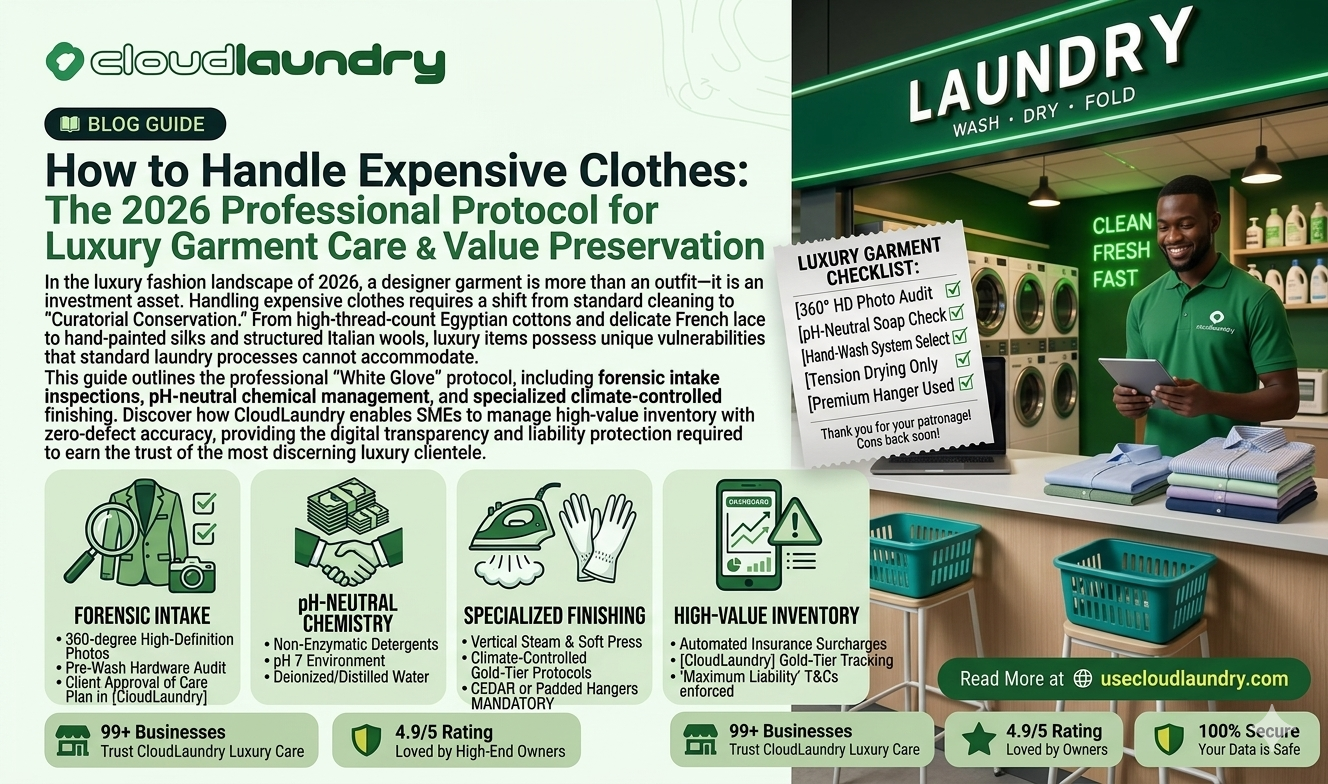
- The High-Resolution Audit: Standard laundry intake is about counting items. Luxury intake is about "Forensic Documentation." Use [CloudLaundry] to take 360-degree high-definition photos of the garment, specifically focusing on seams, buttons, and existing wear.
- The Hardware Inspection: Check for loose beads, fraying buttonholes, or oxidization on metallic zippers. Luxury garments often use delicate, non-standard hardware that can be damaged in a machine.
- The "Stress Test" Consultation: If a garment is structurally delicate (e.g., vintage lace), document this in the [CloudLaundry] app and send a digital "Care Plan" to the client for approval before proceeding.
Deciphering Luxury Fabric Engineering
Expensive clothes often feature "Technological Fabrics" or rare natural fibers that standard care labels don't fully explain.
- Super-Fine Wools (Super 150s - 200s): These are incredibly thin and prone to "friction burn." They require low-agitation, specialized wool detergents.
- Organic Silks: Often dyed with natural pigments that are highly sensitive to pH. A standard alkaline detergent will "kill" the luster of the silk instantly.
- Composite Garments: A jacket made of wool with leather sleeves and silk lining. This is a nightmare for standard cleaning. It requires "Zonal Treatment" where each section is handled differently.
- CloudLaundry Database: Access the built-in [CloudLaundry] library of luxury brands and their specific fabric vulnerabilities to ensure your technicians have the right "Intel" before cleaning.
The "Chemistry of Caution": pH Neutrality
In the world of expensive clothes, aggressive cleaning is the enemy of longevity.
- The Neutral Zone: Luxury fibers thrive in a pH-neutral environment (pH 7). Most commercial detergents are alkaline (pH 9-11) to boost cleaning power, but this "shreds" the protective outer layer of fine fibers.
- Enzyme-Free Cleaning: While enzymes are great for stains, they can actually "eat" the proteins in silk and wool over time. For high-end items, use specialized, non-enzymatic detergents.
- Distilled Water Usage: In 2026, premium laundries use deionized or distilled water for luxury loads to prevent mineral buildup (calcium/magnesium) from dulling the garment's finish.
Specialized Mechanical Handling: The "No-Tumble" Rule
Mechanical action is the primary cause of pilling and structural distortion.
- Hand-Wash Simulation: If a machine must be used, it should be a modern "Wet Cleaning" system that uses a slow, rocking motion rather than a full 360-degree rotation.
- Drying Without Stress: Expensive clothes should almost never be tumble-dried. Tumble drying is a "hot sandpaper" environment. Instead, use tension-drying or flat-drying techniques that maintain the garment's original "block" or shape.
- CloudLaundry Alerts: Use CloudLaundry to lock "Luxury Items" out of the standard dryer queue. The app will require a supervisor's override to move these items to a specialized drying station.
The Art of the "Soft Press"
Ironing expensive clothes is where many businesses fail.
- Steam over Pressure: A heavy iron can "crush" the pile of a luxury fabric or leave "shiny" marks on dark wools. Professionals use vertical steam or a "Cool-Sole" iron plate.
- Internal Padding: Use "ham" cushions and sleeve boards to iron the garment from the inside out, preserving the three-dimensional "drape" designed by the tailor.
- Tissue Stuffing: Once ironed, high-end jackets and gowns should be stuffed with acid-free tissue paper to prevent them from collapsing under their own weight.
Handling Embellishments (Beads, Sequins, and Embroidery)
Nigerian high-fashion is famous for intricate "Aso-Ebi" and "Stone" work.
- The Protective Wrap: Before cleaning, large buttons or heavy stones should be wrapped in foil or soft cloth to prevent them from striking the drum or snagging other parts of the fabric.
- The Net Bag Protocol: Mesh bags are mandatory, but for luxury items, use "Fine-Gage" bags that prevent even the smallest bead from passing through the mesh if it comes loose.
- Documentation: If a bead is found in the machine, use [CloudLaundry] to document exactly where it came from so it can be expertly sewn back on by your in-house tailor before delivery.
Climate-Controlled Storage and Transit
Expensive clothes are sensitive to the environment long after they are cleaned.
- Humidity Control: High humidity leads to mold; low humidity leads to brittle fibers. Luxury garments should be stored in a "Cool-Dry" zone.
- Breathable Packaging: Never return a N200,000 suit in a cheap, airtight plastic bag. Use breathable cotton garment bags or high-end structured boxes.
- The Hanger Standard: Use wide-shouldered, cedar or padded hangers. Thin wire hangers will "shoulder-mark" an expensive sweater or jacket in less than 48 hours.
Managing Liability and Client Expectations
When things go wrong with expensive clothes, they go wrong at a high price point.
- The "Intrinsic Value" Clause: Use the digital Terms of Service in [CloudLaundry] to establish a "Maximum Liability" per item, unless the client pays for an "Extended Protection" surcharge.
- Radical Transparency: If a stain cannot be removed without damaging the expensive fiber, use [CloudLaundry] to send a photo and a voice note to the client: "We have attempted safe removal; going further risks the fabric integrity. Do you wish us to stop or proceed?"
- The Expert Signature: Include a "Certificate of Care" in the packaging, signed by the Master Cleaner, detailing the specialized steps taken to preserve the item.
Case Study: The "Designer Archive" Contract
A boutique laundry in Lekki Phase 1 specialized in "Wardrobe Management" for high-net-worth individuals. One client sent in a collection of 15 vintage couture gowns for restoration. By using CloudLaundry, the business created a "Digital Wardrobe" for the client. Every gown was given a unique QR-tag that linked to its history, fabric composition, and photos of its condition upon arrival. The laundry used "Wet-Cleaning" technology and specialized enzyme-free soaps. Because the client could see the "Care Log" in real-time through the CloudLaundry portal, their trust was absolute. The project was completed with zero damage, and the client now pays a monthly N500,000 retainer for the laundry to manage their entire seasonal wardrobe.
How CloudLaundry Powers Your Luxury Service
CloudLaundry is the best tool to manage your laundry business because it turns "Vague Premium" into "Standardized Luxury":
- High-Value Alerts: Set a "Value Threshold" in the app. Any item valued over N50,000 triggers a mandatory "Manager Review" at every stage—from intake to final fold.
- Specialized Tailoring Integration: Seamlessly route luxury items to your repair and restoration department for loose threads or button tightening.
- Client Portals: Give your VIP clients their own login where they can see high-res "After" photos of their garments before they are even delivered.
- Automated Insurance Surcharges: Automatically calculate and apply a "Premium Handling Fee" for expensive clothes, ensuring your business is compensated for the extra time and risk involved.
Conclusion: The Luxury Standard
How to handle expensive clothes is about moving from a "Volume" mindset to a "Value" mindset. In 2026, the businesses that thrive are those that respect the craftsmanship of the designer as much as the investment of the customer.
By integrating "White Glove" technical standards with the digital precision of CloudLaundry, you protect your business from high-cost liabilities and build an unshakeable reputation for excellence. You don't just "do laundry"; you preserve fashion. Visit usecloudlaundry.com today to see how our platform can help you master the art of luxury garment management with 2026 efficiency.