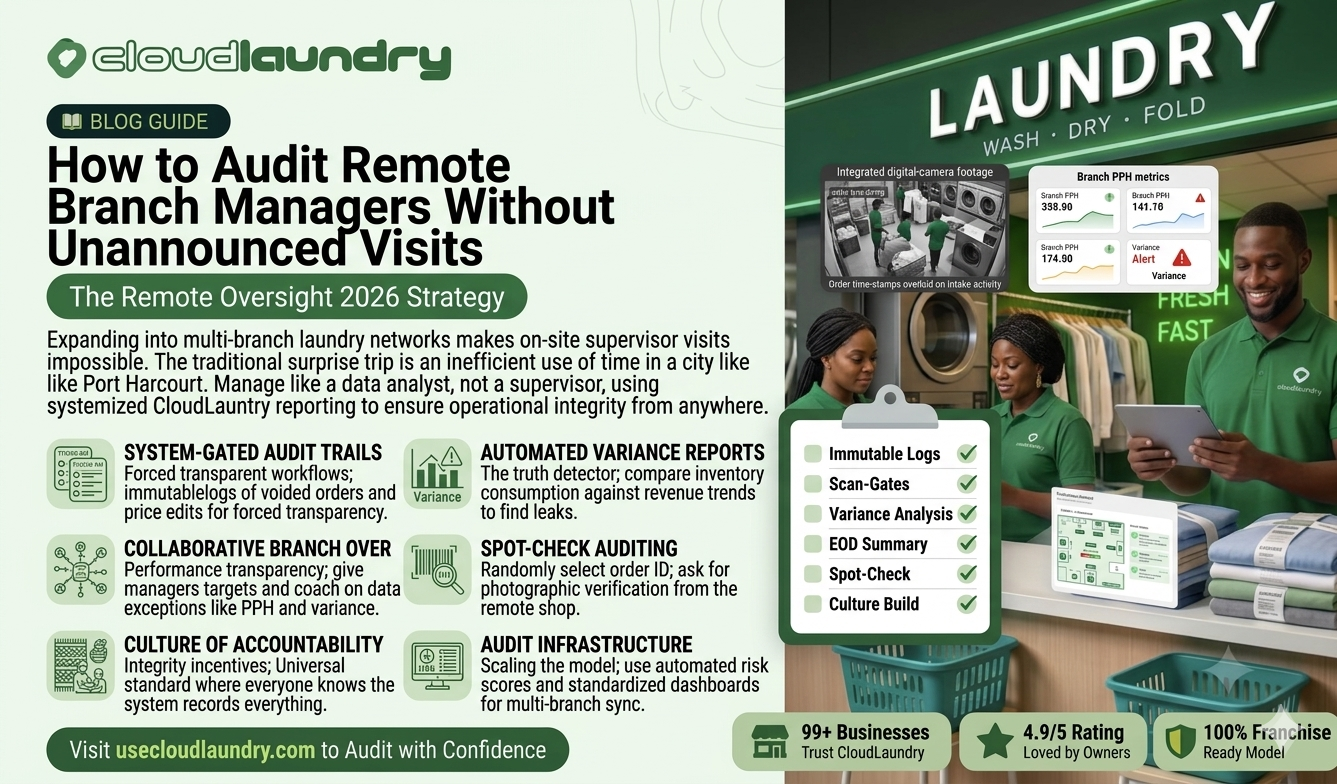
There is a pervasive belief among many business owners that the only way to keep a remote manager honest is to jump in a car and pop up at a branch unexpectedly. While this might catch a lazy employee off guard, it is an incredibly inefficient use of your time. If you have five branches spread across a city like Port Harcourt, you could spend your entire week stuck in traffic, trying to monitor employees instead of working on the strategic growth of your company. In 2026, the successful laundry entrepreneur is not a traveler; they are a data-analyst.
Laundry remote branch auditing 2026 is the process of moving your oversight from the physical realm to the digital realm. It is not about spying; it is about governance. By building systems that make it impossible to hide failures or manipulate records, you remove the need for physical visits entirely. The CloudLaundry ecosystem provides a permanent, searchable audit trail of every transaction, inventory movement, and staff interaction. This guide will show you how to conduct a deep-dive audit of any branch in your network from the comfort of your desk, ensuring your managers remain sharp and your operations remain profitable.
The "System-Gated" Audit Trail
Auditing begins with the design of your workflow. If your managers have the power to "fix" things behind the scenes, you will never truly know what is happening in the branch. You must ensure that every single movement of goods or money leaves a digital footprint.
Building the Digital Fence:
Immutable Logs: In CloudLaundry, every action whether it’s creating an order, issuing a refund, or editing a price is timestamped and tied to a specific user ID. If a manager tries to cover up a mistake, the system will highlight the edit in your remote audit dashboard.
Scan-Required Workflows: An audit-ready business requires that garments move through "Scan-Gates." If a manager claims a branch is busy but the "Intake Scans" show zero activity, you don't need to visit the shop to know there is a problem.
Role-Based Limitations: Restrict the ability to perform high-risk actions. If your remote manager needs to void an order, they must provide a reason that is logged in the system. This forced transparency makes "silent fraud" significantly harder to execute.
Automated Variance Reporting (The "Truth" Detector)
You don't have to watch every transaction to find issues. You only need to look for "Variances." A variance is simply the difference between what the system says should have happened and what actually happened.
Key Variance Metrics:
Inventory Consumption vs. Revenue: This is your primary audit weapon. If your CloudLaundry data indicates that the branch has used 50 liters of detergent, but they have only logged 100 wash orders, you have a massive discrepancy. A manager who cannot explain where that detergent went is a manager who is failing their audit.
Cash-vs-Log Reconciliation: If the "Digital EOD Log" shows that they should have ₦150,000 in cash, but the bank deposit slip shows ₦130,000, you have a clear, objective finding. You can confront the manager with the data rather than a "hunch."
Trend Analysis: Sometimes, a single variance is an accident. But a trend is a management failure. Use the analytics in usecloudlaundry.com to view a branch’s variance performance over a month. If a specific manager consistently shows high inventory loss, you have all the evidence you need to take action.
The "Digital Camera" Approach
Physical cameras are great, but they only provide visual evidence. Digital audits provide contextual evidence. However, when used together, they become a powerful remote-auditing tool.
Integrating Visuals and Data:
Visual Verification: A low-cost camera pointed at the intake counter is not for you to watch all day. It is for you to verify specific incidents. If your audit logs show a massive spike in "voided orders" at 2:00 PM, you can pull the camera footage for that specific window.
The "Spot-Check" Audit: Select one order at random from the system each week and ask the branch manager to send you a photo of the garment still in the shop or a record of its current status. This keeps them aware that you are watching, even if you are not there physically.
Digital Proof-of-Work: Require managers to upload photos of the cleaned "finished goods" shelf at the end of the day. This provides visual proof that the work is being processed according to your standards.
Standardizing Asynchronous Communication
Many entrepreneurs make the mistake of requiring constant live calls to "check in." This is disruptive and rarely provides the information you actually need. Instead, systematize your communication to create a searchable record.
Communication as an Audit Tool:
The "End-of-Day" Summary: Require every manager to submit a standard CloudLaundry report that includes their challenges, their inventory needs, and a confirmation of their cash-on-hand.
Actionable Task Logs: Use a project management tool to assign tasks to remote managers. When they complete a task, they must attach proof. If they don't complete it, you have a documented record of their performance failure.
The "Audit-Review" Call: Instead of "check-ins," have "Review Sessions." Once a week, go through the system data with the manager. If they can’t explain the data, the meeting becomes a training session or a performance intervention.
Empowering the Manager Through Data
Auditing shouldn't feel like a "gotcha" game. If you frame it correctly, it becomes a powerful coaching tool that helps your managers improve their own performance.
The Collaborative Audit:
Performance Transparency: Show the managers their own branch stats. Let them see their PPH (Pieces-per-Hour), their variance levels, and their customer satisfaction scores.
Goal-Driven Management: Give them clear, quantifiable targets. If they meet their targets (keeping variances under 1% and processing orders within the agreed timeframe), you don't need to visit them. You only audit the "exceptions."
The "Coach-Not-Cop" Approach: When you find an issue, start by asking, "The data shows this variance; what do you think happened?" Often, they will tell you exactly what went wrong, which gives you the chance to fix the system rather than just blaming the person.
Detecting "System Gaming"
Experienced managers know how to "game" a system if they think you aren't paying attention. As an auditor, you have to be one step ahead.
Common Gaming Tactics:
"Dummy" Orders: If a manager creates fake orders to inflate their stats, look for high volumes of items that have no corresponding customer history.
Delayed Processing: If a manager leaves orders "pending" to skew their end-of-month revenue reports, look for orders that sit in the "In-Progress" queue for an unusually long time.
Price-List Manipulation: Check that the prices charged are consistent with your network standard. If a manager is giving massive, undocumented discounts to their friends, it will show up in your "Discount/Void" report in CloudLaundry.
Escalation Protocols (When Data Points to Theft)
What happens when your remote audit produces "smoking gun" evidence of misconduct? You need an escalation protocol that moves from data-analysis to formal action.
The Escalation Framework:
Internal Investigation: Gather all the digital logs, inventory variances, and camera footage related to the issue. Create a digital "dossier" of the incident.
The Confrontation: When you present the findings to the manager, have a witness present. Let the data speak for itself. You are not "accusing"; you are "reviewing the records."
Disciplinary Action: Ensure your business policies are clear. Theft or deliberate system manipulation should carry the same consequence regardless of the branch. The audit process is about maintaining the integrity of your brand.
Scaling the Audit Infrastructure
As you grow from 2 branches to 10, the "manual audit" approach will completely collapse. You must build an "Audit Infrastructure" that scales automatically.
The Audit Architecture:
Standardized Dashboards: Every new branch that joins your network automatically populates its data into your central CloudLaundry audit dashboard.
Automated Risk Scoring: As you grow, use the system to assign a "Risk Score" to each branch. A branch with high variance, high staff turnover, or customer complaints gets a "High-Risk" status and requires more frequent review.
Periodic "Deep-Dive" Audits: Even with automated monitoring, you should perform a "Deep-Dive" audit on one branch per month. This involves a comprehensive review of all logs, inventory, and feedback.
Building a Culture of Integrity
The most important part of remote auditing is creating an environment where honesty is the standard.
Culture-Building:
Integrity Incentives: Reward the managers who maintain perfect inventory and cash records. Let them know that their performance is noted and valued.
Standardized Expectations: Everyone should know that the system records everything. When the expectation is universal, the "remote" nature of the management becomes irrelevant.
Communication of Purpose: Explain to your managers that these audits are not a lack of trust; they are a tool for operational excellence. If you are organized, they are organized.
Conclusion: The Future of Remote Management
In the final analysis of laundry remote branch auditing 2026, the goal is to create a business that can be managed from anywhere. By shifting your focus from "surprise visits" to "systematic oversight," you gain the freedom to grow without being held back by the constraints of physical geography.
Auditing is not about finding fault; it is about ensuring that your brand promise is being upheld at every touchpoint. By leveraging the immutable logs, variance analytics, and remote reporting power of the best tool to manage your laundry business, usecloudlaundry.com, you take full control of your remote operations.
Don't let your business be at the mercy of remote managers. Harness the data, the system, and the oversight tools to manage your network with absolute clarity and precision. Visit CloudLaundry today and see how CloudLaundry can help you master the art of the remote audit. Your empire is expanding; make sure your oversight is expanding with it.