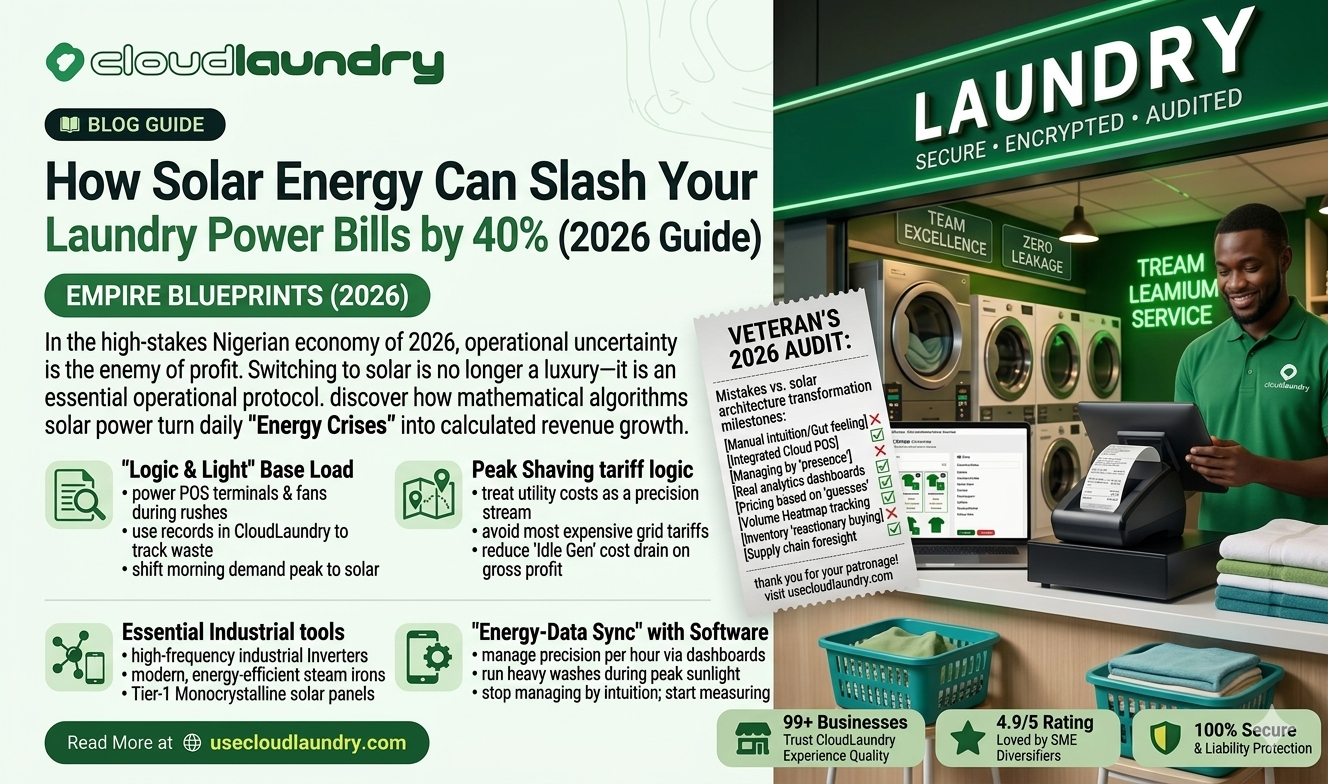
In 2026, the Nigerian laundry owner faces a "Double-Edged Sword" of energy costs. On one side, the national grid remains unpredictable, often leaving shops in total darkness during peak morning rushes. On the other side, the cost of diesel and petrol has reached historic highs, eating away up to 30% or 40% of a laundry's gross profit. For many dry cleaners in Lagos, Abuja, and Port Harcourt, you aren't just working for yourself you are working for the generator and the fuel station.
This energy crisis is the primary reason many laundry businesses fail to scale. When a significant portion of every N5,000 wash goes into a fuel tank, there is nothing left for expansion, staff raises, or equipment upgrades. However, a silent revolution is happening on the rooftops of Nigeria's most profitable shops. Solar energy for laundry business operations is no longer a “future dream” it is a current financial necessity. By harnessing the abundant Nigerian sun, savvy owners are slashing their power bills by a staggering 40%, securing 24/7 uptime, and protecting their margins from the volatility of the oil market.
If you are tired of the "gen-set" noise and the endless cycle of buying fuel, this guide will show you how to transition to a solar-powered future. And to manage this transition with precision, you need the best tool to manage your laundry business, CloudLaundry.
The Basics of Solar for Laundry
Before you install a single panel, you must understand how solar energy integrates with a laundry environment. A laundry business is "Energy Intensive," meaning it requires high bursts of power for heating elements in dryers, water heaters, and heavy-duty motors in industrial washers and steam irons.
- The Hybrid Approach: In 2026, the most effective solar setup for a Nigerian laundry is a "Hybrid System." This involves:
- Photovoltaic (PV) Panels: Installed on the roof to capture sunlight.
- Inverters: The "brain" that converts the sun’s DC power into the AC power your machines need.
- Lithium-Ion Battery Storage: To keep your lights and light machines running during cloud cover or after sunset.
- The Grid/Gen Link: Solar handles the "Base Load" (lights, computers, fans, and light washers), while the grid or generator kicks in only for the highest-surge items like heavy dryers.
By offsetting the base load and the most consistent daytime power needs with solar, you immediately remove the bulk of your daily diesel consumption.
How the 40% Savings is Calculated
Many owners ask, "How exactly does solar save me 40%?" The math is simpler than you think when you look at the "Hidden Costs" of traditional power.
1. Eliminating the "Idle Gen" Cost: Generators burn fuel even when machines aren't running at full capacity. Solar, however, is free once installed. By using solar to power your front desk, CloudLaundry terminals, and ironing stations during the day, you stop burning diesel for low-energy tasks.
2. Peak Shaving: Utility companies often charge more during peak hours. By using solar during the day (the peak period for most laundries), you avoid the most expensive grid tariffs.
3. Reduced Maintenance: Generators require servicing every 100–250 hours. By cutting your gen-set usage by 60%, you also cut your maintenance costs and the frequency of expensive engine overhauls by more than half. When combined with fuel savings, the 40% reduction in "Total Energy Expenditure" becomes a reality.
The Essential Tools for a Solar-Powered Laundry
To successfully transition, you need a specific kit that balances cost with durability. In the Nigerian climate, heat and dust are your enemies.
- Monocrystalline Tier-1 Panels: These are more efficient in low-light and high-heat conditions than cheaper polycrystalline panels.
- High-Frequency Industrial Inverters: Essential for handling the "Start-up Surge" of washing machine motors.
- Lithium Iron Phosphate (LiFePO4) Batteries: Unlike old lead-acid batteries, these can be discharged deeply and last up to 10 years, making them the most cost-effective choice for 2026.
- Smart Energy Meters: These devices allow you to see exactly how much power your shop is consuming in real-time.
Steps to Transition Your Shop
Transitioning to solar isn't an "all-or-nothing" event. It should be a strategic rollout.
- Step 1: Energy Audit: Use your records in CloudLaundry to see your busiest hours. Track your monthly diesel spend and electricity bills to determine your "Energy Baseline."
- Step 2: Efficiency First: Before buying solar, change all your bulbs to LED and upgrade your old, power-hungry irons to modern, energy-efficient models. It is cheaper to save a watt than to buy a solar panel to produce one.
- Step 3: Start with the "Logic & Light" Load: Install a small system first to power your POS, usecloudlaundry.com software, lights, and fans. This ensures that even if the power goes out, your customer service and check-in never stop.
- Step 4: Scale to the Wash Floor: Once you see the savings, add more panels and batteries to handle your washing machines. Dryers should remain on the grid/generator for now, as they are the most expensive to run on solar.
Common Mistakes to Avoid
Many Nigerian SMEs have "fallen into the pit" of bad solar installations. Avoid these three common errors:
- Undersizing the Inverter: If your washing machine needs 3kW to start and you have a 3kW inverter, the system will trip. Always have at least 25% "Headroom" on your inverter capacity.
- Cheap Batteries: Buying used or low-quality lead-acid batteries is a waste of money. They will fail within 6–12 months in the Nigerian heat. Always invest in Lithium.
- Poor Roof Orientation: In Nigeria, panels should generally face South at a slight tilt (15°) to catch the maximum sun. Putting panels in the shade of a nearby building will kill your 40% savings goal.
Case Study: The "Solar Success" in Ikeja
Mr. Chidi operates a busy laundry in Ikeja, Lagos. In late 2025, his diesel bill hit N450,000 a month, and his grid bills were another N120,000. He was considering closing down because his profits were disappearing.
The Intervention: Mr. Chidi invested N4,500,000 in a 10kVA Hybrid Solar System with 15kWh of Lithium storage. He moved his lights, fans, computers running CloudLaundry, and 4 washing machines to the solar system. He kept his 2 industrial dryers on his 20kVA generator.
The Result: His diesel consumption dropped from 15 liters a day to just 4 liters (used only for the dryers). His grid bill dropped by 60%. Within 6 months, his total energy bill had dropped by 42%. He used the saved N240,000 a month to hire two more ironers and open a pickup point in Maryland. He now calls solar his "Silent Business Partner."
Tie into CloudLaundry Softly
Managing a solar-powered business requires a different kind of oversight. You need to know exactly when your peak demand happens so you can schedule your heaviest washes during peak sunlight hours (11 AM – 3 PM). This is where CloudLaundry becomes invaluable.
By using the detailed transaction and productivity reports in the best tool to manage your laundry business, you can identify your "Volume Peaks." You can then instruct your staff to run the most energy-intensive washing cycles during the hours when your solar panels are producing the most power. This "Energy-Data Sync" ensures that you are truly squeezing every kobo of value out of the sun, making your 40% savings a permanent fixture of your balance sheet.
Conclusion
The future of the Nigerian laundry industry is green, quiet, and incredibly profitable. Solar energy is no longer a luxury; it is the most effective way to "insulate" your business from the rising costs of traditional energy. By cutting your power bills by 40%, you aren't just saving money you are gaining the financial freedom to dominate your local market.
Stop being a slave to the fuel station. Start looking at your roof as a source of revenue. Combine the power of the sun with the management power of CloudLaundry to build a resilient, modern, and highly profitable brand.
