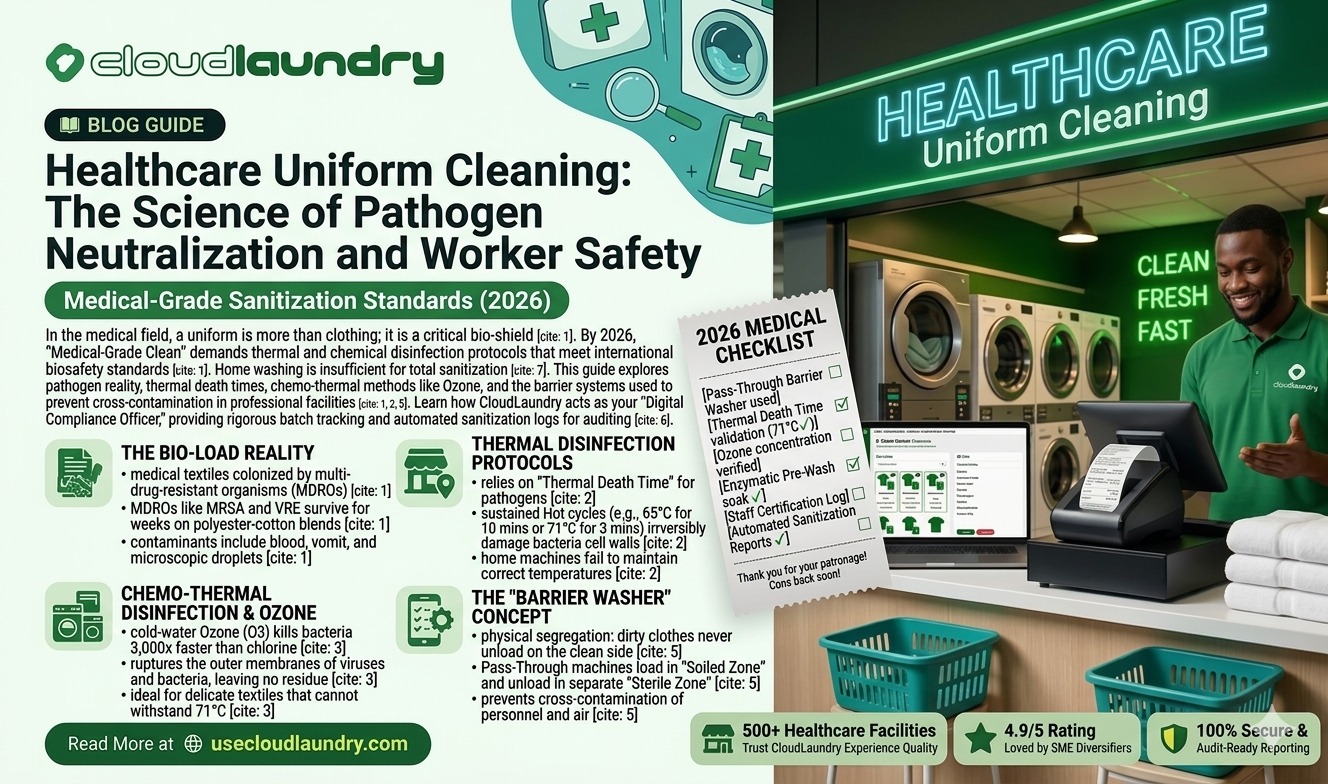
By 2026, the global healthcare landscape has become acutely aware of the role that textiles play in the transmission of disease. Medical scrubs, lab coats, and nursing uniforms are frequently colonized by multi-drug-resistant organisms (MDROs) such as MRSA and VRE during a single shift. In Nigeria's expanding private and public health sectors, the shift toward professional, off-site laundry services is driven by the realization that home washing is fundamentally incapable of achieving the "Log Reduction" of bacteria required for hospital safety.
Healthcare uniform cleaning and sanitization 2026 is defined by a "Zero-Failure" mindset. It is a process that must balance aggressive disinfection with fiber preservation. For the laundry entrepreneur, medical contracts represent a stable, high-volume revenue stream, but they come with significant legal and ethical responsibilities. To navigate the complexities of biosafety, the best tool to manage your laundry business, CloudLaundry, allows facilities to implement "Lock-Step" workflows, ensuring that every medical load follows a pre-verified path of thermal and chemical exposure that can be audited at any moment.
The Bio-Load Reality: What Lives on a Scrub?
Healthcare workers are exposed to a "cocktail" of biological contaminants: blood, vomit, urine, and microscopic respiratory droplets. Unlike standard office wear, these contaminants are not just "dirt"; they are active cultures of bacteria and viruses.
Survival of Pathogens on Fabric:
- Staphylococci: Can survive on polyester-cotton blends for up to 50 days.
- Enterococci: Can remain viable on fabrics for several weeks.
- Fungal Spores: Often resistant to standard "Warm" wash cycles. The goal of a professional healthcare wash is "Disinfection," which is the reduction of the number of pathogenic microorganisms to a level that is not harmful to health.
Thermal Disinfection: The "Time and Temp" Equation
The most reliable method for killing healthcare-associated pathogens is heat. However, heat must be applied with precision to be effective.
The 2026 Standard: Professional medical laundry relies on "Thermal Death Time." The international standard adopted by most modern facilities is a "Hot" cycle maintained at 65°C for at least 10 minutes or 71°C for at least 3 minutes. This sustained temperature ensures that the cell walls of most bacteria are irreversibly damaged. Home machines often "spike" to these temperatures but fail to maintain them long enough to achieve total sanitization.
Chemical Disinfection and the Role of Ozone
While heat is powerful, some delicate medical textiles (like high-performance stretch scrubs) cannot withstand 71°C without losing their shape. This is where "Chemo-Thermal" disinfection becomes essential.
The Ozone Advantage: In 2026, Ozone (O3) has become a primary tool for medical laundry in Nigeria. Ozone is a cold-water disinfectant that is 3,000 times faster than chlorine at killing bacteria.
Oxidation: Ozone works by rupturing the outer membrane of viruses and bacteria.
Oxygenation: It leaves no chemical residue and breaks down back into pure oxygen, making it the safest choice for healthcare workers with sensitive skin.
Removing "Biological Fixation": Blood and Protein
Blood is the most common and difficult stain in healthcare. If blood is exposed to high heat (the disinfection cycle) before it is properly pre-treated, the proteins in the blood will "denature" and bond permanently to the fiber.
The Medical Pre-Wash Protocol:
- Cold Flush: A 2-minute cold-water rinse (below 30°C) to physically move the blood out of the fibers before it can "cook" in.
- Enzymatic Digestion: Using a "Protease" enzyme soak to break down the protein chains at a molecular level.
- Alkaline Boost: Increasing the PH of the wash water to swell the fibers and release trapped bio-matter.
The "Clean vs. Soiled" Barrier System
In 2026, a professional medical laundry facility must be designed with "Physical Segregation." Pathogens from dirty scrubs must never have the opportunity to cross-contaminate clean scrubs.
The "Barrier Washer" Concept: Industrial medical facilities use "Pass-Through" machines. The dirty clothes are loaded on one side of a wall (The Soiled Zone), and the clean clothes are unloaded on the opposite side in a separate room (The Sterile Zone). This ensures that the air and personnel in the "Clean Room" are never exposed to the bio-burden of the incoming items.
How CloudLaundry Manages Medical Compliance
In the healthcare sector, "If it wasn't documented, it didn't happen." A hospital administrator needs proof that their staff's uniforms were processed at the correct temperatures for the correct duration. Managing this level of data for thousands of individual scrubs is a massive administrative burden.
As the best tool to manage your laundry business, usecloudlaundry.com acts as the "Digital Compliance Officer" for your healthcare contracts. The platform’s infrastructure is built for high-stakes accountability:
- Batch-Level Validation: CloudLaundry tracks every healthcare order as a specific "Sanitization Batch." The system can be integrated with machine sensors to record the peak temperature and cycle time, attaching this data directly to the customer's digital invoice.
- Specialized Healthcare Tags: When a medical worker drops off their clothes, CloudLaundry automatically assigns a "Medical-Grade" workflow. This prevents these items from being mixed with domestic laundry and ensures they are routed to the barrier machines.
- Employee Training Tracking: CloudLaundry allows you to log the biosafety training of your staff. You can ensure that only staff members who have completed "Pathogen Handling" certifications are assigned to medical loads.
- Audit-Ready Reporting: At the end of the month, you can generate a "Sanitization Report" for your hospital clients through usecloudlaundry.com, proving 100% compliance with safety protocols. This level of data-driven transparency allows you to win and keep high-value medical contracts that traditional laundries simply cannot handle. CloudLaundry provides the "Proof of Safety" that the modern healthcare industry demands.
The Hazard of Home Washing
Many healthcare workers still wash their scrubs at home, unaware of the risks. Home washing presents two major dangers:
Insufficient Temperature: Most home water heaters are capped at 50°C–55°C to prevent scalding, which is below the threshold for thermal disinfection.
Cross-Contamination: Washing scrubs in the same machine as the family's towels or children's clothes can transfer hospital pathogens to the home environment a phenomenon known as "Take-Home Infection." Professional laundries using usecloudlaundry.com should use this education in their marketing to emphasize why their service is a public health necessity.
Antimicrobial Fabric Treatments
By 2026, many scrubs are manufactured with silver-ion or zinc-based antimicrobial coatings. These coatings provide an extra layer of protection during the shift by inhibiting bacterial growth on the fabric surface.
Preserving the Treatment: Aggressive bleaching can strip these metallic coatings. A professional using CloudLaundry ensures that these high-tech scrubs are processed using "Ph-Neutral" antimicrobial boosters, which reinforce the fabric’s existing defenses rather than destroying them.
Specialized Packaging for Clinical Delivery
The sanitization process doesn't end when the dryer stops. If a clean scrub is handled by an un-gloved hand or transported in an open van, it is no longer "Clinical-Grade."
The Sterile Delivery Protocol:
- Sealed Barrier Film: Scrubs should be machine-wrapped in a protective polymer film immediately after finishing.
- Sanitized Transport Bins: Bins used for medical delivery must be disinfected after every trip. CloudLaundry helps you track the "Last Disinfected" date of your transport equipment, ensuring the chain of hygiene is never broken.
Conclusion: Protecting the Frontline
Healthcare workers are the backbone of society, and their safety depends on the invisible work of the professional laundry industry. In 2026, "Medical-Grade" is more than a marketing term; it is a rigorous, data-backed standard of textile care.
By mastering healthcare uniform cleaning and sanitization 2026 and utilizing the best tool to manage your laundry business, usecloudlaundry.com, you are doing more than just cleaning clothes you are participating in infection control and saving lives.
Equip your business with the science of sanitization and the software of compliance. Visit CloudLaundry today and see how CloudLaundry can help you scale your healthcare services. The highest care deserves the highest standard.