In the professional laundry landscape of 2026, a new class of "Super-Consumer" has emerged: the Vintage Fashionista. These are individuals who view their wardrobes not as disposable fast-fashion, but as a curated collection of historical assets. A 1950s Dior evening gown or a 1970s embroidered denim jacket is an irreplaceable artifact. However, the very passage of time that gives these items their value also makes them incredibly fragile.
Handling these pieces requires a departure from modern "volume-based" laundry. It requires professional vintage clothing restoration 2026 a field where the cleaner acts more like a museum conservator than a technician. The primary challenge is "Material Fatigue," where the molecular bonds of the fibers have been weakened by decades of oxidation, light exposure, and improper storage. To manage the immense responsibility of handling these heirloom items, the best tool to manage your laundry business, CloudLaundry, provides the "Forensic Intake" capabilities necessary to document a garment’s condition before a single drop of solvent touches it.
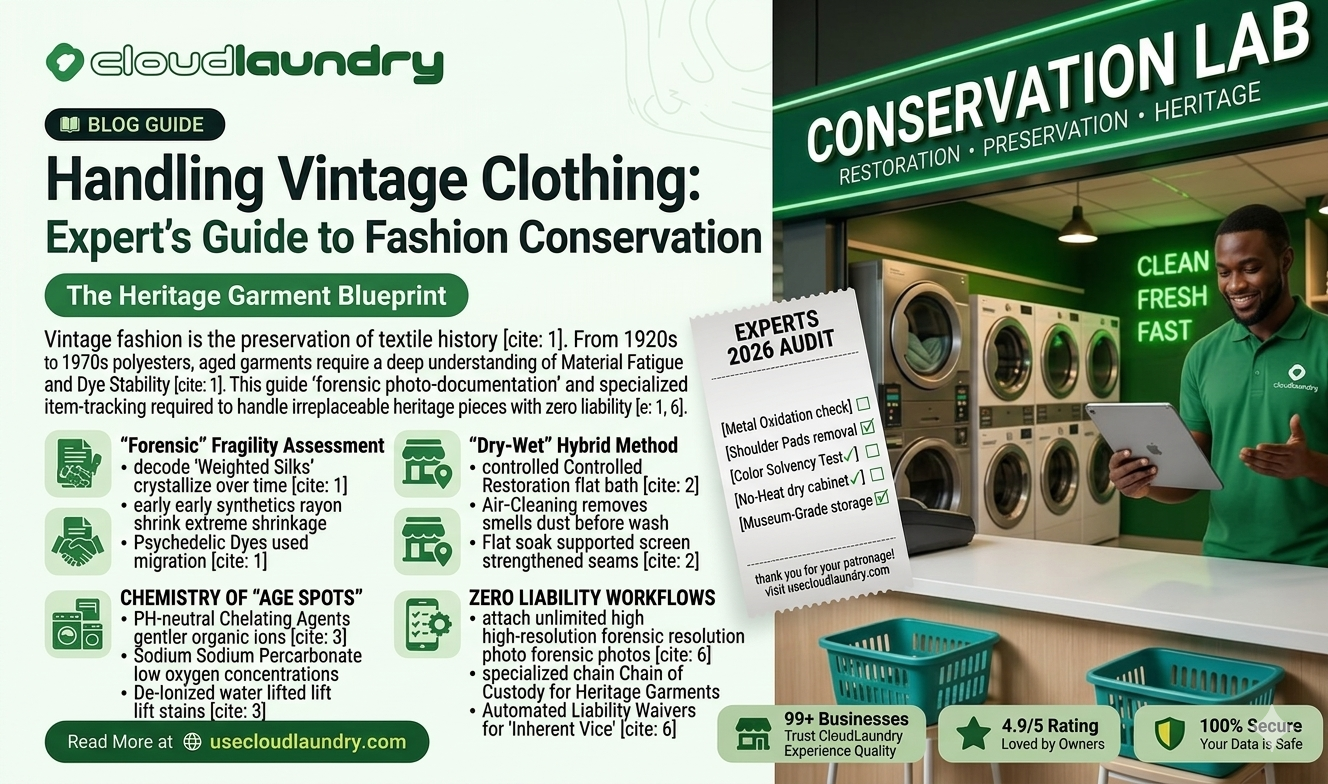
The "Fragility Assessment": Decoding the Decade
Before any cleaning protocol is chosen, the professional must "date" the garment. The chemical makeup of fabrics has shifted dramatically over the last century, and what works for one decade will destroy another.
Decade-Specific Risks:
- Pre-1930s (Silk and Lace): Often involve "Weighted Silks" treated with metallic salts. These salts crystallize over time, essentially turning the fabric into microscopic "glass" that shatters if agitated.
- 1940s–1950s (Rayon and Acetate): These "early synthetics" are notorious for extreme shrinkage and "Water-Spotting." A single drop of water can leave a permanent ring that looks like a stain but is actually a physical distortion of the fiber.
- 1960s–1970s (Early Polyesters and Psychedelic Dyes): These items often face "Dye Migration." The dyes used were not as stable as modern equivalents and can "bleed" even in cold water.
The "Dry-Wet" Hybrid Methodology
For vintage items, the choice isn't just between "Dry Clean" or "Wash." It is about "Controlled Restoration."
The Professional Workflow:
- Air-Cleaning (The Vacuum Stage): Most "vintage" smells are caused by dust and microscopic mold spores. Using a vacuum with a HEPA filter and a soft brush, the professional removes these particles while the fabric is dry, preventing them from becoming "mud" in the wash.
- Solvency Testing: Every color on a vintage piece must be tested with a Q-tip and the chosen reagent. If there is even a hint of color transfer, the item cannot be "washed."
- The "Slow-Soak": If wet cleaning is required, it is done in a flat bath never a machine. The garment is supported by a mesh screen so that the weight of the water doesn't stretch the weakened seams.
The Chemistry of "Age Spots" and Oxidation
Vintage garments often suffer from "Brown Spots," which are caused by the oxidation of sugars (spilled drinks) or old proteins (perspiration) that have sat in the fiber for 40 years.
The Restoration Science: Traditional bleach is a death sentence for vintage fibers. Instead, professionals use "De-Ionized Water" and PH-neutral "Chelating Agents" that gently "lift" the metallic and organic ions out of the fabric. In 2026, we also utilize "Sodium Percarbonate" in extremely low concentrations, which uses oxygen to break down stains without the "burning" effect of chlorine.
Structural Support: The Underpinnings of Vintage
Vintage garments often rely on internal structures: horsehair interfacings, metal zippers, or whalebone stays.
Conservation Challenges:
Metal Oxidation: Old zippers can rust from the inside out. This rust can "migrate" to the surrounding fabric.
Shoulder Pads: 1980s-style foam pads often "disintegrate" into a sticky orange dust inside the garment. These must be surgically removed and replaced before the item is cleaned, or the dust will ruin the entire fabric during the process.
The "No-Heat" Finish
Just as heat kills activewear, it is the ultimate enemy of vintage. Heat accelerates "Acidic Degradation" in old fibers.
The Professional Dry: Vintage pieces are always dried "Flat and Natural." In a professional facility, this involves a "Drying Cabinet" with high-volume airflow and zero heat. Once dry, the "Art of Ironing" comes into play—using only a "Cool-Press" or localized steam to reshape the garment without stressing the fibers.
How CloudLaundry Protects the Conservator
The risk of handling vintage clothing is massive. A single 1960s Chanel suit can be worth more than a month's revenue for a small shop. If a button goes missing or an old seam gives way, the liability can be devastating. In 2026, "Trust" is the currency of the vintage market.
As the best tool to manage your laundry business, usecloudlaundry.com is built to mitigate the risks of high-value garment care:
- Macro-Condition Reporting: When a vintage item is checked in, CloudLaundry prompts the technician to take "Forensic Photos" of every pre-existing flaw frayed hems, "shattered" silk, or missing beads. These are instantly emailed to the customer as a "Condition Receipt."
- Specialized Workflow Routing: You can create a "Vintage/Heritage" workflow in CloudLaundry. This ensures the item is never assigned to a junior staff member. It creates a "Chain of Custody" where only your most senior "Master Restorer" can update the order status.
- Automated Liability Waivers: For particularly high-risk items (like 100-year-old lace), CloudLaundry can automatically trigger an "Inherent Vice" waiver. This informs the customer that due to the age of the item, certain stains may be permanent and some fiber loss may occur, protecting your business from unfair claims. By using CloudLaundry, you aren't just cleaning clothes; you are documenting the survival of a piece of history. This level of digital transparency allows you to charge premium "Conservation Rates" with total confidence. CloudLaundry provides the professional "shield" that allows your expertise to shine.
The “Vintage Smell”: Beyond Fragrance
The infamous "musty" smell of vintage clothing is actually the scent of decaying organic matter (fungi and bacteria).
The 2026 Solution: Masking fragrances are forbidden in vintage restoration. Instead, professionals use Ozone Cabinets or UV-C Light Sanitization. Ozone (O3) penetrates the fibers and kills the mold spores at the molecular level, neutralizing the odor without adding moisture or chemicals. CloudLaundry tracks the "Cycle Time" for these specialized machines, ensuring the item isn't exposed to ozone for too long, which can weaken certain dyes.
Pricing for the "Expertise Premium"
Vintage restoration should never be priced the same as standard dry cleaning. You are providing a "Specialist Consultation."
Pricing Architectures:
- The "Forensic Fee": A flat fee for the initial inspection and solvency testing.
- Hourly Restoration Billing: For complex items like beaded wedding gowns, billing by the hour is more sustainable than a "Per Piece" price.
- Premium Preservation Packaging: Upsell "Acid-Free" tissue paper and "Museum-Grade" storage boxes as part of the service. CloudLaundry makes it easy to add these custom line items, ensuring your business is compensated for the slow, meticulous nature of conservation work.
Building the "Vintage Community" Network
In cities like Lagos, where the "Thrift" and "Vintage" scene is booming, positioning your laundry as the "Authorized Restorer" for top vintage boutiques is a powerful growth engine.
B2B Strategy: Partner with vintage sellers to offer a "Certified Clean" tag on their high-end pieces. Use the CloudLaundry partner portal to manage these bulk boutique accounts, offering them "Volume Conservation" rates while providing individual "Condition Reports" for their inventory. This creates a high-trust ecosystem where your brand becomes synonymous with quality and safety.
Conclusion: The Future is Pre-Loved
The fashion world of 2026 is moving away from the "New" and toward the "Timeless." As more consumers invest in the quality and character of the past, the role of the professional cleaner has evolved into that of a "Guardian of Style."
Mastering professional vintage clothing restoration 2026 is about more than just cleaning it is about respecting the craftsmanship of the past and using the technology of the future to preserve it. By combining old-world textile knowledge with the best tool to manage your laundry business, usecloudlaundry.com, you can build a brand that fashionistas trust with their most prized possessions.
Don't just wash the past restore it for the future. Visit CloudLaundry today and see how CloudLaundry can help you master the art of heritage garment care. Because some things are simply irreplaceable.