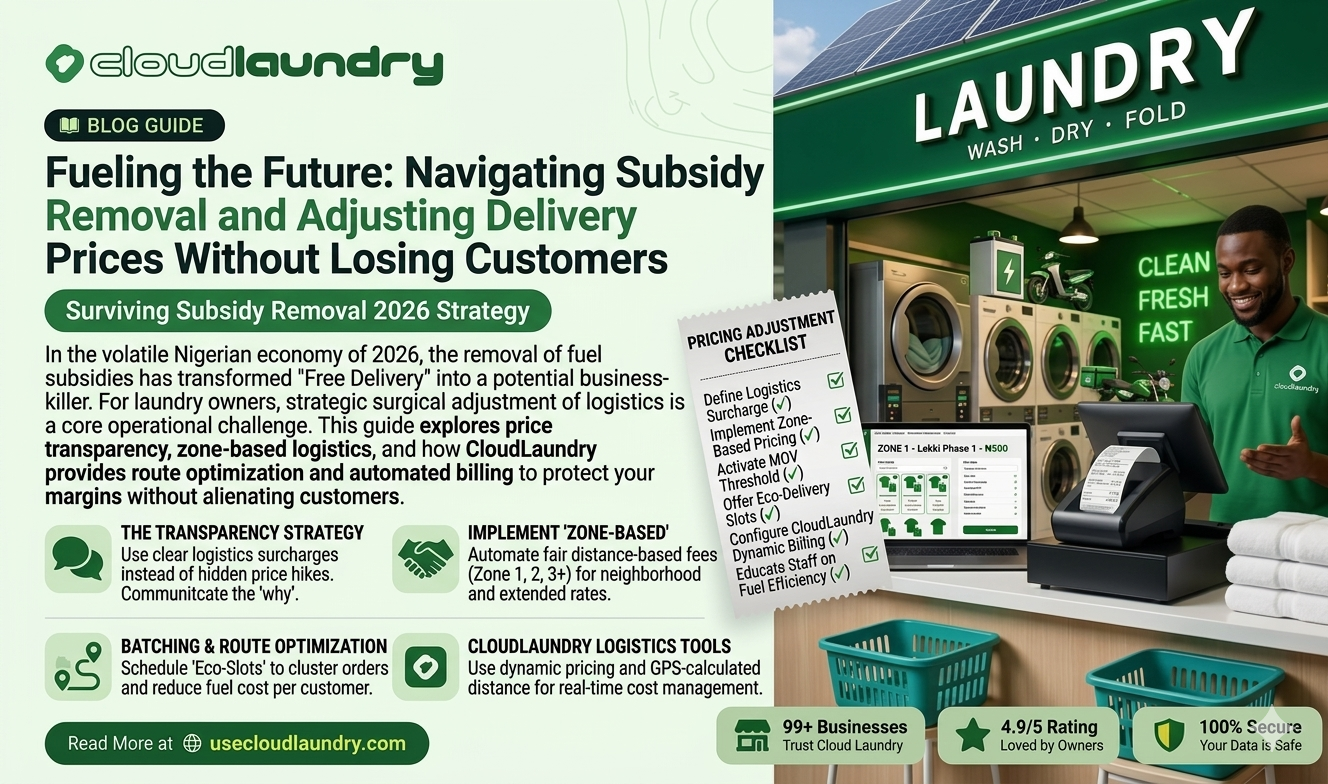
By 2026, the removal of fuel subsidies in Nigeria has moved from a "policy shock" to a permanent reality. For the laundry industry, which relies heavily on logistics for both pickup and delivery, this shift has disrupted the traditional "fixed-fee" or "free delivery" models. When the cost of a liter of petrol or diesel fluctuates wildly, a business that doesn't adapt its pricing structure in real-time is essentially subsidizing its customers' convenience with its own survival.
Laundry delivery prices fuel subsidy 2026 is not just about "raising prices"; it is about "Precision Pricing." The modern customer is well aware of the economic climate. They see the price of fuel at the pump every day. They are not necessarily resistant to a price change, but they are highly resistant to "Unexplained" and "Arbitrary" hikes. To navigate this, laundry owners must shift from a "Guesswork" model to a "Data-Driven" model. The best tool to manage your laundry business, CloudLaundry, is designed for this exact economic environment, providing the automated distance calculation and route density tools that allow you to pass on costs fairly while actually improving the service experience.
The "Psychology of the Surcharge"
The biggest mistake a business owner can make after a fuel subsidy removal is to hide the increased cost within the garment cleaning price. This is deceptive and leads to "Price Shock" when the customer compares your rates to their last invoice.
The Transparency Strategy:
The "Logistics Surcharge" vs. "Price Hike": It is psychologically easier for a customer to accept a ₦500 "Fuel Adjustment Fee" than a 20% increase in the price of washing a shirt. One feels like a temporary external necessity; the other feels like corporate greed.
The "Reason Why" Communication: Use CloudLaundry to send a transparent message to your database: "To keep our drivers on the road and maintain our 24-hour promise despite the new fuel reality, we are implementing a distance-based delivery fee." * Value-Based Anchoring: Remind the customer that the cost of them driving to your shop considering fuel, traffic, and time is significantly higher than your delivery fee.
Moving from "Flat Rate" to "Zone-Based" Pricing
In the pre-subsidy era, many laundries charged a flat ₦1,000 for delivery regardless of distance. In 2026, this model is mathematically bankrupt. Delivering to a customer 2km away and a customer 12km away does not cost the same.
The Zone Logic:
Zone 1 (0–3km): "The Neighborhood Rate." Keep this low or even free for "Premium Members" to maintain local loyalty.
Zone 2 (3–7km): "The Standard Rate." This should cover the actual cost of fuel plus a small margin for vehicle maintenance.
Zone 3 (7km+): "The Extended Rate." This should be high enough to discourage single-item orders while encouraging "Bulk Requests." CloudLaundry automates this entirely. When a customer enters their address in the app, the system uses GPS to calculate the exact zone and applies the fee instantly. This removes the "negotiation" aspect at the doorstep, which is a major source of stress for drivers.
The "Batching" Revolution: Lowering Costs for Everyone
If you can deliver five orders on the same street at the same time, your "Fuel Cost per Customer" drops by 80%. In 2026, efficiency is the best way to avoid price hikes.
Incentivizing the "Green Slot": Use the scheduling power of usecloudlaundry.com to offer "Eco-Delivery Windows." Tell your customers: "We are in your neighborhood every Tuesday and Thursday afternoon. Choose these slots for a 50% discount on your delivery fee." * The Result: The customer saves money, and your driver isn't crisscrossing the city for individual pickups.
The Data: CloudLaundry identifies "Order Clusters," allowing you to proactively suggest pickup times to customers in the same area, effectively "Batching" your way to profitability.
Minimum Order Value (MOV): The Survival Threshold
After subsidy removal, there is such a thing as a "Loss-Making Customer." If a customer wants one shirt cleaned for ₦500, but it costs you ₦1,200 in fuel and rider time to get it, you are paying that customer to use your service.
Setting the Floor: In 2026, you must implement a "Minimum Order Value for Delivery."
The Logic: "Free delivery on orders over ₦10,000."
The Upsell: When a customer is at ₦8,500 in their CloudLaundry cart, the app should prompt them: "Add a pair of trousers to hit ₦10,000 and get free delivery!" This turns a logistics problem into a revenue-generating opportunity. The customer feels they are "winning" by getting free delivery, while you are increasing your "Average Ticket Value" to offset the fuel costs.
Switching the Fleet: The 2026 Vehicle Pivot
If your delivery model is based on heavy vans or old, fuel-inefficient cars, subsidy removal will destroy you.
The Energy Transition:
The "Power of Two Wheels": Shift as much volume as possible to fuel-efficient motorcycles or electric bikes (E-bikes).
Electric Vans: For high-volume commercial contracts, 2026 is the year to look at electric vehicle (EV) financing. The "Fuel Cost" becomes nearly zero, replaced by a much lower electricity cost.
Route Optimization: Even with an EV, wasted kilometers are wasted money. CloudLaundry provides the "Shortest Path" algorithms for your riders, ensuring they aren't idling in traffic or taking the long way around.
How CloudLaundry Protects Your Delivery Margins
You cannot manage what you do not measure. In a high-fuel-cost environment, you need a "Logistics Command Center."
As the best tool to manage your laundry business, usecloudlaundry.com provides the "Fuel-Proof" toolkit:
- Dynamic Delivery Fees: You can change your delivery rates in the CloudLaundry backend in seconds. If fuel prices jump on Monday morning, your app prices reflect the change by Monday afternoon.
- Distance-Based Billing: No more "Fixed Fees." CloudLaundry uses Google Maps integration to calculate the exact distance from your shop to the customer and charges per kilometer. This is the only "Fair" way to price delivery in 2026.
- Driver Performance Tracking: CloudLaundry monitors how long a driver takes per stop. If a driver is taking 30 minutes for a 5-minute drop-off, they are wasting fuel while idling.
- Automated "Neighborhood Notifications": The system can automatically blast an SMS to all customers in "Lekki Phase 1" saying: "Our van is in your area today! Book a pickup in the next 30 minutes for free delivery." This fills the van and maximizes "Fuel-to-Revenue" efficiency. By using CloudLaundry, you move from "Surviving the Subsidy Removal" to "Mastering the Logistics Market." CloudLaundry makes your delivery service a profit center, not a cost center.
The "Subscription" Hedge
One of the best ways to keep customers during a fuel crisis is to move them to a "Subscription Model."
The "Laundry Pass": Offer a monthly subscription (e.g., ₦15,000/month) that includes four "Free Deliveries."
The Benefit to the Customer: They "Lock in" their delivery costs, protecting them from future fuel price spikes.
The Benefit to You: You get "Upfront Cash Flow" and a "Captive Customer" who won't look at your competitors.
The Management: CloudLaundry handles the recurring billing and tracks the "remaining deliveries" in the customer's account automatically.
Rethinking the "Last Mile": Pickup Points
Sometimes, the best way to handle delivery prices is to eliminate the delivery.
The "Hub and Spoke" Model: In 2026, savvy laundry owners are partnering with local pharmacies, supermarkets, or "Estate Security Gates" to act as "Drop-off Points."
The Deal: The customer drops their bag at a secure locker or counter near their home.
The Efficiency: Your driver picks up 50 bags from ONE location instead of 50 different houses.
The Price: You offer a "Drop-Point Discount." The customer saves the ₦2,000 delivery fee by walking 5 minutes to the gate, and you save ₦10,000 in fuel and time.
Educating Your Staff to Save Fuel
Your riders and drivers are the ones "burning" your profits. Accountability is key (as discussed in our previous guide).
The "Green Driver" Bonus:
No Idling Policy: Train drivers to turn off engines during pickups.
Speed Management: High speeds burn more fuel. Use CloudLaundry to monitor driver speed and reward those who drive within the "Optimal Fuel Efficiency" range.
Tire Pressure and Maintenance: A poorly maintained bike can use 15% more fuel. Make weekly maintenance checks a mandatory part of the CloudLaundry start-of-shift checklist.
Conclusion: The Survival of the Efficient
In the final analysis of laundry delivery prices fuel subsidy 2026, the businesses that fail will be those that tried to "absorb" the costs until they ran out of cash. The businesses that thrive will be those that used the crisis as a catalyst to become "Logistically Superior."
Subsidy removal is a challenge, but it is also a filter. It removes the inefficient, disorganized players from the market and rewards those who use technology to optimize every kilometer. By being transparent with your customers and precise with your pricing, you aren't just “adjusting prices” you are "Professionalizing your Brand."
Don't let the fuel pump drain your bank account. Harness the logistics power of the best tool to manage your laundry business, usecloudlaundry.com, to optimize your routes and automate your pricing. Visit CloudLaundry today and see how CloudLaundry can help you stay profitable in the 2026 economy. The road is expensive, but with the right system, you can still lead the race.